
Why does my car squeal when I brake?
What the noise means, when to ignore it, and when to stop driving
- Morning squeal
- Rust on the discs. Normal — no action needed.
- Every-stop squeal
- The pad wear indicator. Book within a week or two.
- Grinding
- Metal on metal. Stop driving.
Most brake squeal is harmless. A squeal on the first two or three stops of the day, especially after rain, is surface rust being scrubbed off the discs and needs no action at all. A squeal on every stop, in any weather, is usually the pad wear indicator — a small metal tab designed to make that exact noise when the friction material runs low. A harsh grinding, rather than a squeal, means stop driving.
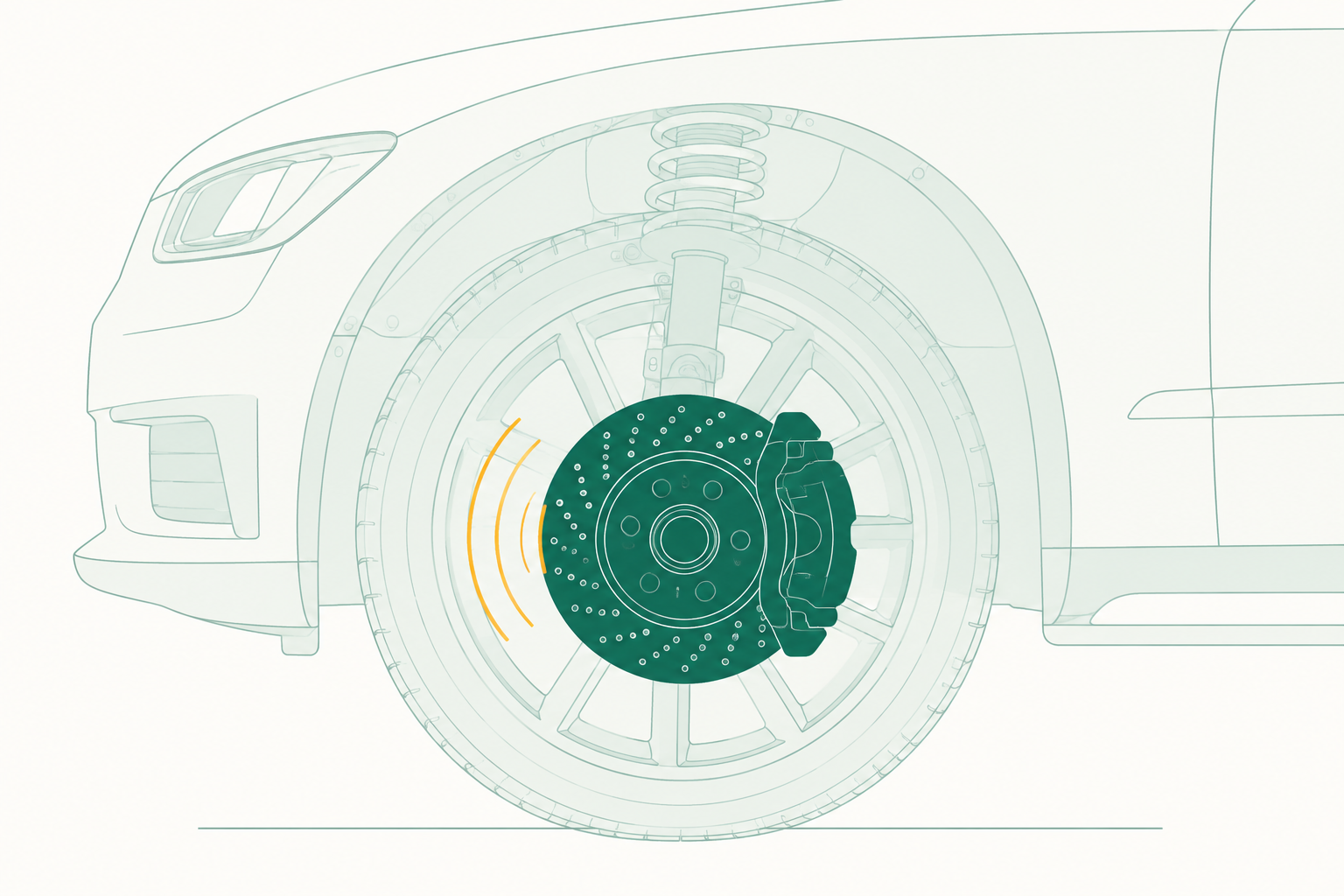
When does it squeal?
Brake squeal is a vibration, not a failure. The pad and disc grip and release thousands of times a second, and when that rhythm falls into the audible range, you hear it. That is why the timing of the noise tells you far more than the noise itself. Find your card below, then open it to confirm.
First two or three stops after the car has stood overnight, then silence
A thin film of rust on the disc face, scrubbed off by the pads.
Nothing. This is normal.
How to be sure
Count the stops. If the noise is gone by the end of your road and doesn’t come back until the car has stood again overnight, that is oxidation. Braking feels entirely normal throughout.
Only in heavy rain, or straight after a puddle
Water between pad and disc changing the friction for a moment.
Nothing, provided it clears once the brakes dry.
How to be sure
A few firm stops on a dry stretch should end it. If the squeal survives dry roads and warm brakes, you’re looking at one of the other cards.
Every stop, light pedal pressure, whatever the weather
The pad wear indicator touching the disc.
Book an inspection within a week or two.
How to be sure
The tell is consistency. Rust squeal is a morning event; indicator squeal is a permanent feature. If you can’t remember your last drive without it, that’s your answer.
Almost constant, from one wheel, even when you’re off the brake
A caliper or its slide pins seized, holding one pad against the disc.
Book promptly — that corner is overheating.
How to be sure
Look for the supporting evidence after a drive: that wheel far hotter than the others, noticeably more brake dust on it, a faint pull to one side under braking, or fuel economy quietly worsening.
Started right after new pads were fitted
Bedding in — or anti-rattle shims left out on fitting.
Normal at first. Persisting means go back.
How to be sure
Count the miles since the work, not the days. A few hundred miles of intermittent squeal is ordinary. Well past that, it’s fitting, not bedding in — and it’s the fitter’s job to sort.
Harsh grinding that gets louder the harder you press
Friction material gone — metal cutting into the disc.
Stop driving. Same-day attention.
How to be sure
Squeal is tonal and often fades as the brakes warm. A grind is coarse, grows with pedal pressure, and you can usually feel it through the pedal itself.
One symptom rarely proves a diagnosis. Use this to judge urgency — and to tell the garage something more useful than “it’s making a noise”.
The wear indicator, explained
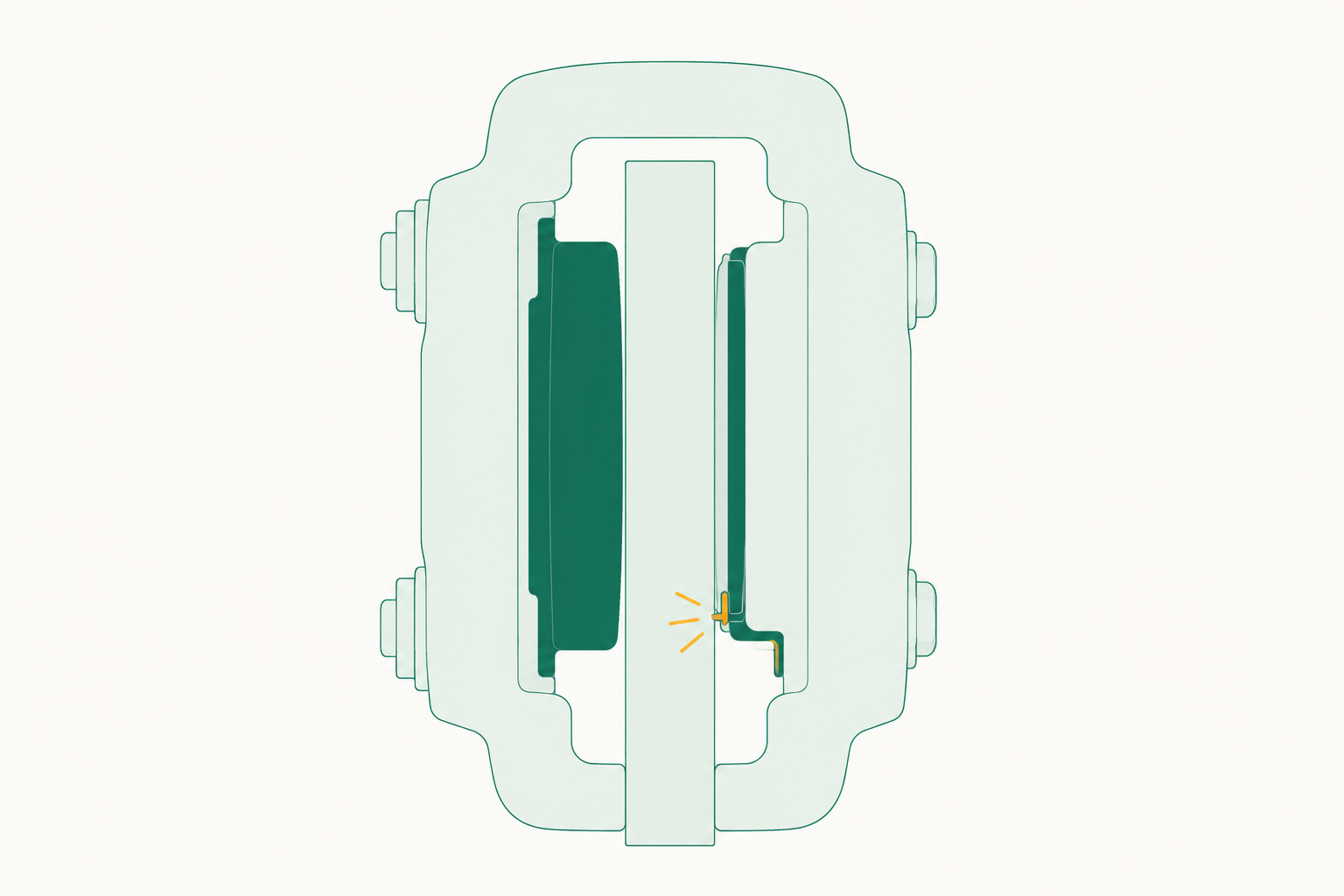
Nearly every brake pad has a small spring-steel tab riveted to its backing plate, set slightly deeper than the friction material. While the pad has life in it, the tab sits clear of the disc and does nothing. As the material wears down, the tab gets closer, and eventually it touches the spinning disc and screams.
That squeal is deliberate engineering, not a fault. Somebody designed a part whose only job is to make an irritating noise while there is still real braking left — and before the backing plate can reach the disc.
Some cars do the same job electrically, with a sensor wire moulded into the pad that completes a circuit and lights a warning on the dashboard. Where fitted, these usually trigger earlier than the mechanical tab — so a brake warning light with no noise generally means you have more time than a squeal does, not less.
The catch: the indicator sits on one pad, often on one side of the car. It tells you when that pad is low. It says nothing about the other three.
Squeals you can ignore No action
Morning rust. Brake discs are bare cast iron, and cast iron starts oxidising within hours of meeting damp air. Park outside overnight in this country and there will be a light film on the disc face by morning. The first few stops scrape it off, sometimes noisily. No inspection will find anything, because there is nothing to find.
Cold pads. Some friction compounds, particularly the harder ceramic and semi-metallic mixes, are noisier when cold and under light pedal pressure. If the squeal appears at walking pace leaving a car park and disappears once the brakes have warmed, the pads are behaving as designed. Annoying, not dangerous.
Bedding in. New pads need to transfer an even layer of material onto the disc before they settle. A few hundred miles of intermittent squeal after a brake job is ordinary. Past that, something is wrong — usually shims left out, contact points not greased, or pads that simply don’t suit the discs they were fitted against.
Squeals that mean book it Within weeks
The wear indicator. Consistency is the tell: every stop, regardless of weather, temperature or how long the car has been standing.
A sticking caliper. When slide pins seize with rust or dried grease, the caliper can’t fully release and one pad stays pressed against the disc. The squeal comes from one corner and doesn’t need the pedal at all. Left alone, a dragging caliper cooks the pad and disc on that corner and turns a routine job into a bigger one.
Glazing. Repeated overheating — a long descent, towing, or riding the pedal — can harden the pad and disc surfaces into something smooth and glassy that grips poorly and squeals under light pressure. Glazed brakes often feel slightly wooden as well as sounding wrong.
Not sure which you have? Our car symptom checker works through braking noises alongside everything else the car is doing, cheapest likely cause first.
Squeal versus grinding Stop driving
Two different sounds, two very different bills, so it’s worth being precise about which one you have.
A squeal is high, sharp and tonal. It often changes with light versus firm pedal pressure and may fade as the brakes warm up. It is a vibration problem — the parts are still doing their job.
A grind is coarse, rough and scraping. It gets louder the harder you press, you can often feel it through the pedal, and it doesn’t come and go with the weather. That is the steel backing plate cutting into the disc face, because the friction material has run out completely.
The financial difference is the whole point of catching a squeal early. Worn pads on healthy discs is a pad job. Once the backing plate has scored the disc, the discs go too. Our brake pads and discs guide has the price ranges for pads alone versus pads and discs together, by model.
What your MOT already told you
Here is the part most brake articles miss, and it is specific to driving in Britain: your car has already been inspected by someone who wrote down what they found. If the squeal is new, the last MOT is the most useful document you own.
Under the DVSA testing rules, brakes are judged by defect category rather than by one measurement, and pads and discs are assessed separately:
| What the tester finds | Category | What it means for you |
|---|---|---|
| Brake pad worn below 1.5 mm of friction material | Dangerous | Fails. The car shouldn’t be driven away. |
| Brake pad worn down to its wear indicator | Major | Fails the test. |
| Pads noted as “wearing thin” | Advisory | Passes. Still legal — but the clock is running. |
| Disc significantly worn, cracked, deeply scored, contaminated or insecure | Major | Fails the test. |
| A raised lip at the disc edge, or “pitted but not seriously weakened” | Advisory | Passes. Almost every used disc has a lip. |
There is no measured minimum thickness for discs in the MOT. The figure stamped on the disc as MIN TH is the manufacturer’s guidance for a garage deciding whether to reuse it — not the test standard. A disc fails for visible, serious defects, not for being a millimetre under spec.
Which makes an advisory about pads something more useful than a warning: it is a dated, written prediction from a professional who had the car on a ramp. If your last certificate said the pads were wearing thin and the car is now squealing on every stop, you already know what the garage is going to find.
You can read the full history free on the government’s MOT history service, or put your reg into our MOT advisory decoder, which translates the tester’s shorthand into what it means and what usually comes next.
Check your own pads in two minutes
You can get a rough answer yourself, on the driveway, with no tools. Car parked, cold, on level ground.
- Look through the wheel spokes
On most alloy wheels you can see the caliper clamped over the edge of the disc, with the outer pad inside it. A torch helps more than daylight.
You’re looking for the friction material — the layer between the metal backing plate and the disc. - Judge the material against the backing plate
A healthy pad has a clearly thicker layer of friction material than the steel plate behind it. When the two look about equal, the pad is getting low. A thin sliver means it’s finished.
Rule of thumb: less material than the thickness of a £1 coin’s edge — book it now. - Run your eye over the disc face
Smooth and evenly shiny is normal. Deep circular grooves you could catch a fingernail in, or a pronounced ridge at the outer edge, mean the disc has taken a beating.
Scoring you can feel usually means discs as well as pads. - Compare left with right
Look at both front wheels. Far more brake dust on one, or a pad visibly thinner on one side, points at a caliper problem rather than ordinary wear.
Uneven wear is its own diagnosis — and it doesn’t fix itself. - Know what this can’t tell you
You are looking at one pad out of four. The inner pad — the one you can’t see without taking the wheel off — is frequently the worn one, because it’s what a sticking caliper punishes first.
A clean-looking outer pad does not rule out a worn inner pad. If the noise persists, get the wheel off.
What waiting actually costs
Brake pads are among the cheapest jobs on a car, and one of the few repairs where delay reliably makes the bill bigger rather than just later. The sequence is always the same: the indicator squeals, the material runs out, the backing plate meets the disc, and a pad job becomes a pad-and-disc job. A seized caliper or a scored hub can be added by the same neglect.
There is also the part that isn’t about money. Worn pads still stop the car — until the day you need every metre of stopping distance, in the wet, with a full boot. The wear indicator exists precisely because that day is impossible to schedule.
For numbers on your car rather than a general range, our brake pads and discs cost guide breaks it down by model, front versus rear, and pads-only versus pads-and-discs.
Squealing on every stop? Find out what pads and discs cost for your exact car before you ring a garage.
See brake prices by model →Squealing brakes FAQ
Is it normal for brakes to squeal in the morning?
Usually, yes. Brake discs are bare cast iron and develop a thin rust film overnight, particularly when the car is parked outside in damp weather. The first two or three stops scrape it off, sometimes with a squeal. If the noise is gone within the first minute of driving and doesn’t return until the car has stood again, nothing needs doing.
Can I keep driving with squealing brakes?
It depends entirely on when the squeal happens. Morning rust squeal needs no action. A squeal on every stop means the pads are near the end of their life — the car is safe to drive for now, but book an inspection within a week or two. Any grinding, or a pedal that feels soft or long, means stop driving and get it looked at the same day.
What’s the difference between squealing and grinding brakes?
A squeal is high-pitched and tonal, often varies with pedal pressure, and can fade as the brakes warm up — it’s a vibration between pad and disc. A grind is coarse and scraping, gets louder the harder you press, and is often felt through the pedal. Grinding means the friction material has gone and metal is cutting into the disc.
Do squealing brakes fail an MOT?
The noise itself isn’t tested — what matters is what’s underneath it. Under DVSA rules a brake pad worn below 1.5 mm of friction material is a Dangerous defect and a pad worn down to its wear indicator is a Major defect; either one fails the test. Pads that are merely getting low are usually recorded as an advisory, which passes.
Why do my brakes squeal when the pads are brand new?
New pads need a few hundred miles to bed in, transferring an even film of material onto the disc, and intermittent squeal during that period is normal. If it’s still there well beyond that, the likely causes are missing anti-rattle shims, contact points that weren’t greased on fitting, or a pad compound that doesn’t suit the discs. Go back to whoever fitted them.
Why do my brakes squeal when the pads look fine?
Squeal is a vibration, so plenty of causes have nothing to do with wear: glazed pad or disc surfaces from overheating, missing or flattened shims, dry caliper slide pins, or debris caught between pad and disc. It’s also worth remembering you can only see the outer pad through the wheel — the inner one may not be fine at all.
How long can I drive once the wear indicator starts squealing?
Think weeks, not months, and drive gently in the meantime. The indicator is set to sound while there’s still usable friction material left, which is deliberate — it’s a warning with margin built in. That margin runs out faster in stop-start town traffic than on motorway miles, and once the material is gone the discs start being damaged.
Do I need new discs as well as pads?
Not automatically. Discs are replaced when they’re scored deeply enough to feel, cracked, badly corroded, warped, or worn past the manufacturer’s minimum thickness — not simply because the pads are being changed. A raised lip at the outer edge is normal on any used disc and isn’t reason enough on its own. If the pads ran down to metal, though, expect the discs to go too.