
Complete guide · DVSA inspection standards
What the MOT actually checks
Every section of the test, in plain English, with the thresholds a tester works to — and, for the first time, what the national record shows happens to your car afterwards.
Every section explainedThresholds where they are publishedNo sign-up
The MOT is a roadworthiness test, not a health check. A tester inspects brakes, tyres, steering, suspension, lights, visibility, structure and emissions against published criteria, and records each item as a pass, an advisory, a minor, a major or a dangerous defect. It never opens the engine, and it never looks at the clutch, gearbox or cambelt.
145m
advisories we tracked forward through the national record to see what actually happened next
376
days, median, between an advisory and the failure it turns into — whatever the fault
3 years
is when a car faces its first test, and every year after that for the rest of its life
What’s on this page
The DVSA publishes the inspection manual testers work to, and it is written for testers. It tells you that a brake disc must not be “significantly and obviously worn”, and leaves you to work out what that means when a garage hands you a certificate with three lines on it.
This page translates each section into the question you are actually asking — will this fail, what does it cost, and does it need doing now. Where the manual publishes a number, we give the number. Where it leaves the call to the tester, we say so rather than inventing certainty.
Thresholds on this page are taken from the DVSA MOT inspection manual for cars and passenger vehicles, which applies in England, Scotland and Wales. Northern Ireland operates a separate system administered by the DVA, under different fees and booking arrangements, so the figures here do not apply there. Outcome data throughout comes from our analysis of the DVSA MOT testing dataset — 145,103,213 advisories tracked across 216,057,619 pairs of consecutive tests. Contains public sector information licensed under the Open Government Licence v3.0.
What is and isn’t tested
The single most useful thing to understand about the MOT is how narrow it is. It answers one question — is this car roadworthy today — and it answers it thoroughly. Everything outside that question is invisible to it.
A tester works through a fixed list. Brakes, steering, suspension, tyres and wheels, lights and electrical equipment, visibility, body and structure, exhaust and emissions, seat belts, registration plates and a few items of other equipment. Each is inspected against published criteria and recorded as a pass, an advisory or a defect.
What the tester does not do is take anything apart. No panels come off, no fluids are sampled, nothing is dismantled. The inspection is visual and functional, carried out with the car on a ramp, in roughly forty-five minutes. That constraint is what defines the boundary between what the MOT sees and what it cannot.
Where the test actually finds things
Not every section produces the same amount of work. Across the national record, the sections dealing with what holds the car up and what slows it down account for the overwhelming majority of everything ever written on a certificate.
| Section of the test | What it covers | Items recorded |
|---|---|---|
| Axles, wheels, tyres, suspension | Springs, dampers, arms, bushes, bearings, tread depth, wheel condition | 304.9m |
| Brakes | Pads, discs, drums, hoses, fluid, parking brake, brake efficiency on rollers | 158.7m |
| Lamps and electrical | Every lamp, beam aim, indicators, wiring, battery security | 46.6m |
| Emissions and nuisance | Exhaust gases, exhaust system, noise, fluid leaks | 32.7m |
| Body and structure | Corrosion, sharp edges, doors, bonnet, towbar, structural condition | 30.5m |
| Steering | Track rods, joints, boots, power steering, steering wheel play | 13.6m |
| Visibility | Windscreen, wipers, washers, mirrors, view of the road | 12.1m |
| Vehicle identification | Registration plates, VIN, plate lettering and spacing | 11.0m |
| Other equipment | Seat belts, seats, horn, speedometer, doors, bonnet catch | 8.1m |
Counts are advisories and defects recorded in each section across the DVSA MOT testing dataset. They reflect how much a section generates rather than how serious it is — tyres are recorded constantly because every car has four of them and they wear every mile. Contains public sector information licensed under the Open Government Licence v3.0.
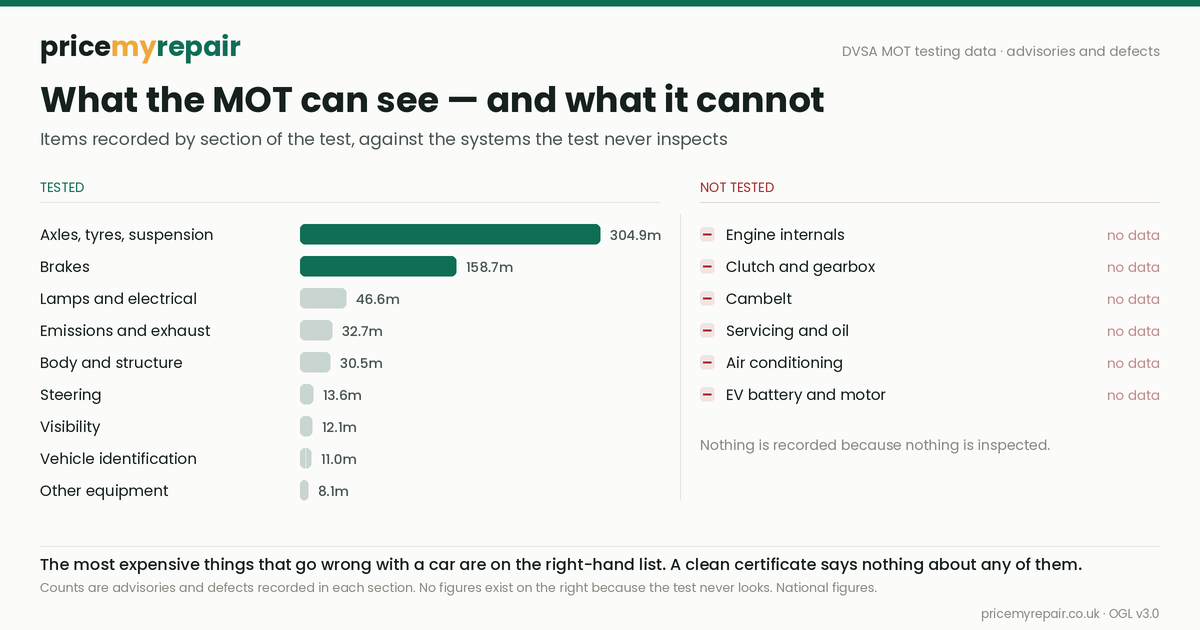
What the MOT never looks at
This is the list that costs people money, because a clean certificate says nothing about any of it.
The engine, inside
Compression, timing, oil condition, cooling system health, turbo, injectors. The tester measures what comes out of the exhaust and nothing about what produced it.
A car can pass every year for a decade on stale oilClutch, gearbox, drivetrain
Not inspected at all. A clutch on its last few thousand miles, a gearbox whining, a differential with play — none of it appears anywhere on the certificate.
£400–£1,010 and invisible to the testThe cambelt
The most expensive omission. A belt has an age limit as well as a mileage one, and nothing in the MOT will ever mention either. Owners routinely discover this the hard way.
£300–£880 planned, engine rebuild unplannedServicing
Oil, filters, spark plugs, coolant, transmission fluid. The MOT and the service schedule are entirely separate documents with entirely separate purposes.
See our service and MOT guideAir conditioning and comfort
Climate control, heated seats, infotainment, parking sensors, cruise control. None of it is a roadworthiness item, so none of it is tested.
Broken air con passes without commentThe battery and motor on an EV
High-voltage systems are outside the scope entirely. Whatever an electric car’s MOT history says, it says nothing about the state of the drivetrain.
Covered on our electric and hybrid pageA pass means the car met the roadworthiness standard on the day it was tested. It is not a warranty, not a condition report, and not a statement about the next twelve months. A car can pass in the morning and break down in the afternoon without anything having gone wrong with the test.
This matters most when buying. A long clean MOT history is genuinely valuable evidence — it tells you the car has been kept roadworthy and shows what a professional noticed each year. What it cannot tell you is whether the cambelt was ever changed, how the clutch feels, or whether the engine has been serviced at all.
When your car needs testing
A car faces its first MOT three years after it was first registered, and then every twelve months for the rest of its life. There is no upper age at which testing stops — a forty-year-old car in daily use is tested annually like any other, although vehicles built more than forty years ago and not substantially changed can be exempt.
Some vehicles are tested from one year old instead. Taxis, private hire vehicles, ambulances and anything built to carry more than eight passengers face their first test far earlier, on the reasonable basis that they cover far more miles carrying other people. If your car is used privately, the three-year rule is the one that applies.
You can test up to a month minus a day before expiry and keep your renewal date. That window is worth using: it gives you weeks rather than days to deal with anything that fails, and it costs nothing. The full rules on dates, retests and the fee are in section 15.
Common questions
Does the MOT check the engine?
Only what comes out of it. The emissions test measures exhaust gases against limits for the car’s fuel and age, and the tester looks for leaks and for a securely mounted exhaust. Nothing internal is examined — no compression test, no oil check, no assessment of the cooling system or the turbo. An engine on the way out can pass comfortably.
Is an MOT the same as a service?
No, and they have almost nothing in common. The MOT is a legal roadworthiness test against pass and fail criteria, carried out by an approved tester with no obligation to fix anything. A service follows your manufacturer’s schedule and replaces consumables before they fail. A car can pass ten MOTs in a row without ever being serviced.
When does a car need its first MOT?
Three years after first registration for a normal private car, then annually. Taxis, private hire vehicles, ambulances and vehicles carrying more than eight passengers are tested from one year old. There is no age at which testing stops, though vehicles over forty years old that have not been substantially altered may be exempt.
Does the MOT check the clutch or gearbox?
Neither. The drivetrain is entirely outside the scope of the test, so a slipping clutch, a whining gearbox or a worn differential will never appear on a certificate. These are also among the most expensive things that can go wrong — which is why a clean MOT history should never be read as a clean bill of health.
Advisory, minor, major, dangerous
Five things can happen to any item on the test, and only two of them fail the car. The difference between the other three is where most of the confusion lives — and it is worth ten minutes, because two of them look identical on a certificate and mean quite different things.
| Result | What it means | Does the car pass? | Can you drive it? |
|---|---|---|---|
| Pass | The item met the standard. Nothing recorded. | Yes | Yes |
| Advisory | Not a defect. Something the tester noticed heading in the wrong direction. | Yes | Yes |
| Minor | A genuine defect, but not one that affects safety or the environment right now. | Yes | Yes |
| Major | A defect that could affect safety or the environment. The car fails. | No | Not until repaired |
| Dangerous | A direct and immediate risk to road safety. The car fails. | No | No — not at all |
A car passes with any number of advisories and minor defects. It fails on a single major or dangerous defect. The certificate lists each item under its own heading, and the wording differs: advisories say monitor and repair if necessary, minors say repair as soon as possible.
441m
advisories in the national record, against 177 million defects — the test warns far more often than it fails
2.5 : 1
warnings to failures across the whole test, though the ratio varies enormously between sections
18.7%
is the highest conversion of any advisory category — suspension. The lowest, oil leaks, is 1.3%
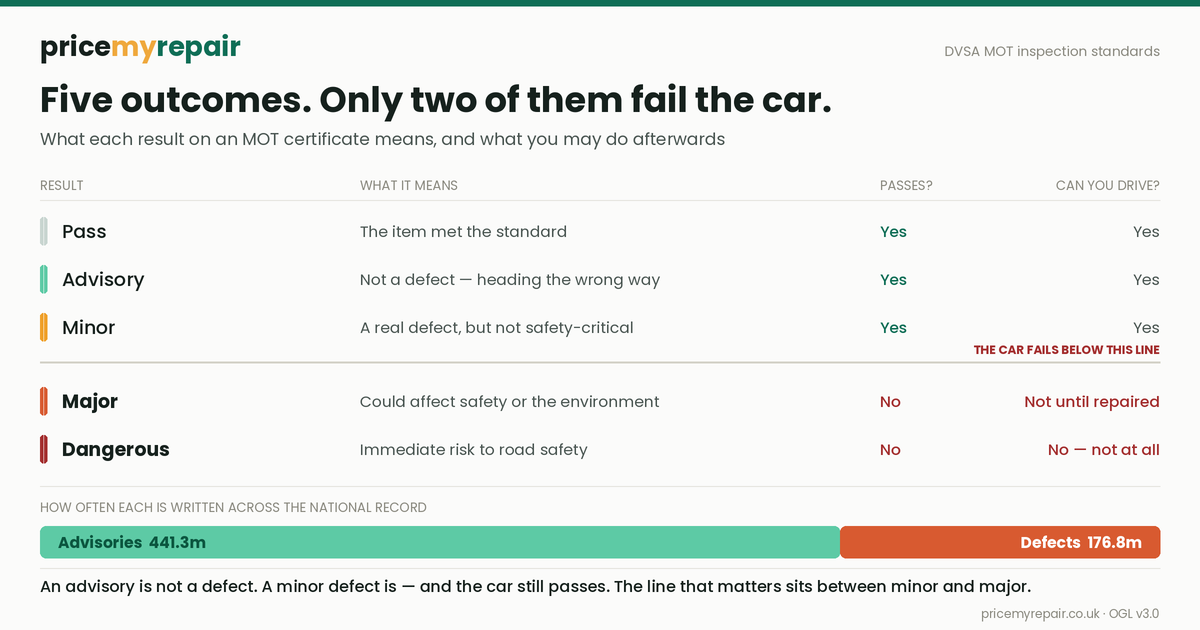
The one people get wrong: advisory is not minor
An advisory is not a defect at all. It is the tester recording something that is currently acceptable but heading in the wrong direction — a pad with a few millimetres left, a spring with surface corrosion, a tyre approaching the limit. Nothing about it is a requirement, and nothing happens if you ignore it.
A minor defect is a defect. It genuinely fails the standard for that item, but the failure is not judged to affect safety or the environment enough to fail the car. A number plate lamp out on a plate with two of them is the classic example: the standard is not met, the car still passes, and the certificate says repair as soon as possible.
Both let you drive away, which is why they get conflated. The practical difference is what they tell you. An advisory is a forecast — this will need doing at some point. A minor is a statement of fact — this is already wrong, and it was only the severity threshold that saved you.
If any item is recorded as a dangerous defect, the car must not be driven — not home, not to another garage, not anywhere. That holds even if your previous MOT certificate is still valid for months, because the certificate is not what makes the car legal to drive. Roadworthiness is.
In practice the car either gets repaired where it is, or it leaves on a trailer. A garage will normally tell you plainly when this has happened; if the wording on the certificate says dangerous, that is the situation regardless of how the conversation went.
What actually happens to an advisory
This is where our own analysis comes in, and it is the part nobody else has published. We took the national testing record and followed individual advisories forward to the same vehicle’s later tests, to see which ones came back as failures and which quietly went away.
| Advisory category | Came back as a failure | Still unresolved a year later | Dealt with |
|---|---|---|---|
| Suspension | 18.7% | 37.1% | 44.2% |
| Lamps and electrical | 14.4% | 24.9% | 60.7% |
| Body and exhaust | 11.8% | 28.2% | 60.0% |
| Tyres | 9.9% | 30.5% | 59.6% |
| Brakes | 9.4% | 36.1% | 54.4% |
| Structural corrosion | 6.7% | 17.5% | 75.9% |
| Axles and bearings | 6.5% | 23.8% | 69.7% |
| Oil leaks | 1.3% | 43.5% | 55.1% |
From our analysis of 145,103,213 advisories tracked across 216,057,619 pairs of consecutive tests on the same vehicle. The three outcome columns account for every tracked advisory, so each row sums to 100%. Figures are by DVSA defect category rather than by individual part — code 5.3 covers the whole suspension, so a category figure is an upper bound for any single component within it. Contains public sector information licensed under the Open Government Licence v3.0.
Most advisories never fail anything. Even suspension, the worst of them, comes back as a failure fewer than one time in five. An oil leak comes back once in seventy-seven. So the honest answer to “do I have to fix this” is usually no — and the useful answer is that it depends enormously which advisory you were given.
The record contains 441 million advisories. We tracked 145 million of them. Both figures are correct and they describe different things.
Tracking an advisory means finding the same vehicle’s next test and seeing what happened to that specific item. That is only possible where a later test exists — so cars that were scrapped, exported, laid up or simply not yet retested drop out of the tracked set. What remains is still the largest analysis of MOT advisory outcomes we are aware of, and it is drawn from cars that stayed on the road.
And the gap is always a year
For the advisories that do become failures, the timing is remarkable. The median gap is 376 days for suspension, 378 for bearings, 379 for brakes, tyres, lamps, exhausts and oil leaks, and 384 for structural corrosion. Eight categories, eight days of spread.
Those components have nothing in common. A spring corrodes over winters; a bulb fails in an instant; brake fluid degrades on a calendar whether the car moves or not. If the figure were measuring how parts deteriorate, the medians would scatter across months. They do not scatter at all — which means it is measuring when owners act, and that is the next test. Section 12 takes that apart properly.
Common questions
What is the difference between an advisory and a minor defect?
An advisory is not a defect — it is the tester noting something acceptable now but heading the wrong way, and the certificate says monitor and repair if necessary. A minor defect genuinely fails the standard for that item, but not badly enough to fail the car, and the certificate says repair as soon as possible. Both let you drive away.
Does a minor defect fail an MOT?
No. A car passes with any number of minor defects and any number of advisories. It fails only on a major or a dangerous defect. That said, a minor is a real fault that has already crossed a standard, so it is worth treating more seriously than an advisory.
Can I drive away with a dangerous defect?
No — not home, not to another garage, not anywhere. A dangerous defect means a direct and immediate risk to road safety, and it applies regardless of whether your previous certificate is still valid. The certificate is not what makes a car legal to drive; roadworthiness is. In practice the car is repaired where it stands or removed on a trailer.
Do I have to fix an advisory?
No. An advisory carries no obligation and your car has passed. Whether it is worth doing depends heavily on which one you were given: across the national record 18.7% of suspension advisories come back as a failure, against 1.3% of oil leaks. Our advisory decoder translates the wording on your certificate and prices it for your car.
Brakes
Brakes are inspected twice: once by eye and hand for condition, and once on rollers for performance. The performance half is where the test has hard numbers, and they are the most useful figures on this whole page — because unlike almost everything else, they are pass or fail arithmetic rather than judgement.
The condition check
The tester looks at everything visible without dismantling anything. Pads and linings where they can be seen, discs and drums from the outside, flexible hoses, rigid pipes, the master cylinder and servo, cables and linkages, and the fluid level through a transparent reservoir. Reservoir caps are not removed.
| What is found | Result | What it means for you |
|---|---|---|
| Pad worn down to its wear indicator | Major | Fails. Repair before driving. |
| Friction material below 1.5mm | Dangerous | Fails. Must not be driven at all. |
| Pad or lining contaminated with oil or grease | Major | Fails — and something is leaking onto it. |
| Disc or drum significantly and obviously worn | Major | Fails. Note the wording — see below. |
| Brake fluid below the minimum mark | Minor | Passes, but recorded as a defect. |
| Brake fluid not visible in the reservoir | Dangerous | Fails outright. |
| Brake fluid clearly contaminated | Major | Fails. Only judged where it can actually be seen. |
| Flexible hose damaged enough to expose the reinforcement | Major | Fails. Lesser chafing is a minor. |
| ABS warning lamp not working or showing a fault | Major | Fails, even though the brakes themselves work. |
Categories from the DVSA MOT inspection manual, section 1. A vehicle passes with minor defects and fails on any major or dangerous one. Contains public sector information licensed under the Open Government Licence v3.0.
Brake discs carry a minimum thickness figure stamped on them by the manufacturer. It is reasonable to assume that going below it fails the MOT. It does not.
The inspection manual states plainly that a disc or drum must be significantly and obviously worn before it should be rejected, and that being worn below the manufacturer’s recommended limits is not a reason in itself. In other words there is no published number for the tester to measure against — the call is theirs, made by eye and by hand.
That single fact explains a lot about brake quotes. Two testers can look at the same disc and reach different conclusions without either being wrong, and a garage recommending discs is giving an opinion rather than reading a threshold. It is entirely fair to ask what they measured and how far past it they think you are.
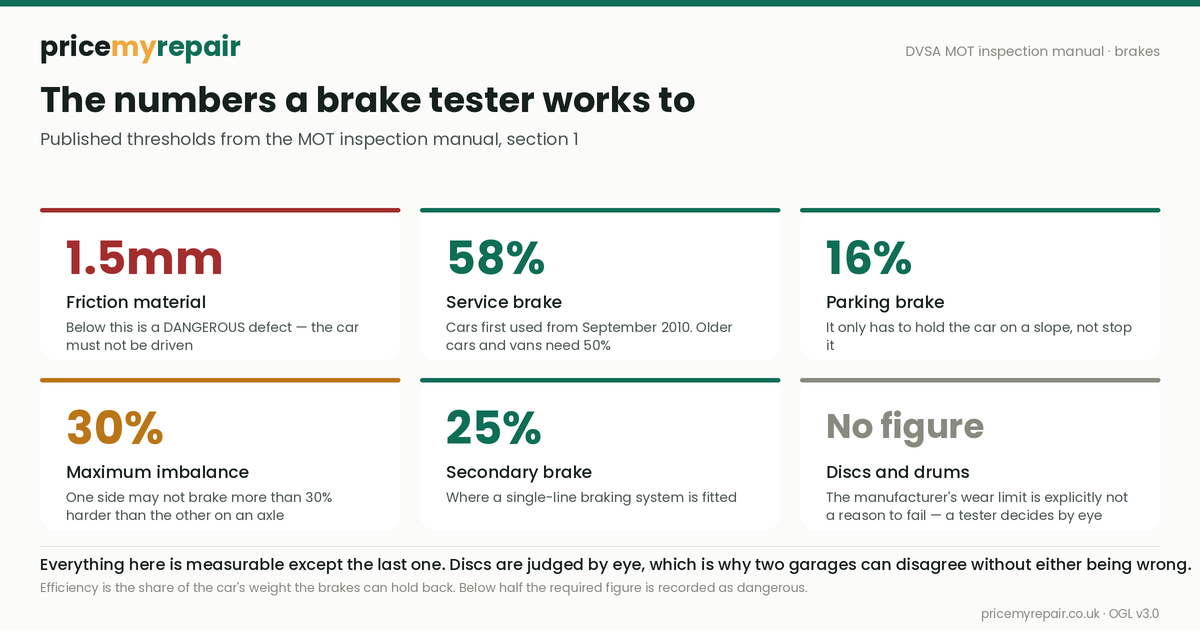
The performance test, and the numbers behind it
The car is driven onto rollers and each wheel is braked in turn. The tester records the force at every wheel, and the system works out two things: how much of the car’s weight the brakes can hold back, and whether the two sides of each axle match.
Efficiency is the headline figure. A car first used from September 2010 must reach 58% on the service brake. Anything older needs 50%, as do vans up to three and a half tonnes. The parking brake has its own, much lower requirement of 16% — it only has to hold the car, not stop it.
Falling short is a fail; falling far short is worse. Below the requirement is a major defect. Below half the required value — under 29% on a modern car — is recorded as dangerous, and the car does not leave under its own power.
| System | Minimum efficiency | Applies to |
|---|---|---|
| Service brake | 58% | Cars first used from September 2010 |
| Service brake | 50% | Older cars, and vans up to 3.5 tonnes |
| Secondary brake | 25% | Vehicles with a single-line braking system |
| Parking brake | 16% | Every vehicle that needs one |
Where more than half the wheels on a system lock on the rollers, the efficiency requirement is treated as met. Some four-wheel-drive cars cannot be roller-tested and are measured with a decelerometer on the road, or held on a gradient of up to 16% for the parking brake instead.
Imbalance: the fault you feel before you see
Both sides of an axle have to brake evenly. If one wheel produces less than 70% of the force of the other on the same axle, that is a major defect — a difference of more than 30%. On a steered axle, if one side drops below half the other, it is dangerous.
This is what a car pulling under braking actually is. The usual causes are a seized caliper slide, a partially collapsed hose acting as a one-way valve, or contaminated friction material on one side. All three are repairable without replacing everything, which is worth knowing before agreeing to a full set.
A binding brake shows up here too. If the rollers record significant effort with no brake applied, that is a major defect — and on the road it means a wheel that runs hot, kills fuel economy and destroys the pads on that corner.
What happens to brake advisories afterwards
Brakes generate an enormous amount of paperwork. Across the national record the section accounts for 158.7 million recorded items — second only to tyres and suspension — and it warns far more often than it fails, at roughly four advisories per defect.
9.4%
of brake advisories come back as a failure at a later test
36.1%
are still unresolved a year later — the third most ignored category of any
379
days, median, from a brake advisory to the failure it turns into
That ignore rate is the strange one. Brakes are the system most drivers would name first if you asked what matters on a car, and the threshold is public and precise — 1.5mm, printed in the manual. Yet more than a third of brake advisories are still there when the car comes back.
The explanation is access, not indifference. Checking a tyre takes a coin and thirty seconds. Checking pad thickness properly means getting a wheel off, which most people cannot do on the street. The knowledge is public; the view is not. Tyres, which anyone can inspect while walking to the door, are ignored less often despite failing at a similar rate.
What it costs, and what to ask
Ask about the slides first
Seized caliper slides make one pad wear fast, cause squeal and produce imbalance on the rollers. The fix is cleaning and re-greasing rather than parts, and a mechanic with the wheel off answers this in two minutes.
A fraction of a £150–£340 caliperPads only, or discs as well
Since there is no published disc threshold, this is a judgement — so ask what they saw and how far gone it is. Pads alone is a legitimate answer more often than the quote suggests.
£90–£220 pads · £180–£460 with discsFluid is on a calendar
Brake fluid absorbs moisture from the air whether the car moves or not, which lowers its boiling point. The test only fails visibly contaminated fluid, so passing says little about its condition.
£50–£90 for a full changeCommon questions
How thin can brake pads be before they fail an MOT?
Friction material below 1.5mm is recorded as a dangerous defect, which means the car fails and must not be driven at all. A pad worn down to its built-in wear indicator is a major defect — also a fail, but without the driving prohibition. Testers commonly write an advisory somewhere between three and five millimetres.
What brake efficiency do you need to pass an MOT?
58% on the service brake for a car first used from September 2010, and 50% for anything older or for a van up to three and a half tonnes. The parking brake needs only 16%. Falling below the requirement is a major defect; falling below half of it is dangerous.
Do worn brake discs fail an MOT?
Only if they are significantly and obviously worn. The inspection manual states that being worn below the manufacturer’s recommended thickness is not in itself a reason to reject — so there is no number for the tester to measure against, and the decision is a judgement. It is reasonable to ask what they saw before agreeing to replacement.
Does a brake warning light fail an MOT?
It depends which light. An illuminated brake pad wear indicator is explicitly not a reason for failure. A brake fluid warning light on or defective is a minor defect. An ABS warning light that stays on, or does not work at all, is a major defect and fails the car even though the brakes themselves may work perfectly.
Tyres and wheels
Tyres are the most examined thing on any car. A single defect code — a tyre worn close to the legal limit — accounts for 161 million entries in the national record, more than any other item on any part of the test. They are also the one place where falling short is not merely a fail but a dangerous defect.
The tread rule, exactly as written
The requirement is more specific than most drivers realise, and in one respect more generous. The primary grooves must be at least 1.6mm deep across the central three-quarters of the breadth of the tread, and around the entire circumference. Both halves of that sentence matter.
Around the entire circumference is the half people forget. A tyre can measure comfortably above the limit at the point you happen to look and be illegal a few inches further round. Wear is rarely even, so checking one spot proves nothing — roll the car forward half a turn and look again.
The outer eighths being allowed to go bald surprises people, and it should not be read as permission. A tyre worn like that is reporting a geometry or suspension problem, and the replacement it needs is a symptom rather than the cure. It is also the pattern that reaches the legal zone next.
Almost every other wear item on a car fails as a major defect: the car does not pass, but you may drive it away to get it fixed. Tread depth below the requirement is categorised as dangerous, which means the car must not be driven at all.
It is also the only item on the certificate enforceable away from the test. The penalty for driving on an illegal tyre runs to £2,500 and three points, and it applies to each tyre separately — so a car on four is four offences, which is enough to lose a licence.
Everything else the tester looks for
| What is found | Category | Worth knowing |
|---|---|---|
| Tread depth below the requirement | Dangerous | Do not drive it away. |
| Lump, bulge or tear from structural failure | Dangerous | The carcass has separated internally. |
| Valve badly damaged or misaligned | Dangerous | Risk of sudden deflation. |
| Cut deep enough to reach the ply or cords | Major | Testers may open a cut carefully to check. |
| Different sizes on the same axle | Major | Front and rear may differ; left and right may not. |
| Different structure on the same axle | Major | Radial and cross-ply cannot be mixed on an axle. |
| Tyre fouling part of the vehicle | Major | Only if it is actually fouling at the time of test. |
| Tyre pressure monitoring system malfunctioning | Major | Applies to cars first used from January 2012. |
| Obviously under-inflated | Minor | The car passes, but it is recorded as a defect. |
| More than one loose or missing wheel nut | Dangerous | One alone is a major. |
| Fracture or welding defect on a wheel | Dangerous | Repaired alloys are looked at closely. |
Categories from the DVSA MOT inspection manual, section 5.2. Two things commonly assumed to be failures are not: an asymmetric tyre fitted the wrong way round is not a reason for rejection, only for advice; and a tyre pressure warning lamp lit because a pressure is low, rather than because the system has failed, should be recorded as advisory information. Contains public sector information licensed under the Open Government Licence v3.0.
The spare is not tested
Only the wheels and tyres fitted to the car at the time of inspection are examined. If a tester notices a defect on a spare they will mention it, but nothing about the spare affects the result. A car can pass with a spare that is a decade old, flat, or illegal.
Which matters more than it sounds, because the spare is what you fit at the roadside. Space-saver tyres have their own speed and distance restrictions printed on them, and a full-size spare that has sat under the boot floor for years may be well past the point anyone would fit it deliberately.
What the record shows about tyres
161m
entries for a single code — a tyre worn close to the limit, the most recorded item on any certificate
9.9%
of tyre advisories come back as a failure at a later test
30.5%
are still unresolved a year later, despite being the one item anyone can check with a coin
Risk rises with age and then falls back. Tyre advisories convert at 7.2% on a three-year-old car, 10.9% at ten years and 12.1% at fifteen — the peak. By twenty-six years the rate is down to 8.3%, which reflects which cars are still being presented rather than any improvement in tyres. Section 13 explains that pattern properly.
What to check yourself, and what it costs
The 20p test
Insert a 20p coin into a primary groove. If the outer band of the coin disappears, you are comfortably above the limit. If you can see it, the tyre needs measuring properly.
Free, and it is the same measurement the tester makesCheck all the way round
The requirement applies around the entire circumference. Roll the car forward half a wheel turn and check again, in several places across the central portion.
Uneven wear is the normal case, not the exceptionLook at where it wore
Even wear is age and mileage. Wear on one shoulder is alignment or a worn suspension part — replacing the tyre without fixing the cause buys you the same bill again.
See the tyre advisory guideCommon questions
What is the legal tyre tread depth in the UK?
1.6mm in the primary grooves, across the central three-quarters of the breadth of the tread and around the entire circumference. That applies to cars, and to goods vehicles up to 3,500kg. Vehicles with more than eight passenger seats have a lower requirement of 1.0mm.
Can the edge of a tyre be bald and still pass?
Legally yes. The inspection manual states that either side of the central three-quarters may be devoid of tread. It is the rule as written rather than a loophole — but a tyre worn that way is reporting a geometry or suspension fault, and the bald band tends to spread inwards towards the zone that does count.
Does an under-inflated tyre fail an MOT?
Not on its own. A tyre that is obviously under-inflated is recorded as a minor defect, so the car still passes but the fault appears on the certificate. A tyre pressure monitoring system that has actually malfunctioned is a major defect and does fail — though a warning lamp lit simply because a pressure is low should be recorded as advisory information instead.
Does the MOT check the spare tyre?
No. Only the wheels and tyres fitted to the car at the time of the inspection are examined. A tester who notices a problem with a spare will point it out, but it does not affect the result — so a car can pass with a spare that is flat, ancient or illegal.
Suspension
Suspension holds two records in the national record, and they are the two you would least want. It is the advisory most likely to come back as a failure, at 18.7%, and the one least likely to be dealt with, at 44.2%. No other category on the certificate holds both extremes — and the reason has nothing to do with money.
How the tester finds it
This is the part of the test that needs the car off the ground. Wheels are jacked clear or placed on play detectors, and each one is levered, rocked and shaken while the tester watches the components. Where the front suspension has spring force acting on the lower arm, the car has to be jacked under that arm specifically, so the load comes off the ball joints and any wear actually shows.
Which is exactly why you cannot check this yourself. A worn joint under load looks and feels identical to a good one. The play only appears when the weight is off it — and that is the difference between suspension and every other item people are told to keep an eye on.
Almost everything in this section is a judgement — excessively worn, seriously weakened, likely to fail. Three figures are not. For play in pins and bushes, the manual defines excessive as more than 2mm on a 12mm diameter pin, more than 3mm on a 25mm pin, and more than 10% of the diameter on anything larger than that.
If a garage tells you a joint has play, those are the numbers behind the verdict. Asking what they measured is a fair question, and on a component this cheap it is worth asking before agreeing to a corner’s worth of parts.
What fails, and what the phrase means
| What is found | Category | In plain terms |
|---|---|---|
| Suspension pin, bush or joint excessively worn | Major | Play beyond the published limits. |
| Joint likely to become detached | Dangerous | The corner could come apart. |
| Joint dust cover severely deteriorated | Minor | Passes. The joint is fine but exposed. |
| Dust cover missing or no longer sealing | Major | Grit is getting in — the joint is next. |
| Spring fractured or seriously weakened | Major | Corrosion pits the steel until it snaps. |
| Spring fixings loose enough to see movement | Dangerous | The spring is moving against its seat. |
| Shock absorber with severe leakage or no damping | Major | Severe is the operative word — see below. |
| Shock absorber missing or likely to detach | Dangerous | Only counts if one was fitted as standard. |
| Suspension component excessively damaged or corroded | Major | Thin steel pressings rot from the inside. |
| Structure weakened within 30cm of a mounting | Major or dangerous | The prescribed area — see below. |
Categories from the DVSA MOT inspection manual, section 5.3. Two things commonly assumed to fail do not: a missing bump stop rubber is explicitly not a reason for rejection, and lateral play in a MacPherson strut top bush is normal on many cars when the suspension hangs free — it only counts if it is due to wear. Contains public sector information licensed under the Open Government Licence v3.0.
Misting is not leaking
A film of oil on a damper body is one of the most common things people are told needs replacing. The manual is unambiguous: slight seepage causing a film of fluid on a shock absorber is not a reason for rejection. Dampers are sealed against a moving shaft and a trace of oil past that seal is normal.
What does fail is severe leakage, or a damper that no longer damps. Those are different findings with a different look — running wet, a pool of oil, or a corner that keeps bouncing after a push. If the word on the certificate is misting or seepage rather than leaking, the car passed on that item — our guide to that phrase covers when it does become a fail.
What suspension advisories are actually about
Break the section into its parts and one component dominates everything else in the record.
The most common finding is also the cheapest fix. An anti-roll bar link is a short rod with a small ball joint at each end, and it is the usual cause of a knock over bumps. It is worth knowing that before a quote arrives, because nothing about the noise distinguishes it from an arm bush costing three times as much. Prices for the whole section are in our suspension repair cost guide.
The prescribed area, and why 30cm
Corrosion is judged differently depending on where it is. General body rust has to significantly reduce the structural rigidity of the car before it fails. But within 30 centimetres of any suspension, spring or sub-frame mounting, a much stricter standard applies — that zone is a prescribed area, and weakened structure there is a major defect on its own.
The logic is load. A mounting point carries everything the road does to the car, so metal near it is doing structural work that a wing or a door skin is not. It is also the reason a rust advisory near a mounting is a different kind of information from a rust advisory on a sill — and why nobody can price it until somebody has scraped it back.
The silence problem
18.7%
of suspension advisories return as a failure — the highest of any category
44.2%
get repaired before the next test — the lowest of any category
376
days to failure, median — the shortest gap of the eight categories
Compare it with wheel bearings and the reason gives itself away. A bearing and a coil spring sit on the same corner of the car, cost roughly the same to replace, and are inspected in the same part of the test. Bearings get repaired 69.7% of the time. Springs and arms, 44.2%.
The difference is not money and not difficulty. A failing bearing hums, and the hum gets louder every week until somebody books it in. A corroded spring makes no sound at all, lights no lamp, and the car drives exactly as it did the day before it snaps. Owners act on warnings, and suspension is the one system that gives none.
Risk also peaks higher here than anywhere else. Suspension advisories convert at 7.3% on a three-year-old car and 22.3% at fifteen — the highest point of any curve in the record. Section 13 explains why the figure falls again after that, and why the fall says more about which cars are still being tested than about the cars themselves.
Common questions
How much play in a suspension joint fails an MOT?
More than 2mm on a 12mm diameter pin, more than 3mm on a 25mm pin, or more than 10% of the diameter on anything larger. These are the only published figures in the whole suspension section — everything else is assessed as excessively worn, seriously weakened or likely to fail, which are judgements rather than measurements.
Does a leaking shock absorber fail an MOT?
Only if the leakage is severe or the damper no longer damps. The manual states that slight seepage causing a film of fluid is not a reason for rejection, so misting is normal on a sealed unit with a moving shaft. If the certificate says misting or seepage, the car passed on that item.
Why is suspension the advisory people ignore most?
Because it gives no warning. Only 44.2% of suspension advisories are repaired before the next test, the lowest of any category, while wheel bearings on the same corner reach 69.7%. A bearing hums and a spring is silent — and owners act on symptoms rather than on paperwork.
What is a prescribed area on an MOT?
The structure within 30 centimetres of any brake, steering, seat belt or suspension mounting. Corrosion elsewhere on the body only fails if it significantly reduces the car’s structural rigidity; within a prescribed area, weakened or badly repaired structure is a major defect in its own right, because that metal is carrying load.
Steering, axles and bearings
Steering is the section with the most precise published numbers in the entire test, and the least room for argument. It is also the section where warnings barely exist: it produces 7.4 million advisories against 6.2 million defects, a ratio of about 1.2 to 1, where suspension runs at four to one.
Free play: the clearest measurement on the test
The method is simple enough to picture. Wheels on the ground, pointing straight ahead, engine running if the car has power steering. The tester turns the wheel gently left and right as far as it goes without the road wheels moving, and measures how far a point on the rim travelled.
The distinction the manual insists on is worth carrying into any conversation with a garage. Play caused by wear or maladjustment fails. Play caused by the way the mechanism is built — a flexible coupling deflecting, a spring compressing in the power steering — does not. The same movement at the rim can be either, and telling them apart is the tester’s job rather than a measurement.
What else is inspected
| What is found | Category | Worth knowing |
|---|---|---|
| Steering ball joint with excessive wear or play | Major | The most recorded steering item by a wide margin. |
| Ball joint worn enough to risk detachment | Dangerous | The wheel can part company with the linkage. |
| Steering rack gaiter damaged or deteriorated | Minor | The car passes — see below. |
| Gaiter missing or no longer keeping dirt out | Major | Grit reaching the rack is what ends it. |
| Power steering fluid below the minimum mark | Minor | Checked through a sight glass; caps are not removed. |
| Power steering reservoir empty | Major | Different finding, different category. |
| Power steering not working | Major | Dangerous only if the steering itself suffers. |
| Electronic power steering warning lamp showing a fault | Major | The lamp alone fails it. |
| Excessive play in the upper steering column bearing | Major | Only the top bearing is testable. |
| Structure weakened within 30cm of a steering mounting | Major or dangerous | A prescribed area, as with suspension. |
Categories from the DVSA MOT inspection manual, section 2. Two findings commonly assumed to fail do not: a steering box that seeps oil is a minor defect and only fails when oil is actually dripping, and movement in a column with universal joints or a flexible top bearing is normal on many cars. Contains public sector information licensed under the Open Government Licence v3.0.
The gaiter, and why a minor here matters more than most
A split rack gaiter is a minor defect, so the car passes. That is the letter of it. What the grading does not convey is that the rubber concertina is the only thing keeping road grit and water off the rack’s internals, and a rack is one of the more expensive things under a car.
So this is the clearest case on the whole certificate for treating a minor as urgent. The gaiter itself is a modest job. Waiting until it becomes a major — missing, or no longer sealing — usually means the damage it was preventing has already started.
Wheel bearings: the one item judged by ear
Every wheel is raised, spun and listened to. The tester rocks it for play and spins it for roughness, and roughness is assessed by sound. It is the only part of the MOT where the verdict comes from hearing rather than seeing or measuring.
Which is exactly why bearings behave so differently in the data. Bearings and springs sit on the same corner of the car and cost roughly the same to put right, but 69.7% of bearing advisories are dealt with before the next test against 44.2% for suspension. A bearing announces itself — the hum gets louder every week — and owners act on noise.
69.7%
of axle and bearing advisories get dealt with — second only to structural corrosion
1.2 : 1
advisories to defects on steering — one of the narrowest ratios of any section
10 years
is where steering risk peaks, at 17.4% — the earliest peak of any category
That early peak is unusual and worth pausing on. Most categories climb to fifteen years or beyond. Steering tops out at ten, at 17.4%, and is down to 11.8% by twenty-one. Whatever wears out in a steering linkage does so on a shorter clock than springs, tyres or brakes — and the cars that survive past it appear to have had it dealt with.
What it costs
Wheel bearing
Priced per corner. On many modern cars the bearing comes as a complete hub assembly, which raises the parts cost but cuts the labour considerably.
£120–£300 per cornerAlignment after any linkage work
Replacing a track rod end changes the geometry, so alignment afterwards is not an upsell — it is part of doing the job properly. Ask whether the quote includes it.
£40–£80 for a four-wheel checkPlay on the rim is a symptom
Free play beyond the limit is the total of every worn joint between the wheel and the road. Finding which one is the diagnosis, and it is rarely the rack itself.
See our suspension and steering costsCommon questions
How much steering play is allowed in an MOT?
Measured at the rim of a standard 380mm steering wheel: up to 13mm for rack and pinion steering, up to 48mm where several joints sit between the wheel and the rack, and up to 75mm for non-rack-and-pinion systems. The limits scale up or down with wheel diameter, and play caused by the design of the mechanism rather than by wear does not count.
Does a split steering rack gaiter fail an MOT?
A damaged or deteriorated gaiter is a minor defect, so the car passes with it recorded. It becomes a major defect once the gaiter is missing or no longer keeps dirt out. Since the gaiter is the only thing protecting the rack’s internals from grit and water, this is one minor worth treating as urgent.
Does a noisy wheel bearing fail an MOT?
Yes, if it is excessively rough. Each wheel is raised, spun and listened to — bearings are the only item on the test assessed by ear. Excessive roughness or play is a major defect; a bearing likely to collapse or with play severe enough to affect directional control is dangerous.
Does a power steering warning light fail an MOT?
An electronic power steering warning lamp indicating a system malfunction is a major defect and fails the car. Hydraulic systems are judged differently: fluid below the minimum mark is a minor, an empty reservoir is a major, and power steering that is not working at all is a major — dangerous only if the steering itself is adversely affected.
Lights and electrical
Lighting is one of only two parts of the test where failures outnumber warnings — 35.7 million defects against 10.8 million advisories, a ratio of more than three to one. The reason is structural rather than harsh: a bulb works or it does not, and there is no gradual state for a tester to write down.
Headlamp aim: numbers, and no advisory band
Beam aim is one of the few things on the test with a published tolerance, and it is not a single figure. The car sits on a marked area, beam equipment is aligned to it, and the tester reads where the horizontal cut-off of the dipped beam falls against a set of lines. Where the acceptable band sits depends on how high the headlamp is mounted.
This is why an aim advisory is a warning rather than a grace period. Aim outside the band is a major defect and fails the car. If your certificate carries an advisory about beam aim, the beam was inside the band — close enough to the edge that the tester wrote it down anyway.
One detail worth knowing before you go in. The tester checks the beam without touching your dashboard levelling control. If it reads too low because the dial was left turned down, they re-check with it at its highest setting — but setting it back yourself removes the ambiguity, and costs nothing.
The modification that fails more cars than people expect
Fitting HID or LED bulbs into a headlamp unit that was built for halogen is a fail, recorded as light source and lamp not compatible. It applies to any car first used from April 1986 — effectively every car on the road.
The reason is optical rather than bureaucratic. A halogen reflector is shaped around the exact position and shape of a halogen filament, and a different light source in that housing scatters light where the design never intended. The result is glare for oncoming drivers and, often, a worse beam for you.
What is fine is a complete headlamp unit manufactured with LED or HID sources. The distinction is between converting a lamp and replacing it.
Everything else in the section
| What is found | Category | Worth knowing |
|---|---|---|
| All stop lamps missing or inoperative | Dangerous | The only dangerous grade in the lighting section. |
| Stop lamps stay on after the brake is released | Dangerous | Usually a failed pedal switch, and cheap. |
| A headlamp missing or not working | Major | On LED units, more than half the sources out. |
| Up to half an LED lamp’s light sources not working | Minor | Passes. Multi-source lamps are graded by proportion. |
| Something on the lens obviously reducing light output | Major | Clouded or tinted lenses count. |
| Headlamp levelling device not working | Major | Or not operable from the driver’s seat. |
| One of two number plate lamps out | Minor | Passes — see below. |
| The only number plate lamp out, or all of them | Major | Fails. |
| Indicators flashing outside 60 to 120 times a minute | Minor | The classic symptom of one bulb already gone. |
| Battery insecure but not likely to fall | Minor | Applies to electric and hybrid cars too. |
| Wiring at imminent risk of fire or sparking | Dangerous | Visual inspection only, but a thorough one. |
Categories from the DVSA MOT inspection manual, section 4. Two things commonly assumed to fail do not: sequential or dynamic indicators are explicitly not a reason for rejection, and on some cars with LED rear lamps a proportion of the stop lamp LEDs dim when the rear fog lamp is on, which is not a defect. Contains public sector information licensed under the Open Government Licence v3.0.
The number plate lamp, graded by how many you have
This one confuses people because the grading depends on the car rather than the fault. If your plate has two lamps and one has failed, it is a minor defect — the car passes, and the certificate says repair as soon as possible. If the plate has only one lamp and it is out, or if every lamp has gone, it is a major defect and the car fails.
It is also the item nobody can see from the driver’s seat. It sits behind you, it never dims as a warning, and it fails silently. A walk round the car with the lights on, once a month, removes it entirely — and the same walk covers every other bulb in this section. Our advisory decoder translates whatever wording ends up on your certificate.
Why lighting has almost no warning stage
1 : 3.3
advisories to defects — one of only two sections where failures outnumber warnings
14.4%
of lamp advisories return as a failure, second only to suspension
60.7%
get dealt with before the next test — helped by how cheap most of them are
A brake pad wears from eight millimetres to five to two, and somewhere in that range a tester can reasonably write that it is getting thin. A bulb has no equivalent. It illuminates or it does not, so there is nothing to warn about — which is why this section records three failures for every warning while suspension records one for every four.
The practical consequence is that the 376-day rule does not apply here. Everywhere else on the certificate, an advisory buys you roughly a year. In this section there is usually no advisory at all, so the only defence is looking before you book — the checklist in section 16 covers it in five minutes.
Common questions
What are the MOT limits for headlamp aim?
For headlamps with their centre up to 850mm from the ground, the beam’s horizontal cut-off must fall between the 0.5% and 2.75% lines. For lamps mounted higher than that, between 1.25% and 2.75%. Aim outside the band is a major defect — there is no advisory category for it, so an advisory means the beam fits but only just.
Do LED bulbs in halogen headlights fail an MOT?
Yes. Converting a halogen headlamp unit to HID or LED bulbs is a major defect on any car first used from April 1986, recorded as light source and lamp not compatible. A complete replacement headlamp unit manufactured with LED or HID sources is acceptable — the rule is about converting a lamp, not replacing one.
Does one number plate light out fail an MOT?
Not if the plate has two lamps and only one has failed — that is a minor defect, so the car passes with it noted as repair as soon as possible. If the plate has a single lamp and it is out, or if all the lamps have failed, it is a major defect and the car fails.
Do sequential indicators fail an MOT?
No. The manual states explicitly that indicators functioning sequentially or dynamically are not a reason to fail. What does matter is the flash rate: indicators must flash between 60 and 120 times a minute, and anything outside that is a minor defect — usually because a bulb elsewhere in the circuit has already gone.
Visibility
This is the most extreme section of the entire test. Across the national record it produces 11.7 million defects against 357,000 advisories — roughly thirty-three failures for every warning. Suspension runs at four warnings per failure. The difference between them is a factor of about 130, and it is not about severity.
Zone A, and where it actually sits
The tester sits in the driver’s seat and looks out. That is the whole method — field of vision through the windscreen, then through the front side windows, then the view of the mandatory external mirrors. What they are assessing is whether anything significantly affects the view of the road.
The detail people get wrong is what Zone A is centred on. It is a 290mm strip centred on the steering wheel, within the area the wipers sweep — not on the driver’s eyeline, and not adjusted for how tall you are. The manual says explicitly that the effect on tall or short drivers is not considered.
And the limits are not a switch. Failure for damage is only justified where it significantly affects the view of the road. If the only thing obscured is the sky or the bonnet, that is not a rejection. Ten and forty millimetres describe where the judgement usually lands, not a rule that fires on its own.
This is worth knowing before you replace a screen. The manual states that repaired windscreens are judged solely on whether the repair interferes with vision, and that an invisible or barely detectable repair finished flush with the surrounding glass does not count as damage at all.
So a chip in Zone A is not automatically a new windscreen. A proper resin repair, done before the chip spreads, removes the problem for the test as well as structurally — and it costs a fraction of the glass. What it will not survive is being left through a winter.
Wipers, washers and the bonnet catch
| What is checked | What the manual says |
|---|---|
| Wiper blades | Rejected only where clearly damaged or worn. A blade that smears rather than clears is the practical test. |
| Washers | Must provide enough fluid for the wipers to clear the screen effectively. An empty bottle fails. |
| Wiper parking position | Wipers that stop in a position obscuring the view are a defect in their own right. |
| Mirrors | The mandatory external mirrors and the view of them. Extra interior mirrors are not part of it. |
| Bonnet catch | Only the primary catch, on cars where an open bonnet would block the view. Secondary safety catches are not inspected. |
| Objects in the view | Sat navs, air fresheners, hanging trinkets. A tester may remove them, but must tell you. |
| Stickers and permits | Parking permits, disabled badges and taxi signs count only where they seriously restrict the view. |
| Tinting | Fails only where the driver’s view is significantly affected. |
From the DVSA MOT inspection manual, section 3. The bonnet catch sits in this section for a reason that becomes obvious once stated: a bonnet that flies up while the car is moving is a visibility problem. Contains public sector information licensed under the Open Government Licence v3.0.
Why this section has almost no advisories
12.7m
wiper entries — the largest single item in the section by a clear margin
6.6m
washer entries. An empty bottle is one of the cheapest failures on the test
1 : 33
advisories to defects — the most extreme ratio anywhere in the test
A brake pad goes from eight millimetres to five to two, and somewhere in that range a tester can reasonably write that it is wearing thin. A wiper blade has no equivalent. It clears the screen or it smears it. A washer bottle is full enough or it is not. A chip is inside the limit or over it.
Which means the warning stage barely exists here, and that changes what you can do about it. We hold no conversion figure for this section, because there are too few advisories to track — and that absence is the finding rather than a gap in the data.
So everything we have written about the 376-day rule is suspended in this section. Elsewhere on the certificate an advisory buys you roughly a year to plan. Here there is usually no advisory at all — which is why the five-minute check in section 16 matters more for visibility than for anything else on the car.
What to do before you book
Look at the screen from outside
Sit in the driver’s seat first to find where the steering wheel is, then check that 290mm strip specifically. A chip you have stopped noticing is still a chip.
Repair beats replacement, if you catch it earlyRun the wipers on a wet screen
Not a dry one — that damages the blade and tells you nothing. If they smear, chatter or leave a band uncleared, they are worn in the way the manual means.
Blades are among the cheapest parts on any carFill the washer bottle properly
With screenwash rated for cold weather, not water. Then check the jets actually hit the glass — a blocked or misaligned jet fails in the same way an empty bottle does.
Free to check, minutes to fixCommon questions
How big can a windscreen chip be before it fails an MOT?
Over 10mm in diameter inside Zone A, and over 40mm elsewhere in the area the wipers clear. Neither is automatic: the manual only justifies failure where the damage significantly affects the driver’s view of the road, and damage outside the swept area is not assessed against these limits at all.
Where is Zone A on a windscreen?
It is a 290mm wide strip within the area swept by the wipers, centred on the steering wheel. Not on the driver’s eyeline, and not adjusted for height — the manual says the effect on tall or short drivers is not considered. That is why the same chip can fail on one car and pass on another.
Does a repaired windscreen fail an MOT?
Not if the repair is good. Repaired screens are judged solely on whether the repair interferes with vision, and an invisible or barely detectable repair finished flush with the glass does not count as damage. A resin repair done before the chip spreads is a fraction of the cost of a new screen.
Can an empty washer bottle fail an MOT?
Yes. Washers must provide enough fluid for the wipers to clear the screen effectively, so an empty reservoir, a blocked jet or one aimed off the glass all fail. It is among the cheapest and most avoidable failures on the whole test, and there is no advisory stage to warn you first.
Body, structure and corrosion
Rust is the only thing on the whole test that behaves differently from everything else. Every wearing part climbs in risk to about fifteen years and then improves, because the neglected cars have left the road. Corrosion climbs, reaches a plateau, and never turns back down — and that single fact tells you more about buying an older car than any other figure we hold.
Two standards, and which one applies where
This is the distinction that decides most rust arguments, and the manual is precise about it. Section 6 covers the general structure and explicitly excludes prescribed areas — those are assessed under brakes, steering, suspension and seat belts instead. So the same patch of rust is judged by two different standards depending on what it is near.
| Where the corrosion is | What it takes to fail | Assessed under |
|---|---|---|
| Within 30cm of a brake, steering, suspension or seat belt mounting | Strength or continuity significantly reduced, or inadequately repaired | Sections 1, 2, 5 and 7 |
| Anywhere else on the load-bearing structure | Overall structural rigidity of the vehicle significantly reduced | Section 6.1.1 |
| Body panels, undertrays, spoilers, mirror housings | Damaged or corroded enough to injure when grazed, or insecure | Section 6.2.1 |
| Within 30cm of a towbar mounting | Strength or continuity significantly reduced — not a prescribed area | Section 6.1.6 |
| Near an engine mounting | Only if severe enough to cause excessive movement | Section 6.1.8 |
A prescribed area is any load-bearing structure or supporting panel within 30cm of a mounting point for a tested item. The strictest standard applies there because that metal is carrying load. Elsewhere, the bar is much higher — the car’s overall rigidity has to be significantly reduced. Contains public sector information licensed under the Open Government Licence v3.0.
Corrosion is assessed by tapping and scraping with a corrosion assessment tool — a small hammer-like device — using what the manual calls reasonable hand pressure. Sound metal returns a sharp note; corroded metal sounds dull, flakes, or gives under the tool.
What a tester may not do is punch through. If the metal fails under reasonable hand pressure it was not structurally sound, and the finding stands. That is a fair line, and it is worth knowing if you are ever told a car was damaged during a test.
Why corrosion is the exception to everything else
We split every tracked advisory by the age of the car when it was written. Seven categories produce the same shape. Two do not.
The improvement in wear items is not the parts getting better. It is which cars are still being presented. A car that was being neglected at twelve is often gone by twenty — scrapped, exported or standing untested on a drive — so it stops contributing. What remains is a selected group of survivors.
Selection cannot rescue corrosion, and that is the whole point. A careful owner can postpone a clutch, nurse a bearing or replace a damper on their own schedule. Nobody can un-rust a car. So while the wear curves come back down, the rust curves climb to a level and stay there for every remaining year in the record.
And yet rust is the most repaired advisory of all
75.9%
of structural corrosion advisories are dealt with before the next test — the highest rate of any category
17.5%
are still unresolved a year later — the lowest ignore rate on the certificate
6.7%
come back as a failure, which is lower than brakes or tyres
This looks like a contradiction and is not one. Structural rust converts to failure less often than brakes do, and gets fixed more often than anything else. What that combination measures is the weight of the consequence rather than the frequency of the fault.
A worn pad is a purchase. Structural rust is a decision about the car. When somebody hears that the metal near a mounting is going, they either commit to welding or they start planning the car’s exit — and both of those resolve the advisory. Very few people simply carry on, which is exactly what more than a third of owners do with brakes.
The rest of the section
The exhaust
A major leak or an insecure system fails. Missing mountings alone do not necessarily make it insecure — the tester assesses overall security, not the count of brackets.
£60–£300 · see the corroded exhaust guideDriveshaft boots
Severely deteriorated is a minor. Split or missing so that it no longer keeps dirt out is a major — because grit in a constant velocity joint ends the joint.
11.3m entries · what the phrase meansFuel system
A chafing pipe is a minor, a damaged one a major, a leak or fire risk dangerous. Any defect at all in an LPG, CNG or hydrogen system is dangerous.
A hole above the fuel line still failsTowbars
Pins, jaws and hooks worn by more than 25% of original thickness are rejected, as are pin holes elongated by more than 25%. Up to 3mm play on a detachable ball is acceptable.
Structure within 30cm is checked, but not to prescribed-area standardDoors
Driver and front passenger doors must open from outside and from inside. A worn hinge or catch is a minor unless the door no longer works as intended.
No door handle from the factory is not a defectThe driver’s seat
A fore and aft adjustment mechanism that does not work as intended is a major defect. A seat that was fixed from the factory is fine — it is broken adjustment that fails.
One of the least expected items on the testCommon questions
Will my car fail its MOT for rust?
It depends entirely on where the rust is. Within 30cm of a brake, steering, suspension or seat belt mounting — a prescribed area — significantly reduced strength is a major defect on its own. Anywhere else on the structure, the car only fails if its overall rigidity is significantly reduced, which is a much higher bar. Surface rust on a panel is not a failure.
What is the difference between a prescribed area and general corrosion?
A prescribed area is any load-bearing structure within 30cm of a mounting for a tested item, and it is judged to the strictest standard because that metal carries load. General structure is assessed under section 6, where the test is whether the car’s overall structural rigidity is significantly reduced. The same patch of rust can be a fail in one place and acceptable in another.
Does a split CV boot fail an MOT?
A boot that is severely deteriorated is a minor defect, so the car passes. It becomes a major defect once it is split, missing or insecure such that it no longer prevents dirt getting in — because grit inside a constant velocity joint destroys the joint. It is one of the most recorded items in the whole section.
Does a blowing exhaust fail an MOT?
A major leak fails, as does a system that is insecure or one letting fumes into the cabin. What does not automatically fail is a missing mounting or two — the manual says one or more missing or defective exhaust mountings does not necessarily make the exhaust insecure, because the tester assesses overall security rather than counting brackets.
Emissions, exhaust and leaks
This is the section where the test has become dramatically stricter over time, and where the numbers are least known. The diesel smoke limit for a new car has fallen from 3.0 to 0.7 — a tightening of more than three quarters — and there is a precise, published figure for how big an oil puddle has to be before it fails.
Petrol: four readings, all of which must pass
The car is warmed up, the probe goes in the tailpipe, and the engine is held between 2,500 and 3,000rpm. Three readings are taken there, then a fourth once it settles back to idle. Every one has to be inside its limit.
| Reading | Limit | What it tells the tester |
|---|---|---|
| CO at fast idle | 0.2% maximum | How completely the fuel is being burnt. |
| HC at fast idle | 200ppm maximum | Unburnt fuel getting through — misfires, worn engine. |
| Lambda at fast idle | 0.97 to 1.03 | Whether the mixture is right. Outside this and the engine is running rich or lean. |
| CO at idle | 0.3% maximum | The same check with the catalyst under less load. |
Default limits for the basic emissions test. Older cars without a catalyst are tested to far looser figures — 3.5% CO and 1,200ppm HC — and some cars have manufacturer-specific limits that override the defaults. The manual also requires that a limit be exceeded continuously for at least five seconds before failing, because some engines give unstable readings. Contains public sector information licensed under the Open Government Licence v3.0.
Lambda is the one people have not heard of and the one worth understanding. It measures how close the air-fuel mixture is to ideal — exactly 1.00 is perfect, and the test allows three percent either way. A reading outside that window usually means a failing oxygen sensor, an air leak, or a fuelling fault, and it fails the car even if CO and HC are both fine.
Diesel: the limit that has fallen furthest
Diesels are not measured for gases at all. They are accelerated hard against a smoke meter, which records opacity — how much light the exhaust blocks, on a scale where zero is clear air.
On a car fitted with a DPF, the tester also checks that no visible smoke of any colour comes out during the metered acceleration. Visible smoke is a major defect on its own — the meter reading does not save you.
Separately, evidence that the filter has been tampered with is a major defect, and a filter that has clearly been cut open and rewelded is rejected unless the owner can show a legitimate reason, such as professional cleaning. Removing a DPF that was fitted as standard fails the car regardless of how clean the exhaust reads.
The engine management light works both ways
The tester turns on the ignition and watches the malfunction indicator lamp. It should illuminate and then go out. If it stays on, the car’s own computer has found a fault and that is a major defect.
What catches people out is the other direction. A lamp that does not illuminate at all is also a major defect, because it suggests the bulb has been removed or the circuit tampered with. This applies to petrol cars first used from July 2003 and diesels from July 2008.
Fluid leaks: the 75-millimetre rule
There is a precise published figure for this and almost nobody knows it. With the engine idling, a leak fails if it creates a pool on the floor more than 75mm across within five minutes — or if several smaller leaks together drip at that rate.
Three fluids are explicitly excluded. Engine coolant, screen wash and the fluid used for selective catalytic reduction — AdBlue — are named in the manual as not being reasons for failure. So a coolant drip is a problem for your engine and not for your certificate.
1.3%
of oil leak advisories come back as a failure — the lowest rate of any category
43.5%
are still unresolved a year later — the highest ignore rate of any category
8.9m
oil leak advisories in the record, most of them phrased as not excessive
That pair of figures is the most interesting on the whole page, because they belong together. Oil leaks are the most ignored advisory in the record and also the one that almost never returns as a failure. Those are not two findings — they are one.
Ignoring an oil leak advisory is, on this evidence, a reasonable decision. The wording testers use is usually “oil leak, but not excessive”, and the gap between not excessive and a 75mm puddle in five minutes is enormous. A weep from a cam cover can sit there for years without ever approaching the threshold — and the data says that is exactly what happens.
What it does not mean is that the leak is harmless to the car. Oil on a rubber bush degrades it, oil on a brake pad contaminates it, and a leak losing enough to matter will show on the dipstick. The MOT is telling you it is not an environmental or safety problem yet, which is a narrower statement than it looks. Our guide to that phrase covers where it typically comes from.
Exhaust noise, and what is not measured
There is no decibel limit in the MOT. The tester revs the engine to around 2,500rpm and judges whether the noise is unreasonably above what a similar car with a standard silencer in average condition would make. That is a judgement, deliberately, and it is why aftermarket exhausts sit in a grey area rather than a numbered one.
Emission control equipment is checked visually and only where visible. The manual limits this to components a tester can see and identify — catalytic converter, oxygen sensors, EGR valve, DPF, SCR. Missing, obviously modified or obviously defective is a major defect on cars first used from September 2002.
Catalytic converter
Checked for presence and obvious defect, not for efficiency directly — but a failing one shows up in the gas readings, particularly lambda and HC.
£350–£1,200Diesel particulate filter
Presence, tampering and visible smoke. A blocked filter is not itself a defect, but the smoke and the warning light that follow both are.
£180–£400 to cleanEGR valve
Listed as visible emission control equipment. A sticking valve raises soot and triggers the management light, which fails the car on its own.
£280–£650Common questions
What are the MOT emissions limits for a petrol car?
On the basic test, all four readings must pass: CO up to 0.2% and HC up to 200ppm at fast idle, lambda between 0.97 and 1.03 at fast idle, and CO up to 0.3% at normal idle. Older cars without a catalyst are tested to much looser limits of 3.5% CO and 1,200ppm HC, and some cars have manufacturer-specific figures that apply instead.
What is the diesel smoke limit for an MOT?
Where no manufacturer’s plate value exists, the default is 3.0 for a turbocharged car first used before July 2008, 2.5 for a non-turbocharged one, 1.5 for cars first used between July 2008 and December 2013, and 0.7 for anything first used from January 2014. Where the car does carry a plate value, that figure applies with 0.05 added as tolerance.
Does an oil leak fail an MOT?
Only if it is substantial. The published threshold is a pool more than 75mm across forming within five minutes with the engine idling, or several leaks dripping collectively at that rate. Coolant, screen wash and AdBlue leaks are explicitly not reasons for failure. In the national record only 1.3% of oil leak advisories ever return as a failure — the lowest of any category.
Does the engine management light fail an MOT?
Yes, and in both directions. A lamp that stays on indicating a malfunction is a major defect, and so is a lamp that does not illuminate at all when the ignition is turned on, because that suggests it has been removed or tampered with. It applies to petrol cars first used from July 2003 and diesels from July 2008.
What the MOT never checks
Everything above describes what a tester examines. This section is about the other list — and it is the more expensive one. The components most likely to cost you four figures are, almost without exception, the ones nothing in the test will ever mention.
The pattern behind the two lists
The test inspects what can be seen, measured or operated without taking anything apart. That is a sensible boundary for a forty-five minute roadworthiness check, and it produces a consistent side effect: tested items are mostly the cheap ones.
The cambelt, and the limit people miss
Nothing in the MOT looks at a cambelt, and it is the single most consequential omission. The belt drives the camshaft in time with the crankshaft; on many engines, if it breaks, the pistons meet the valves and the repair stops being a belt and becomes an engine.
Manufacturers publish two limits, and the second is the one that catches people. There is a mileage figure, which most owners know about, and an age figure, which most do not. Rubber degrades on a calendar whether the car moves or not — so a low-mileage car can be well past its belt without ever approaching the mileage number.
Wet belts add a further wrinkle. Some modern engines run the belt inside the engine, lubricated by oil. They degrade differently, and shed material that can block the oil pick-up — which turns a belt problem into an oil starvation problem. Our guides cover scheduled belts at £300 to £880 and wet belts at £450 to £1,000, with model-specific figures on the individual pages.
Everywhere else in this guide we can tell you how often something comes back as a failure, because the national record contains 145 million advisories to track. For everything in this section there is no figure at all — not because we did not look, but because the test never does.
That absence is worth sitting with. A car’s MOT history is the best free evidence available about its condition, and it is completely silent on the components most likely to end its life.
The four checks people assume are covered
How old your tyres are
Only depth is measured. A tyre with plenty of tread and a decade of age passes without comment, even though the rubber hardens and grip falls away long before the tread runs out.
The date code is moulded into the sidewall — four digitsThe condition of your brake fluid
The tester checks the level and looks for visible contamination through the reservoir. Moisture content, which is what actually lowers the boiling point, is not measured at all.
Tested by a garage with a meter, in secondsYour coolant and antifreeze strength
A coolant leak is explicitly not a reason for failure, and the concentration is never measured. Weak antifreeze does not affect roadworthiness on a test day in July, and destroys an engine in January.
A refractometer check costs almost nothingEngine oil, at all
Level, condition, age, specification — none of it. The tester checks oil temperature during a diesel smoke test and that is the entire interaction between the MOT and the oil in your engine.
See our service cost guide for what does cover itAnd the rest of the untested list
| Component | Why the test skips it | What it costs |
|---|---|---|
| Clutch | Inside the bellhousing. Nothing about it is visible or measurable on a ramp. | £400 – £1,010 |
| Dual-mass flywheel | Same access problem, and usually replaced with the clutch when it goes. | £700 – £1,500 |
| Gearbox | Sealed unit. A whine or a jumping gear tells you nothing a tester can record. | £500 – £2,500 |
| Head gasket | Requires a pressure test or a chemical sniff test, neither of which is part of the MOT. | £600 – £1,100 |
| Turbocharger | Not listed as visible emission control equipment. A failing one shows up as smoke, not as a turbo defect. | £450 – £1,600 |
| Air conditioning | Not a roadworthiness item. Broken climate control passes without comment. | Regas from about £60 |
| Traction battery and motor | High-voltage systems are outside the scope. An electric car’s MOT history says nothing about its drivetrain. | No published range |
| The 12-volt battery | Checked only for security and leaks. Whether it will start the car tomorrow is not assessed. | £90 – £220 |
National independent-garage ranges, parts and labour. These are estimates for planning rather than quotes — final prices come from garages, and vary considerably by model. Every one of these can be priced for your specific car through the reg check.
What this means when buying
A long clean MOT history is genuinely valuable and routinely over-read. It proves the car has been kept roadworthy and shows what a professional noticed each year, which is more than any seller’s description gives you. Our used car check reads that record and prices whatever it contains.
What it cannot do is tell you about the top of that chart. Ask when the cambelt was last changed and for the invoice. Drive the car properly and feel the clutch bite point. Look at the oil on the dipstick and the coolant in the expansion tank. None of that appears in any record, and all of it costs more than everything the MOT does cover.
Common questions
Does the MOT check the cambelt?
No, and it is the most expensive omission on the test. Manufacturers set both a mileage limit and an age limit, and the age one is routinely missed because a low-mileage car seems safe. On many engines a snapped belt lets the pistons meet the valves, at which point the bill stops being a belt and becomes an engine.
Does the MOT check how old my tyres are?
No. Only tread depth, condition and pressure are assessed, so a tyre with plenty of tread and ten years of age passes without comment. Rubber hardens over time and wet grip falls away long before the tread runs out — the date code is moulded into the sidewall as four digits if you want to check.
Can a car pass its MOT and still be unsafe to drive?
Yes, and the distinction matters. A pass means the car met the roadworthiness standard on the day it was tested against the specific items in the manual. A cambelt about to snap, a clutch on its last miles or brake fluid full of moisture are all invisible to that standard.
Does an MOT check the engine oil?
Not the level, condition, age or specification. The only time oil enters the test is when a tester measures its temperature to confirm a diesel is warm enough for the smoke test. A car can pass every year for a decade without the oil ever having been changed.
What happens after the test
Everything above this point describes the day of the test. This section is about the year that follows — and it contains the one finding from our analysis that surprised us enough to check the code twice.
How we measured it
An advisory is a prediction, so it can be scored. The tester is saying that something is heading in the wrong direction. Whether it actually did is a question the national record can answer, because every test is linked to the vehicle that took it.
We paired 216 million consecutive tests on the same vehicles and followed 145 million advisories forward to see what happened to that specific item. Three outcomes are possible: it came back as a failure, it was still sitting there unresolved, or it had been dealt with. For the ones that failed, we recorded how many days passed.
The result
376
days, median, from a suspension advisory to the failure it becomes — the fastest of the eight
384
days for structural corrosion — the slowest. Eight days separates the extremes
14×
the difference in how often the fastest and slowest categories convert at all
Why this should not happen
These components have nothing in common. A coil spring corrodes across winters of salt and water. A bulb filament fails in an instant, from vibration and hours of use. Brake fluid absorbs moisture from the air on a calendar, whether the car moves or not. Tread wears by the mile. Rust does not care how far you drive.
If the figure were measuring deterioration, the medians would be scattered across months. Materials with completely different failure mechanisms, operating on completely different timescales, have no reason to reach a threshold at the same moment. Yet eight categories land within eight days of each other.
It is not measuring the parts. It is measuring when somebody decided to act — and that day is the next MOT, because it is the only date in a car’s year with authority behind it.
Your manufacturer publishes a service schedule. Your handbook lists fluid intervals. Your garage writes advisories. Only one of those has a date, a legal consequence and someone else holding the pen. The 376-day figure is what it looks like when that is the only mechanism doing any work.
We should be careful about how far to push this. The data shows when things converted, not why owners behaved as they did. But no explanation based on materials survives contact with eight days of spread across rubber, steel, fluid and glass.
Two things the figure does not say
It does not mean most advisories fail. Conversion rates run from 18.7% down to 1.3%, so the overwhelming majority never become anything. The median describes only the ones that did convert — it is about when, not whether.
And it is a median, not a distribution. We know the midpoint; we do not know how many converted after thirty days or after seven hundred. Anyone quoting this as “advisories fail after a year” has read one number as though it were a rule.
Two sections are also outside it entirely. Lighting and visibility barely produce advisories at all — a bulb works or it does not — so there is no meaningful warning period to measure. Section 07 and section 08 cover why.
What to do with it
If the number is really about timing rather than parts, then it is a planning tool rather than a warning.
Treat the list as a forecast
Whatever is advised this year is, on the national evidence, roughly what you will be paying for next year. Price it the day you get it and you have a twelve-month budget instead of a surprise.
The advisory decoder prices each line for your modelGive it your own deadline
Everything converges on the test date because nothing else has one. Pin the advisory to something already in the diary — a service, a tyre change, a holiday departure — and the car suddenly has a second date it has to meet.
Any booked visit works. It need not be the test itself.Separate what cannot wait
The median hides the range. A tyre near the limit is enforceable at the roadside today. A corroded spring can snap without notice. Neither is a next-year problem.
Check the wording, not just the count of linesOn an older car there is a fourth question, and it is the one that decides the rest. When the advisory list starts approaching a meaningful share of what the car is worth, the decision stops being about which repair and becomes one about the car. Our worth-fixing calculator does that arithmetic honestly, and our quote checker tells you whether a price you have been given is normal.
Common questions
How long after an advisory does a car usually fail?
376 days as a median for suspension, rising to 384 for structural corrosion — one MOT cycle almost exactly. Eight defect categories span just eight days between them, which is what makes the figure interesting rather than the number itself.
Why do completely different parts fail at the same time?
They almost certainly do not fail at the same time — they get recorded as failures at the same time, which is a different thing. Steel, rubber, fluid and glass deteriorate on unrelated timescales, so the convergence has to come from something outside the materials. The most plausible candidate is the moment somebody looks again, which is the following test.
Is it worth acting on an advisory before the next test?
For most items, waiting until a visit you were making anyway is a defensible choice — that is the whole logic of combining a repair with a service. The exceptions are tyres, which carry a roadside penalty the moment they go under the limit, and anything structural, where the failure mode is sudden rather than gradual.
What share of advisories ever become a failure?
A small minority. The highest rate in the record is suspension at 18.7%, and the lowest is oil leaks at 1.3%, so between four and ninety-nine advisories in every hundred come to nothing depending on the category. Our timing figure describes only the ones that did convert, which makes it a statement about when rather than about how likely.
How age changes the odds
Split every tracked advisory by how old the car was when it was written, and a pattern appears that nobody would predict from mechanics alone. Most categories climb to a peak somewhere between ten and eighteen years — and then get better. Understanding why is the difference between reading this data and being fooled by it.
Where each category peaks
15
years is where four of the nine categories peak, including the highest point in the whole record
10
years for steering — the earliest peak of any category, and the only one before fifteen
3.1×
the increase in suspension risk between a three-year-old car and a fifteen-year-old one
The numbers behind it
| Category | Young car | At its peak | Oldest cars | Shape |
|---|---|---|---|---|
| Suspension | 7.3% at 3 years | 22.3% at 15 | 17.0% at 26 | Peaks, then falls |
| Steering | 11.3% at 4 years | 17.4% at 10 | 11.8% at 21 | Peaks early, then falls |
| Lamps | 10.0% at 10 years | 15.6% at 18 | 14.6% at 20 | Peaks, then falls |
| Brakes | 5.7% at 3 years | 12.3% at 16 | 9.5% at 26 | Peaks, then falls |
| Tyres | 7.2% at 3 years | 12.1% at 15 | 8.3% at 26 | Peaks, then falls |
| Axles and bearings | 4.2% at 4 years | 7.5% at 15 | 5.7% at 22 | Peaks, then falls |
| Body and exhaust | 4.9% at 3 years | 14.3% at 23 | 14.3% at 25 | Rises, then flat |
| Structural corrosion | 2.4% at 3 years | 9.5% at 23 | 9.1% at 26 | Rises, then flat |
| Oil leaks | 0.4% at 3 years | 1.6% at 23 | 1.5% at 26 | Rises, then flat |
Steering and lamps start later in this table because the youngest age bands did not clear our minimum of 30,000 advisories, not because those cars had none. National figures from our analysis of the DVSA MOT testing dataset. Contains public sector information licensed under the Open Government Licence v3.0.
Why the improvement is not an improvement
The obvious reading of a falling curve is that very old cars are somehow better. They are not. What changed is which cars are being measured. A car that was being neglected at twelve years old is often gone by twenty — scrapped, exported, or standing on a drive untested — and once it stops being presented, it stops contributing to the data entirely.
So the twenty-five-year-old cars in this record are a selected group. Keeping a car that long is a decision, and it tends to come with either real maintenance or very few miles. Read that way, the late figures are as much a portrait of the owners as of the vehicles.
If the improvement after fifteen years were about the cars rather than the population, every category would show it. Two do not, and they are exactly the two you would expect.
Every wear item can be deferred, nursed or replaced at a moment of the owner’s choosing, so a fleet increasingly made of attentive owners pulls those numbers down. Rust offers no such option. A category whose damage only accumulates cannot be improved by changing who owns the cars — which is exactly why its two lines reach a level and hold while the rest retreat.
A second caveat, and it is the one people miss
“Fifteen years old” pools different calendar years. The record spans two decades of testing, so a fifteen-year-old car measured early in the dataset was tested under a different standard, against a different fleet, from a fifteen-year-old car measured near the end of it.
What we have is a like-for-like comparison of vehicle ages, not of calendar years. That is still far better than comparing whole model histories, which is what most published failure rankings do — but it is not the same as a controlled experiment, and we would rather say so.
What to take from it
Read the car, not the age
Two fifteen-year-old cars of the same model can be in completely different condition. The average for that age tells you about the mixture, not about either of them.
The used car check reads the individual recordWeight rust differently
Wear items are recoverable and the data shows owners recovering them. Corrosion is not, and its curve says so. On a car past fifteen, a rust advisory is a different kind of information from a bearing advisory.
Even when the immediate cost looks similarWatch what repeats
One advisory is information. The same advisory across three consecutive tests is a process that has had three more years to work — and a record of what previous owners decided about it.
The decoder translates each phraseAnd on an older car there is a threshold worth naming. When a single repair approaches half of what the car is worth, the decision stops being about the fault and becomes one about the car. That is also the point at which cars start leaving this dataset — our worth-fixing calculator does that sum with real figures.
Common questions
At what age is a car most likely to fail its MOT?
Risk peaks between fifteen and eighteen years for most categories, with suspension highest of all at 22.3% at fifteen years. Steering is the exception, peaking earliest at ten years. Corrosion behaves differently again — it keeps rising until about twenty-three years and then holds that level rather than falling.
Do old cars really get better after fifteen years?
The figures improve, but the cars do not. Neglected cars leave the road before that age and stop being tested, so what remains is a selected group kept by people who chose to keep them. The statistics describe survivors rather than old cars in general — which is why the same improvement never appears in the corrosion figures.
Is there anything that never improves with age?
Corrosion, and only corrosion. Body and exhaust climbs from 4.9% at three years to 14.3% by twenty-three; structural rust from 2.4% to 9.5%. Both then hold that level for every remaining year in the record. Every other category turns back down at some point, which is the clearest evidence that the turn is about ownership rather than engineering.
Is a twenty-year-old car a bad buy?
Not on age alone, and the data is oddly encouraging on this point — cars still being presented at that age tend to be well-kept. What matters is the individual record rather than the average, and what to weight most heavily is any mention of corrosion, because it is the one thing on the certificate that never gets better on its own.
Model, fuel and engine size
Age explains a great deal, but not everything. Hold age constant and three other variables still move the odds — which car it is, what it burns, and how big the engine is. The third of those produces the strangest result in the whole dataset.
Engine size: the U-shape nobody expects
The reasonable assumption is that bigger engines mean more to go wrong. Split failure rates by engine capacity and the opposite appears at both ends — the extremes do best, and the middle of the range does worst.
The most likely reading has nothing to do with engineering. A car with a 2.5-litre engine or larger was expensive when new and is usually still worth something, so the arithmetic of repair against value stays favourable for longer. Cars under a litre are mostly recent city cars — simple, lightly used, and not yet old enough to have accumulated much.
The middle of the range is where ordinary family cars live. High mileages, modest residual values and complicated enough to have plenty to go wrong. That combination, rather than the capacity itself, is the plausible explanation — and we would rather offer it as a reading than dress it up as a finding.
One detail supports that. The 2.0 to 2.4 band is the worst of all at three years old, at 18.8%, and then overtakes every other mid-range band by fifteen. That is the shape you would expect if the band contained a lot of diesels, which fail most often when young and then converge with petrol.
Fuel: the clearest ranking we have
| Fuel | At 3 years | At 10 years | Sample size |
|---|---|---|---|
| Hybrid | 10.2% | 18.9% | 9.2m tests |
| Electric | 12.1% | 23.8% | 3.0m tests |
| Petrol | 14.3% | 30.5% | 499m tests |
| Diesel | 17.6% | 30.2% | 317m tests |
| LPG | 18.8% | 31.3% | 0.7m tests |
Hybrids are lowest at every age we measured, and the gap does not close — a twelve-year-old hybrid fails less often than a six-year-old petrol. The electric figures rest on a much smaller and much earlier population, so treat them as an early signal rather than a settled result. The MOT does not test the battery, motor or power electronics on any electrified car. Contains public sector information licensed under the Open Government Licence v3.0.
LPG is the outlier at the wrong end, and it has not appeared anywhere else in our work. Converted cars fail more often than diesels at every age in the range — 18.8% at three years against 17.6% for diesel, and 31.3% at ten. The sample is small at 681,000 tests, but it is consistent across the whole span rather than noisy.
Which of the three matters most
2.7×
between best and worst model at exactly ten years old — the widest spread of the three
1.9×
between best and worst fuel at three years — 10.2% for hybrid against 18.8% for LPG
1.2×
between best and worst engine band at fifteen years — the narrowest of the three
The model is the biggest single lever, by some distance. Comparing 268 models at exactly ten years old, failure rates run from 14.6% to 39.2%. The same comparison at fifteen years, across 157 models, puts the same names at both ends — which is what makes it a signal rather than noise.
Most published failure rankings compare whole model histories. That is distorted by fleet age: a model built in the nineties looks poor simply because its surviving examples are now thirty years old, and a recent model looks excellent because most of its examples are five.
Fixing the age removes the largest source of that distortion. It does not remove all of them — the record spans two decades of testing, so “ten years old” still pools different calendar years — but comparing ten-year-old cars with ten-year-old cars is a substantially fairer question than comparing everything with everything.
And what none of it tells you
These are populations, not predictions about a specific car. A well-kept example of a poorly-ranked model will outperform a neglected example of a well-ranked one every time, and the gap between two individual cars of the same model and age is far wider than the gap between models.
None of it measures reliability either. The MOT tests roadworthiness on one day and never inspects the clutch, gearbox, cambelt or engine internals. A model can pass the test consistently and still be expensive to own — those are different questions, and only one of them is in this data.
What is worth doing is reading the individual record. Our used car check reads a car’s own history and prices whatever it contains, and the worth-fixing calculator handles the question that eventually replaces all of these — whether this particular car is still worth the money.
Common questions
Does engine size affect MOT failure rates?
Yes, but not in the direction most people expect. Engines of 2.5 litres and above have the lowest failure rate at every age, and those under a litre are close behind — while the 1.0 to 1.9 range does worst. At fifteen years the gap is 27.8% against 34.5%. The likeliest explanation is what those cars are worth and how they are used rather than the capacity itself.
Which fuel fails the MOT least often?
Hybrids, at every age measured. 10.2% of three-year-old hybrids fail against 14.3% of petrols, 17.6% of diesels and 18.8% of LPG conversions, and hybrids stay lowest all the way through. That result rests on 9.2 million tests, so it is not a small-sample artefact.
How much does the model matter compared with the age?
The model is the widest of the three variables we can isolate. At exactly ten years old, failure rates across 268 models run from 14.6% to 39.2% — a spread of 2.7 times. Fuel produces about 1.9 times at three years, and engine capacity about 1.2 times at fifteen.
Do electric cars fail their MOT less often?
They fail less than petrol or diesel at every age in our data, but more than hybrids, and the rate roughly doubles between three and twelve years. The sample is 3 million tests against 499 million for petrol and comes largely from early models, so treat it as a signal rather than a verdict. Nothing in the test examines the battery or motor.
Dates, retests and the fee
The rules around the test are simpler than the test itself, and worth knowing because two of them save real money. The fee is capped by law, and a failure does not automatically mean paying twice.
The fee is a ceiling, not a price
£54.85 is the most a test centre may charge for a car, and most charge considerably less. It is a statutory maximum set by DVSA, unchanged for well over a decade, and it applies identically to a franchised dealer and a back-street garage. There is no VAT on it — a price quoted as the test fee “plus VAT” is wrong.
Cheap MOTs are usually a way of getting your car onto a ramp. A test advertised well below the cap is a loss leader that puts a technician in front of a vehicle with a fresh list of things it needs. That is not sinister, and it can be good value — but it is worth reading a failure sheet as a quotation rather than an instruction. Our MOT cost guide covers the full fee table by vehicle class.
What happens if it fails
Whether a retest costs anything depends almost entirely on where the car goes next, and on how quickly it comes back.
The next-working-day route only covers a specific list. DVSA names the items that qualify — lamps, wipers, tyres, seat belts, doors, mirrors, the fuel filler cap, registration plates and similar quick fixes. A failure on brakes or structure does not qualify, however fast you return.
Dates and the early window
| Rule | Detail |
|---|---|
| First test | Three years after first registration. Taxis, private hire vehicles, ambulances and anything carrying more than eight passengers are tested from one year old. |
| How long a certificate lasts | Twelve months from the date of the test, not from the date of the previous expiry. |
| Testing early | Up to one month minus a day before expiry, and you keep your existing renewal date. Testing earlier than that resets the anniversary and loses you the difference. |
| Upper age limit | None. Vehicles built more than forty years ago and not substantially altered may be exempt, but there is no age at which testing simply stops. |
| Where the record lives | Test history is published and free to check by registration on the government service, including advisories going back years. |
The early window is the single most useful rule here. Using it costs nothing and buys up to four weeks to deal with a failure, which matters most when a part has to be ordered. Ignoring it means a failure discovered on the expiry date, with the car unable to be legally driven.
Driving without a valid certificate
There are exactly two exceptions and they are narrow. You may drive to a test you have already booked, and you may drive to a garage for repairs. Both require a direct route, and your insurance has to be valid — most policies are not valid without a current MOT, which is worth checking rather than assuming.
Everything else is an offence carrying a fine of up to £1,000. The certificate is not what makes a car legal to use; roadworthiness is, and the certificate is evidence of it on one particular day.
If any item is recorded as dangerous, the car must not be driven at all — not to another garage, not home, not to a pre-booked appointment. That holds even if the previous certificate still has months left on it.
In practice the car is either repaired where it stands or moved on a trailer. If the certificate says dangerous, that is the situation regardless of how the conversation at the desk went.
Common questions
How much can a garage charge for an MOT?
No more than £54.85 for a car, £58.60 for a Class 7 van and £29.65 for a motorcycle. Those are statutory maximums rather than fixed prices, so most garages charge less — commonly between £30 and £45. There is no VAT on the test fee, so any quote adding VAT to the test itself is wrong.
Is an MOT retest free?
It can be, in two situations. If you leave the car at the test station, have it repaired there and it is retested within ten working days, the retest is free. If you take it away and return it to the same station by the end of the next working day, a free partial retest applies to a DVSA-listed set of quick items. Returning within ten working days otherwise means a capped partial fee, and going to a different station means paying in full again.
Can I drive my car without a valid MOT?
Only to a test you have already booked, or to a garage for repairs, by a direct route and with valid insurance. Anything else risks a fine of up to £1,000. And if the certificate records a dangerous defect, neither exception applies — the car must not be driven anywhere.
How early can I get my MOT done?
Up to one month minus a day before the current certificate expires, and you keep your existing renewal date. Testing any earlier resets the anniversary, so you lose whatever remains. Using the full window is worth doing — it gives you weeks rather than days to deal with anything that fails.
Checklist before you book
Everything above explains what a tester does. This is the short version of what you can do first — and it is worth more than it sounds, because more than a quarter of every defect ever recorded sits in the two sections you can check on your own driveway in ten minutes.
Two things make that figure worth acting on rather than just noting. The items are cheap — bulbs, blades, washer fluid, a chip repair. And they are precisely the sections that give no advisory warning, as section 07 and section 08 set out. Everywhere else on the certificate you get roughly a year’s notice. Here you get none.
Ten minutes, no tools
Every lamp, with somebody watching
Sidelights, dipped and main beam, fog lamps front and rear, indicators on both sides, hazards, brake lights, reverse, and the number plate lamp. Have someone stand behind while you press the brake.
The rear plate lamp is the one nobody ever seesIndicator speed
They must flash between 60 and 120 times a minute. Noticeably fast usually means a bulb has already gone somewhere in the circuit — which is two failures for the price of one look.
Count them for ten seconds and multiply by sixWipers on a wet screen
Never on a dry one — that damages the blade and tells you nothing. If they smear, chatter, or leave an uncleared band, they are worn in the way the manual means.
Blades are among the cheapest parts on any carWashers, and where the jets land
Fill the bottle with proper screenwash rather than water, then check the jets actually hit the glass. A blocked or misaligned jet fails exactly as an empty bottle does.
One of the most avoidable failures on the testThe screen, from the driver’s seat
Find where the steering wheel sits, then check the 290mm strip directly above it for chips over about 10mm. Elsewhere in the wiped area the allowance is larger.
A resin repair beats a new screen, if you catch it earlyTread, with a 20p coin
Push a 20p into the main grooves. If the outer band disappears you are comfortably clear. Check several points around each tyre — the requirement applies all the way round.
The only failure that is also a roadside offenceFive more that take a minute each
| Check | Why it matters |
|---|---|
| Horn | One press. It has to be loud enough and continuous — a horn that has gone quiet is a defect nobody notices until the day. |
| Seat belts | Pull each one sharply. It should lock. Check the full length of the webbing for fraying or cuts, including the ones nobody uses. |
| Mirrors | The mandatory external ones must be secure and undamaged. A cracked mirror glass is a defect, and a replacement is usually inexpensive. |
| Doors | Driver and front passenger doors must open from inside and from outside. Try both, on both doors. |
| The view out | Remove anything hanging from the mirror, and check that a sat nav or phone mount is not sitting in the wiped area of the screen. |
Also worth doing before you set off: turn the headlight levelling dial back to its normal position if it has been nudged, and make sure the dashboard warning lamps illuminate and then go out when you turn the ignition on — a management light that never comes on fails just as one that stays on does.
What not to bother with
Washing the car makes no difference to the result. A tester may refuse to test a vehicle that is genuinely filthy underneath — because they cannot see what they are meant to inspect — but ordinary road dirt is not a factor, and a spotless car does not pass more easily.
Nor is it worth clearing the boot for the sake of it, beyond making sure the tester can reach anything they need to see. What does matter is being straightforward about anything you already know is wrong: hiding a fault wastes a test fee rather than avoiding one.
Timing the booking
Use the full early window. Testing up to a month minus a day before expiry keeps your renewal date and buys up to four weeks of slack. That is the difference between a failure being an inconvenience and being a car you cannot legally drive. The rules are in section 15.
If you are also having the car serviced, do it before the test rather than after. Trivial failures get caught first, and anything found underneath can be quoted while the car is still on the ramp. Our service cost guide covers what each level includes.
And read the certificate properly when you get it back. Failures are today’s problem; advisories are next year’s forecast, and they are the more useful half of the document. Our advisory decoder translates each phrase and prices it for your exact model.
Common questions
What should I check before an MOT?
Every bulb including the rear number plate lamp, the indicator flash rate, the wipers on a wet screen, the washer bottle and jets, the windscreen for chips above the steering wheel, and tread depth with a 20p coin. All of it takes about ten minutes, needs no tools, and covers the sections that give no advisory warning.
How many MOT failures could the driver have prevented?
Lighting and visibility together account for 47.5 million of the 176.8 million defects in the national record — 26.9%. Both are inspectable from outside the car without tools, and both go almost straight to a failure rather than issuing an advisory first, so nothing warns you in advance.
Should I service the car before the MOT or after?
Before, where the same garage does both. Straightforward failures get picked up first, and anything found underneath can be quoted while the car is already on the ramp rather than at a second booking. A service does not test the same things as an MOT, so it is not a substitute for either.
Does a dirty car fail an MOT?
Not for being dirty. A tester can refuse to test a vehicle so filthy underneath that they cannot inspect what they need to see, but ordinary road grime is not a factor and a clean car gets no advantage. What matters far more is that the tester can access everything, including the boot floor and the spare wheel well.
Methodology and citation
Every outcome figure on this page comes from one analysis, and it is worth being explicit about how it was done — partly so you can judge it, and partly because we would like people to use it.
What we did
The DVSA publishes the full MOT testing record under the Open Government Licence. It contains every test carried out, every item recorded, and the vehicle each belongs to. What it does not contain is any analysis of what happened next — and that is the gap this page fills.
We paired consecutive tests on the same vehicle and followed individual advisories forward. For each one we recorded which of three things happened by the following test: it became a failure, it was still there unresolved, or it had been dealt with. Where it became a failure, we recorded the number of days.
| Method | Detail |
|---|---|
| Source | DVSA MOT testing data, published under the Open Government Licence v3.0 |
| Coverage | England, Scotland and Wales. Northern Ireland operates a separate system and is not included |
| Advisories tracked | 145,103,213 |
| Test pairs | 216,057,619 pairs of consecutive tests on the same vehicle |
| Advisories in the record | 441,262,439 in total — the tracked figure is smaller because tracking needs a later test to exist |
| Defects in the record | 176,812,282 |
| Grouping | By DVSA defect category rather than by individual component |
| Minimum sample | 30,000 advisories per age band, 30,000 tests per model comparison, 100,000 tests per engine capacity cell |
| Thresholds | Taken from the DVSA MOT inspection manual for cars and passenger vehicles, read directly rather than from secondary sources |
What it cannot tell you
These limits are real and we would rather state them than have them found.
Categories, not components
Figures are grouped by DVSA defect code section. Code 5.3 covers the whole suspension, so a category rate is an upper bound for any single part within it rather than a figure for that part.
A spring is not the same as an anti-roll bar linkSurvivorship
Only cars presented for testing appear. Vehicles scrapped, exported or laid up drop out, which is why wear rates improve after fifteen years without the parts improving.
Explained in full in section 13Medians, not distributions
The 376-day figure is a midpoint. We do not know how many advisories converted after a month or after two years, so it should not be read as “advisories fail after a year”.
The shape of the distribution is not in our outputAges pool calendar years
The record spans two decades of testing, so “fifteen years old” mixes cars measured under different standards at different points in time. It is equal vehicle age, not equal historical moment.
Still fairer than comparing whole model historiesNo location data
The aggregates we hold do not identify where a test took place, so every figure on this page is national. We have never published a regional or city-level figure and would not without the underlying data.
Which is why our city guides use national numbersCorrelation, not cause
The data records what happened, not why. Where we offer an explanation — the 376-day convergence being the clearest case — we mark it as a reading rather than a finding.
Stated as such wherever it appearsJournalists, researchers and anyone else are welcome to use these figures. No permission is needed and no attribution is required beyond ordinary good practice — but we would appreciate a link, and we are happy to answer questions about method or to run a specific cut of the data on request.
Suggested wording: PriceMyRepair analysis of DVSA MOT testing data. pricemyrepair.co.uk/what-the-mot-checks/
Contact: info@pricemyrepair.co.uk
The underlying data is public. Contains public sector information licensed under the Open Government Licence v3.0.
Every question on this page
Sixty-four questions, answered in the section they belong to. Each one links to its answer.
What is and isn’t tested
Does the MOT check the engine? Is an MOT the same as a service? When does a car need its first MOT? Does the MOT check the clutch or gearbox?Advisory, minor, major, dangerous
What is the difference between an advisory and a minor defect? Does a minor defect fail an MOT? Can I drive away with a dangerous defect? Do I have to fix an advisory?Brakes
How thin can brake pads be before they fail an MOT? What brake efficiency do you need to pass an MOT? Do worn brake discs fail an MOT? Does a brake warning light fail an MOT?Tyres and wheels
What is the legal tyre tread depth in the UK? Can the edge of a tyre be bald and still pass? Does an under-inflated tyre fail an MOT? Does the MOT check the spare tyre?Suspension
How much play in a suspension joint fails an MOT? Does a leaking shock absorber fail an MOT? Why is suspension the advisory people ignore most? What is a prescribed area on an MOT?Steering, axles and bearings
How much steering play is allowed in an MOT? Does a split steering rack gaiter fail an MOT? Does a noisy wheel bearing fail an MOT? Does a power steering warning light fail an MOT?Lights and electrical
What are the MOT limits for headlamp aim? Do LED bulbs in halogen headlights fail an MOT? Does one number plate light out fail an MOT? Do sequential indicators fail an MOT?Visibility
How big can a windscreen chip be before it fails an MOT? Where is Zone A on a windscreen? Does a repaired windscreen fail an MOT? Can an empty washer bottle fail an MOT?Body, structure and corrosion
Will my car fail its MOT for rust? What is the difference between a prescribed area and general corrosion? Does a split CV boot fail an MOT? Does a blowing exhaust fail an MOT?Emissions, exhaust and leaks
What are the MOT emissions limits for a petrol car? What is the diesel smoke limit for an MOT? Does an oil leak fail an MOT? Does the engine management light fail an MOT?What the MOT never checks
Does the MOT check the cambelt? Does the MOT check how old my tyres are? Can a car pass its MOT and still be unsafe to drive? Does an MOT check the engine oil?What happens after the test
How long after an advisory does a car usually fail? Why do completely different parts fail at the same time? Is it worth acting on an advisory before the next test? What share of advisories ever become a failure?How age changes the odds
At what age is a car most likely to fail its MOT? Do old cars really get better after fifteen years? Is there anything that never improves with age? Is a twenty-year-old car a bad buy?Model, fuel and engine size
Does engine size affect MOT failure rates? Which fuel fails the MOT least often? How much does the model matter compared with the age? Do electric cars fail their MOT less often?Dates, retests and the fee
How much can a garage charge for an MOT? Is an MOT retest free? Can I drive my car without a valid MOT? How early can I get my MOT done?Checklist before you book
What should I check before an MOT? How many MOT failures could the driver have prevented? Should I service the car before the MOT or after? Does a dirty car fail an MOT?Enter your registration — we’ll read your MOT history, show when the next test is due, and price every outstanding advisory for your exact model.