
What the engine management light actually means
One lamp, a thousand possible faults, and the single difference that decides how urgent yours is
- Steady, car drives normally
- A stored fault. Get the code read this week.
- Steady, power noticeably down
- Limp mode. Drive gently, straight to a garage.
- Flashing
- Active misfire. Slow down and stop safely.
The engine management light means one thing only: the engine’s control unit has stored a fault code. It does not tell you what is wrong, how serious it is, or what it will cost. The urgency is carried by how the lamp behaves. Steady, with the car driving normally, means get the code read within days. Flashing means an active misfire that can destroy your catalytic converter in minutes, and that one means stop.
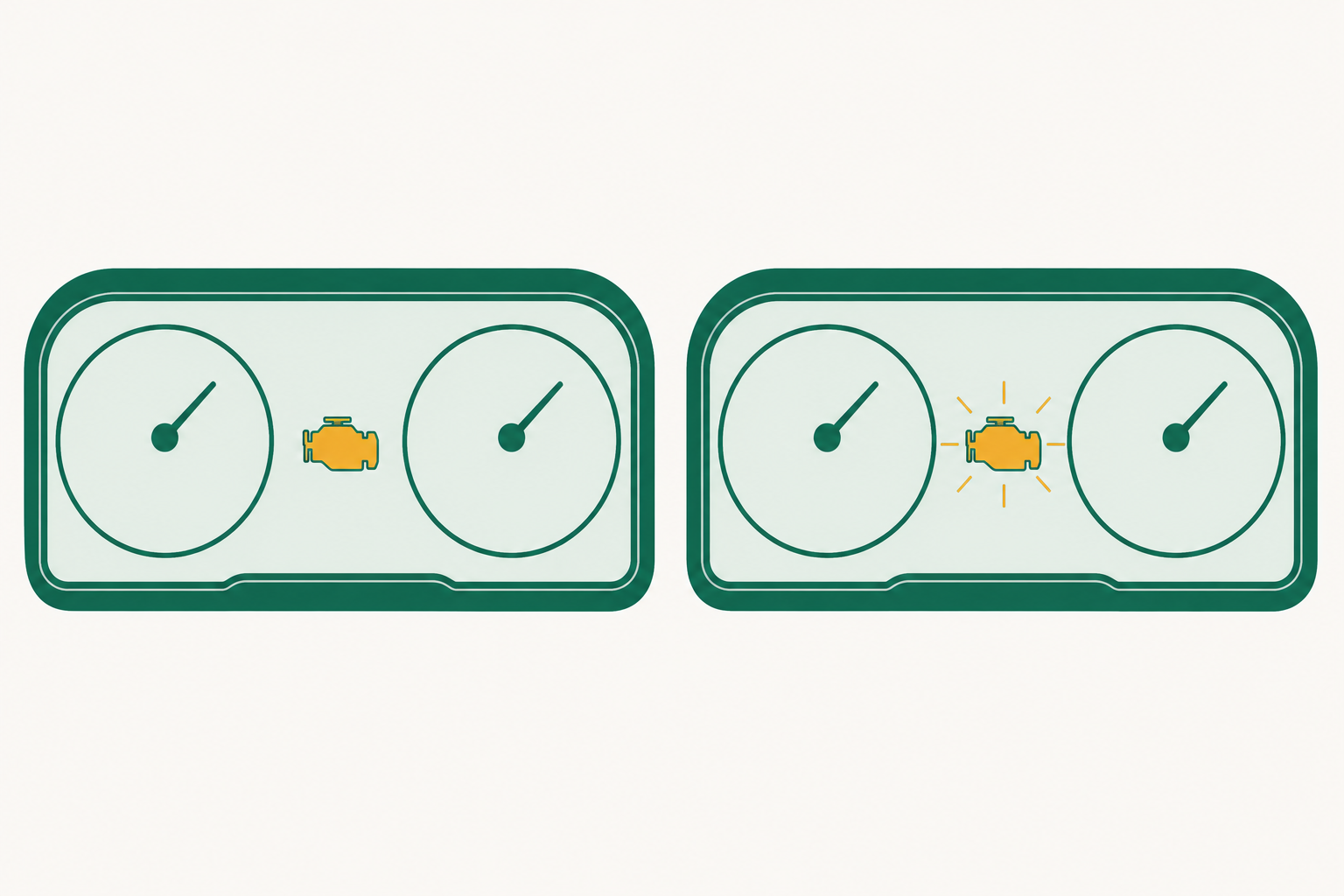
One lamp for a thousand faults
Modern engines run under the supervision of a control unit that monitors dozens of sensors many times a second. When a reading falls outside what the unit expects — for long enough, and often enough — it stores a code and lights the lamp on your dashboard. That is the entire mechanism, and it explains the thing that frustrates people most about this light: the same amber symbol covers a loose fuel cap and a failing catalytic converter.
It also explains why the lamp sometimes goes out on its own. Many faults are intermittent, and the control unit will extinguish the lamp after a number of clean journeys while keeping the code in memory as history. A light that has gone out has not necessarily fixed itself; it has stopped shouting.
What the colour does tell you is priority. The engine light is amber, which in dashboard convention means investigate. Red lamps — oil pressure, coolant temperature, brake system — mean stop. If an amber engine light arrives at the same time as a red one, the red one is the message and the amber one is a passenger.
What yours is doing
Behaviour is the diagnosis here, not the symbol. Find your card, then open it to confirm — and where two sound plausible, work on the more urgent one until you have ruled it out.
The light is flashing while you drive
An active misfire, sending unburnt fuel into the exhaust.
Reduce speed, stop somewhere safe, and do not press on.
How to be sure
A flashing lamp usually arrives with a rough, uneven idle and a car that feels like it is running on fewer cylinders than it has. You may smell unburnt fuel. This is the one dashboard behaviour where continuing the journey reliably makes the bill larger.
Steady amber, and the car drives exactly as it always has
A stored fault the control unit can work around for now.
Get the code read within days. Cheap to check, cheap to be wrong about.
How to be sure
Nothing else has changed: same power, same economy, same noises. That does not make it trivial, because emissions faults often feel like nothing at all from the driver’s seat while quietly damaging the exhaust. It does mean you have time to do this properly rather than urgently.
Steady amber, with obvious power loss and revs that will not climb
Limp mode — the control unit protecting the engine by capping output.
Drive gently and directly to a garage. Do not take the motorway.
How to be sure
The car feels capped rather than weak, often refusing to rev beyond a fixed point regardless of throttle. Turbocharged engines frequently do this by shutting off boost. Restarting sometimes clears it temporarily, which is a symptom rather than a fix.
It came on shortly after you filled up
A fuel filler cap that has not sealed, so the evaporative system detects a leak.
Remove the cap and refit it until it clicks. Then drive normally.
How to be sure
The timing is the whole clue. Give it several journeys, including one longer run: if the cap was the cause, most cars extinguish the lamp by themselves once the system has tested clear a few times. If it is still lit after a week, it was something else.
Steady light with rough running, a juddery idle or hesitation on pull-away
A misfire that has not yet become severe enough to flash the lamp.
Book it promptly, before it turns into the flashing version.
How to be sure
The car shakes at idle in a way you can feel through the seat, and smooths out as revs rise. Ignition components and injectors are the usual causes, and the stored code will normally name the cylinder involved, which saves a great deal of guessing.
The engine light plus a red lamp — oil pressure or temperature
Whatever the red lamp is reporting. The amber one is secondary.
Stop and switch the engine off. Do not drive to the garage.
How to be sure
You do not need to be. Red lamps in a car mean the same thing red lamps mean everywhere else. An oil pressure warning in particular is measured in minutes of engine life, not days, and no diagnostic reading is worth the journey to obtain it.
One symptom rarely proves a diagnosis. Use this to judge urgency — and to tell the garage “steady, no power loss, came on after a fill-up” rather than “the light’s on”.
Steady versus flashing Stop driving
This distinction is deliberate engineering, and almost nobody is told about it when they buy a car. A steady lamp reports a fault. A flashing lamp reports a fault that is actively causing damage right now.
The damage in question is to the catalytic converter. When a cylinder misfires, its fuel is not burnt in the engine — it is pushed out into the exhaust, where it meets a component that runs at several hundred degrees and is designed to oxidise whatever reaches it. Raw fuel arriving continuously does exactly that, and the resulting temperature spike can melt the ceramic honeycomb inside.
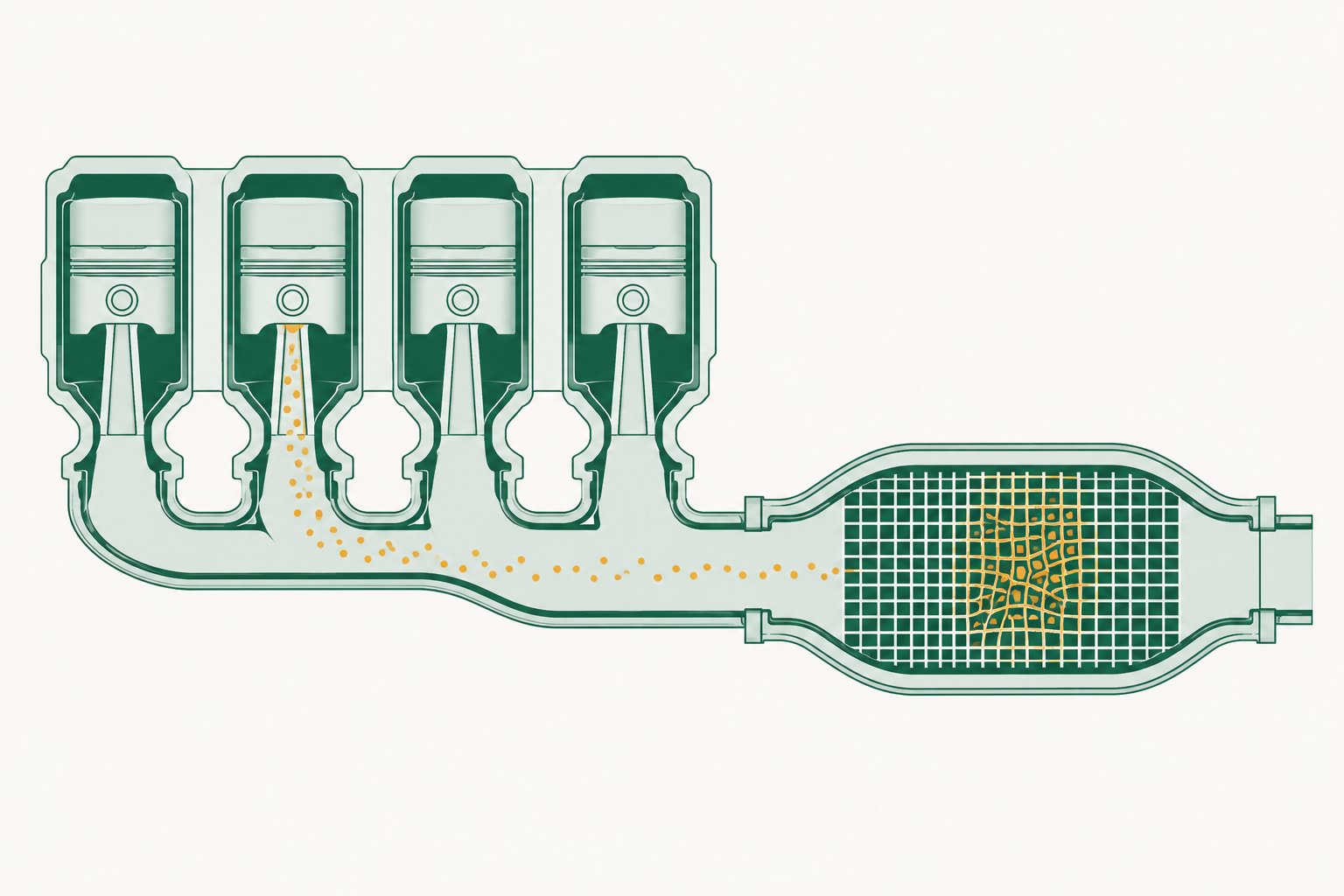
A flashing engine light is the car telling you it is destroying its own catalytic converter. That component can be ruined in a few miles, and it is usually far more expensive than whatever caused the misfire.
The arithmetic is what makes this worth knowing. The cause of a misfire is often an ignition component or an injector — a modest repair. The catalytic converter it can take with it is not. Pulling over turns one bill into one bill rather than two.
What sets it off, cheapest first
There are thousands of possible codes, but a small number of causes account for most lit lamps on ordinary cars. Working roughly from cheapest to dearest:
The fuel filler cap. Genuinely the most common trivial cause. The evaporative emissions system checks the fuel tank holds pressure, and a cap that has not clicked home fails that check. Free to fix, and worth ruling out before you pay anyone.
Ignition components. Worn plugs and tired coils cause misfires, and they are consumables — part of what a service covers and what a stretched service interval quietly skips.
Sensors reporting nonsense. Oxygen sensors in the exhaust and the airflow sensor in the intake both drift with age. The engine fuels according to what they report, so a sensor that lies makes a healthy engine run badly — and produces the black smoke covered in our exhaust smoke guide.
Recirculation and filtration. A sticking EGR valve or a loaded particulate filter will both light the lamp, and both are strongly associated with short-journey driving.
Injectors and the catalytic converter. The expensive end. Injectors that no longer atomise, or a converter that has lost efficiency — often because something upstream was left unfixed for months.
If the light arrived alongside something you can hear or feel, our car symptom checker works from the symptom rather than the code, cheapest likely cause first.
Why clearing the code is not a repair
Any cheap scanner can erase a stored code and put the lamp out. Nothing else changes. The sensor still reports what it reported, the misfire still misfires, and the lamp returns as soon as the control unit runs the same test again — sometimes within a mile, sometimes after a week of short journeys.
Clearing also destroys information. Freeze-frame data records the conditions at the moment the fault was stored: engine speed, load, coolant temperature, whether the engine was warm. That context is often what separates a five-minute diagnosis from an afternoon of guesswork, and erasing the code erases it.
There is one exception worth stating plainly. If you have fixed the cause — refitted the fuel cap, replaced the coil — clearing the code is a reasonable final step to confirm the repair, because a lamp that stays out afterwards is evidence. Clearing it and hoping is not.
What your MOT already told you
This is the one dashboard lamp with a direct, unambiguous MOT consequence, and the way it is written catches people out. The tester turns on the ignition and watches: the lamp must illuminate, and then it must go out. On some cars the engine has to be running before it extinguishes.
Note what that check is not. There is no diagnostic scan. Nobody plugs a computer into your car during an MOT and reads your stored codes. The test is entirely about whether the lamp behaves correctly, which has an obvious consequence for anyone tempted to solve the problem with a screwdriver.
The defect is worded “inoperative or indicating a malfunction”. Removing the bulb fails the test exactly as surely as leaving the light on — and a lamp that never illuminates at all is the version a tester spots in a second.
| What the tester finds | Item | Category | What it means for you |
|---|---|---|---|
| Engine management lamp inoperative or indicating a malfunction — petrol | 8.2.1.2 (h) | Major | Fails. Both directions: lit, or missing entirely. |
| Engine management lamp inoperative or indicating a malfunction — diesel | 8.2.2.2 (g) | Major | Fails. Same wording, separate section. |
| Stored fault codes in the engine control unit | — | Not read | No scan is carried out. Only the lamp is checked. |
| Emissions above the manufacturer’s specified limits | 8.2.1.2 (a) | Major | Fails. Often the fault the lamp was reporting. |
| Emissions above default limits | 8.2.1.2 (b) | Major | Fails. Used where no vehicle-specific limits exist. |
| Lambda coefficient outside the permitted range | 8.2.1.2 (c) | Major | Fails. A direct measure of how well fuelling is controlled. |
| Emissions test unable to be completed | 8.2.1.2 (d) | Major | Fails. Limp mode can be enough to prevent the test. |
| Emission control equipment missing, obviously modified or defective | 8.2.1.1 (a), 8.2.2.1 (a) | Major | Fails. Covers what is visible and identifiable. |
| Evidence the particulate filter has been tampered with | 8.2.2.1 (c) | Major | Fails. Cut open and rewelded without a documented reason. |
| Diesel with a particulate filter emitting visible smoke of any colour | 8.2.2.2 (d) | Major | Fails on sight, with no measurement required. |
Two details worth knowing. The lamp check applies to cars new enough that one was a required fitment, which covers essentially every ordinary modern car — and a small set of vehicle types, including kit cars, amateur-built vehicles and American pickups, are not required to have the lamp at all.
The practical upshot is that a lit engine light is not a maybe. It is a booked failure with a date attached to it, and the date is your next test. If a previous certificate carried an advisory about emissions or exhaust components, our MOT advisory decoder translates the wording into what usually comes next.
Check it yourself in five minutes
None of this needs tools, and the first four steps are worth doing before you phone anyone.
- Establish steady or flashing
Watch the lamp for a full minute while the engine runs. A flash can be slow enough to miss at a glance, and this single observation decides whether you drive the car at all.
Flashing changes the plan from “book it” to “stop here”. - Check nothing red is lit as well
Scan the whole cluster rather than the one lamp you noticed. Oil pressure and temperature warnings outrank everything on this page.
A red lamp makes the amber one irrelevant. - Try the free fix
Take the fuel filler cap off and refit it until it clicks. Then drive normally for several journeys including one longer run.
Costs nothing, and it is a genuinely common cause. - Read the levels while you are there
Oil on the dipstick and coolant in the expansion tank, cold and on level ground. Write both down with the date.
Two numbers that change the conversation at the garage. - Know what a code can’t tell you
Get the code read — many parts shops do it free — and write down the code itself rather than somebody’s interpretation of it. A code names a circuit and a symptom, not a broken part.
A converter-efficiency code does not mean “buy a converter”.
What waiting actually costs
An engine light is unusual among the symptoms on this site because ignoring it has a guaranteed cost rather than a probable one: it fails your next MOT whatever else happens. Everything else here is a risk. That is a certainty with a date on it.
The second cost is the cascade. Most of the expensive components in an exhaust system are destroyed by faults upstream that were cheap when the lamp first lit. A sensor reporting badly makes an engine run rich for months, and rich running is what kills converters and clogs filters. The repair you eventually pay for is frequently not the fault you originally had.
The third is negotiating position. Arriving at a garage with a stored code, a note of when the lamp came on, and a description of what the car is doing puts you in a different conversation from arriving with a lit dashboard and no information. If you have already been given a figure, our repair quote checker shows where it sits against UK ranges before you agree to anything.
Got the code? See what the likely repairs cost on your exact car before you ring a garage.
See repair costs by job and model →Engine management light FAQ
Can I drive with the engine management light on?
If it is steady and the car drives normally, yes, for a short period, but get the code read within days. If it is flashing, no: that indicates an active misfire that can destroy the catalytic converter within a few miles. If a red warning lamp is lit as well, stop and switch the engine off.
What does a flashing engine management light mean?
It means a misfire is happening right now and unburnt fuel is being pushed into the exhaust. The catalytic converter oxidises whatever reaches it, so raw fuel arriving continuously overheats it and can melt the honeycomb inside. Reduce speed and stop somewhere safe rather than completing the journey.
Does the engine management light fail an MOT?
Yes. A lamp that is illuminated to indicate a malfunction is a major defect on both petrol and diesel cars. So is a lamp that does not work at all, because the defect is worded as inoperative or indicating a malfunction. Removing the bulb fails just as surely as leaving the light on.
Does the MOT read my fault codes?
No. There is no diagnostic scan in an MOT and nobody connects a computer to your car for it. The tester turns on the ignition and checks that the lamp illuminates and then goes out, which on some cars only happens once the engine is running.
Why did the engine light go off on its own?
Because the fault was intermittent and the control unit stopped seeing it. After a number of journeys where the same test passes, most systems extinguish the lamp while keeping the code in memory as history. The fault has not necessarily been fixed, and a garage can still retrieve it.
Can a loose fuel cap turn the engine light on?
Yes, and it is one of the most common trivial causes. The evaporative emissions system checks that the fuel tank holds pressure, and a cap that has not sealed fails that check. Refit it until it clicks and drive normally for several journeys, including one longer run.
Is it worth clearing the code myself?
Only after fixing the cause. Clearing puts the lamp out without changing anything, and the code returns when the control unit next runs the same test. It also erases the freeze-frame data recording the conditions when the fault occurred, which is often what makes a diagnosis quick.
How much does it cost to find out what the light means?
Reading the code is frequently free at a parts shop and inexpensive at a garage, but reading a code is not diagnosis. A code identifies a circuit and a symptom rather than a failed part, so expect a garage to charge for the testing that follows if the cause is not obvious.