
Blue, white or black smoke — what your exhaust is telling you
Three colours, six causes, and the one rule that turns any smoke at all into an MOT failure
- Thin white, cold morning
- Condensation. Gone within a minute — no action.
- Blue haze
- Oil reaching the combustion chamber. Book it in.
- Thick white and sweet
- Coolant burning. Stop and check the level.
Exhaust smoke is coloured by whatever is burning that should not be. Blue means engine oil is getting into the combustion chamber. Thick white that lingers and smells faintly sweet means coolant. Black means the engine is burning more fuel than it can use. Thin white vapour on a cold morning is condensation and means nothing at all — it should disappear within a minute of setting off.
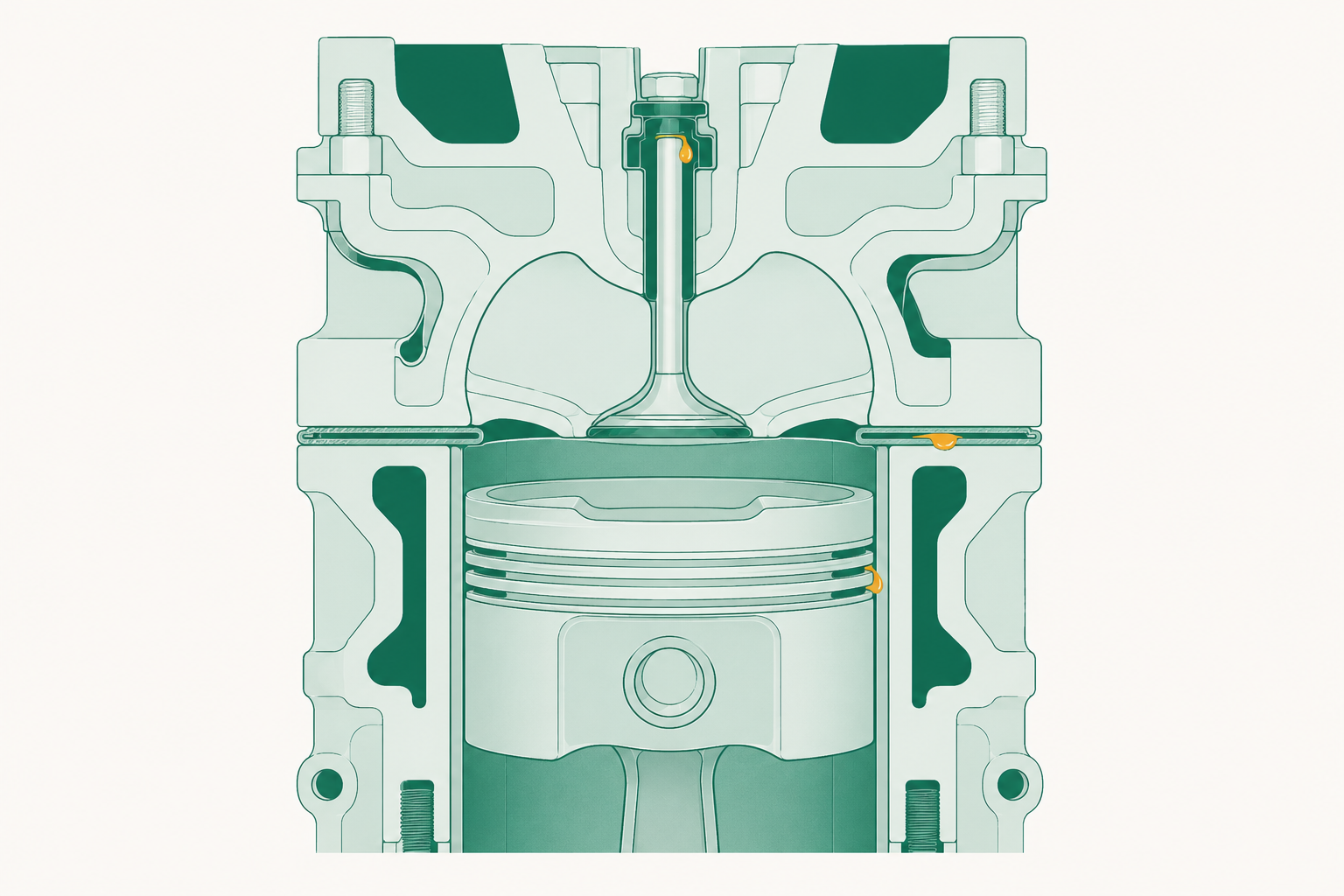
First: steam or smoke?
Burning a litre of fuel produces roughly a litre of water, and on a cold morning that water condenses the moment it meets the air. Every car does it, every winter, and it looks alarming in a mirror. The test is whether it persists. Condensation thins and vanishes within a few seconds of leaving the tailpipe and stops entirely once the exhaust is hot — usually within a minute of driving.
Real smoke behaves differently. It hangs in the air behind the car, it is still there when the engine is fully warm, and it has a colour you can name against a dark background. If you can see it in the mirror at a set of traffic lights after twenty minutes of driving, it is not steam.
One further complication on modern diesels: a car regenerating its particulate filter runs hot deliberately and can produce a hot smell and a faint haze while it does so. That is the system working, not failing, and it is covered further down.
What each colour is telling you
Judge the colour against something dark, and judge it when the engine is warm. Find your card, then open it to confirm — and where two sound plausible, work on the more urgent one until you have ruled it out.
Thin white vapour on a cold start, gone before the end of your road
Condensation — water produced by combustion, meeting cold air.
Nothing. Every healthy car does this in cold weather.
How to be sure
It disperses within a couple of seconds rather than hanging behind the car, and it stops once the exhaust is warm. There is no smell and no drop in oil or coolant level. On a cold enough morning you may also see a drip of clear water from the tailpipe, which is the same thing.
A blue puff on startup, or after idling at lights, then clearing
Worn valve stem seals letting oil seep down the valve guides while the engine sits.
Book it. Not urgent, but it will not improve on its own.
How to be sure
The timing is the giveaway: oil pools while the engine is stopped or idling, then burns off in one visible cloud when you accelerate away. Between clouds the car is clean. Oil consumption is usually modest, so the level drops slowly rather than dramatically.
A constant blue haze under acceleration, with oil needing topping up between services
Worn piston rings or bores, or a turbocharger passing oil through failing seals.
Get it diagnosed before the oil level becomes the problem.
How to be sure
Turbo seals usually smoke worst on hard acceleration and when lifting off after a run. Rings and bores smoke more evenly and often come with a whiff of oil around the engine bay. Either way, if you are adding oil between services and seeing blue, the two facts are the same fact.
Thick white that hangs in the air, smells faintly sweet, and does not clear when warm
Coolant entering the combustion chamber — usually a failed head gasket.
Stop and check the coolant level. Do not keep driving to see if it settles.
How to be sure
Check the expansion tank cold: a level that keeps dropping with no puddle on the drive points inside the engine. Look under the oil filler cap for a mayonnaise-coloured emulsion, and watch the temperature gauge. This one arrives with symptoms rather than on its own.
Black smoke on acceleration, often with poor economy and a flat-feeling engine
Over-fuelling — a blocked air filter, a lying airflow sensor, tired injectors or a stuck EGR valve.
Diagnose it properly. Several cheap causes, one expensive one.
How to be sure
Start with the air filter, because a choked one produces exactly this and costs almost nothing. If a warning light is on, the stored fault code will usually name the sensor or circuit involved, which is far quicker than guessing at injectors.
Any visible smoke at all from a diesel fitted with a particulate filter
The filter is failing, blocked, damaged, or something upstream is overwhelming it.
Deal with it before the MOT. It is an automatic failure.
How to be sure
You do not need a meter, and neither does the tester. On a car fitted with a diesel particulate filter, visible smoke of any colour is a major defect in its own right. If you can see it, it fails.
One symptom rarely proves a diagnosis. Use this to judge urgency — and to tell the garage “blue, only on lift-off, oil down half a litre a month” rather than “it smokes”.
Blue: oil where it should not be Within weeks
Blue smoke means engine oil is being burnt alongside the fuel, and there are only three realistic ways it gets there. Which one you have is decided by when the smoke appears rather than by how much of it there is.
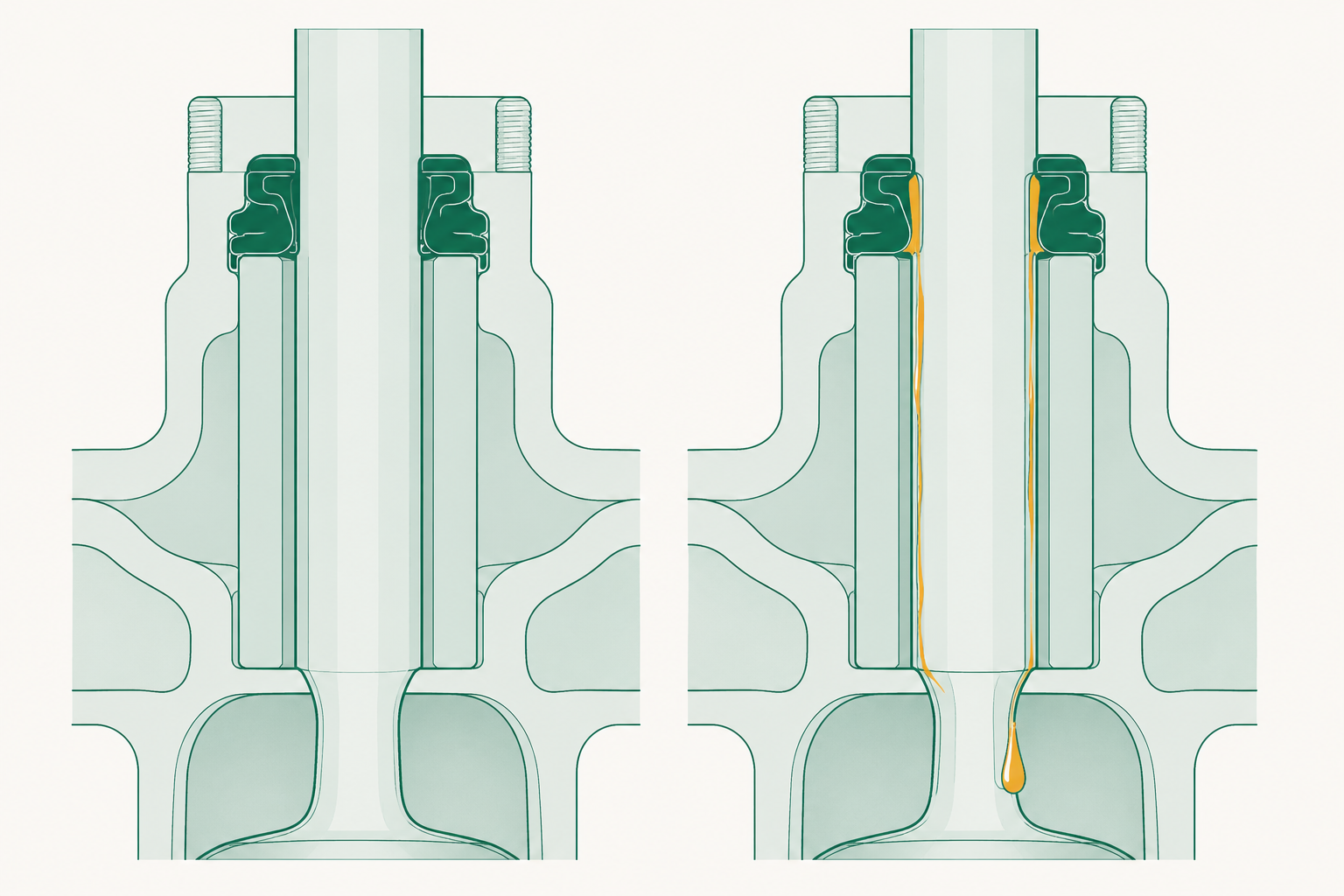
Down the valve stems. Each valve slides through a guide with a small rubber seal at the top, keeping oil in the head out of the port below. Those seals harden with heat cycles until they no longer wipe the stem clean. Oil then creeps down while the engine is stopped or idling, and burns in one puff when you next accelerate — the classic cloud pulling away from traffic lights.
Past the piston rings. Rings scrape oil off the bore on every stroke. Once they or the bore wear, oil is left behind to burn, and this version smokes constantly rather than in puffs — worst under load, when the pressure differential is highest. This is genuine engine wear and the most expensive answer on this page.
Through the turbo. A turbocharger spins in a bearing fed with engine oil, sealed at both ends. When those seals fail, oil is drawn into the intake or the exhaust directly. Blue smoke that is worst on hard acceleration, or in a cloud when you lift off after a fast run, points here — and a turbocharger is a job worth catching early, because debris from a failing one can travel onward into the engine.
An engine that needs topping up between services and shows blue smoke is not two problems. It is one problem, measured two ways — and the dipstick is the more reliable of the two measurements.
White: steam, or something worse Stop driving
Thin white vapour that disappears is water, and it is normal. Thick white smoke that hangs in the air, smells faintly sweet and continues when the engine is hot is coolant being burnt in the cylinders, and the usual route in is a failed head gasket.
The head gasket seals the joint between the cylinder head and the block, keeping combustion pressure in and separating the oil and coolant galleries that cross that joint. When it fails between a coolant gallery and a cylinder, coolant is drawn in and boiled off, which is why the smoke is dense and white rather than a haze. The supporting evidence is what makes this one straightforward to confirm: a coolant level that drops with no puddle underneath, a mayonnaise-coloured emulsion under the oil filler cap, a temperature gauge that climbs, or bubbles in the expansion tank with the engine running.
Diesels add one more possibility. White or grey smoke on a cold start that clears as the engine warms is usually unburnt fuel rather than coolant, which points at glow plugs or tired injectors rather than anything structural. The distinction is temperature: coolant smoke gets no better as the engine warms, while cold-start fuel smoke disappears.
What makes the coolant version urgent is not the smoke, it is the overheating that comes with it. If the level is dropping and the gauge is moving, the cheapest version of this repair is the one you stop for.
Black: too much fuel Within weeks
Black smoke is unburnt fuel — carbon particles that found no oxygen to burn with. The engine is either being given too much fuel or not enough air, and the good news is that the cheap causes are more common than the expensive ones.
Start with airflow. A blocked air filter starves the engine and is the single cheapest thing on this list to rule out, which is why it belongs in what a service covers. A mass airflow sensor that has drifted out of calibration reports less air than is arriving and the engine fuels to match. Both produce black smoke with poor economy and a flat-feeling engine.
Then fuelling. Injectors that no longer atomise properly dump fuel in droplets rather than mist, and droplets do not burn cleanly. On diesels a stuck EGR valve recirculates exhaust gas when it should not, displacing the oxygen the engine needed. Both usually store a fault code, which is why reading the code is quicker and cheaper than replacing parts in order of price.
Black smoke also has a downstream cost. Soot that leaves the engine has to go somewhere, and on a diesel it lands in the particulate filter, while on a petrol it can poison the catalytic converter. Fixing the cause is usually a fraction of replacing what the cause destroyed.
If your car has a particulate filter
A diesel particulate filter traps soot and periodically burns it off, which is called regeneration and needs sustained heat to happen. A car used only for short journeys never gets hot enough for long enough, so the filter loads up, and a loaded filter eventually refuses to clear itself at all. That is the whole story behind most DPF problems, and it is why the same car can be faultless on a motorway commute and troublesome on a school run.
What matters here is that the MOT treats a filtered car differently and far more harshly than an unfiltered one, and most owners do not know it until they fail.
On a diesel fitted with a particulate filter, visible smoke of any colour is a major defect. No meter, no measurement, no argument — if the tester can see it during the check, the car fails.
The manual also tells testers to reject a filter that has clearly been cut open and rewelded unless there is a documented reason, such as professional cleaning. Removing a filter to cure smoke does not cure anything: it converts a repairable fault into a car that cannot legally pass a test.
What your MOT already told you
Smoke is one of the few symptoms on this site that the MOT genuinely does test, and it tests it in two completely different ways depending on what fuel you burn. Petrol cars get judged by eye at idle and on acceleration. Diesels get a meter down the tailpipe and a number to beat.
That number is not universal. The limit is whatever the manufacturer stamped on the plate in your engine bay, usually marked with the letters 24 R and a figure. Where there is no plate value, the tester falls back on a default band based on when the car was first used, and those bands have tightened enormously: the oldest turbocharged diesels were held to a limit more than four times looser than the one applied to the newest cars.
| What the tester finds | Item | Category | What it means for you |
|---|---|---|---|
| Petrol: dense blue or clearly visible black smoke for five continuous seconds at idle | 8.2.1.2 (f) | Major | Fails. Judged by eye, no meter involved. |
| Petrol: excessive blue or black smoke on acceleration that would obscure other drivers’ view | 8.2.1.2 (g) | Major | Fails. The acceleration version of the same check. |
| Diesel: smoke opacity above the manufacturer’s plate value | 8.2.2.2 (a) | Major | Fails. Your own limit, from your own VIN plate. |
| Diesel: smoke opacity above the default limit | 8.2.2.2 (b) | Major | Fails. Used only where no plate value exists. |
| Excessive smoke or vapour of any colour likely to obscure other road users’ vision | 8.2.2.2 (c) | Dangerous | Fails. The only emissions defect rated Dangerous. |
| Diesel with a particulate filter emitting visible smoke of any colour | 8.2.2.2 (d) | Major | Fails on sight. No measurement needed. |
| Emissions test not completed because smoke far exceeds the limit | 8.2.2.2 (f) | Major | Fails. The tester may abandon the test early. |
| Evidence the particulate filter has been tampered with | 8.2.2.1 (c) | Major | Fails. Cut open and rewelded without a documented reason. |
| Engine management light inoperative or indicating a malfunction | 8.2.1.2 (h), 8.2.2.2 (g) | Major | Fails on either fuel, regardless of what the smoke does. |
| Smoke test refused — abnormal engine noise or an unsatisfactory cambelt | 8.2.2.2 | Refusal to test | Recorded on a VT30. The tester judged it unsafe to rev. |
Testers are told to enter your plate value plus 0.05 into the smoke meter, so that manufacturing tolerances cannot fail a car that is actually within specification. It is a small piece of fairness built into the test that almost nobody outside the trade knows exists.
Two practical consequences. First, you can read your own limit before you book anything, because the plate is in your engine bay. Second, an advisory about exhaust or emissions on a previous certificate is a dated warning from someone who measured it — and our MOT advisory decoder translates the wording into what usually comes next.
Check it yourself in ten minutes
Do this with the engine fully warm, on a clear day, with somebody else watching from a safe distance behind the car.
- Get the colour against something dark
Position the car so the exhaust is against a dark background — a wall, a hedge, shade. Colour is almost impossible to judge against a bright sky.
Film it on a phone. Smoke never performs at the garage. - Test all three conditions, warm
Idle for thirty seconds, then a firm acceleration in a high gear at low speed, then lift off completely after a run. Note which of the three produces smoke.
On lift-off points at the turbo; on acceleration at rings or fuelling. - Read both levels cold, and write them down
Oil on the dipstick and coolant in the expansion tank, on level ground. Repeat in a week and compare.
Which one is disappearing tells you which colour you are looking at. - Find your own smoke limit
On a diesel, look for the manufacturer’s plate in the engine bay, usually with 24 R and a number in a box. That figure is the limit your car will be tested against.
You can know your MOT limit before the garage does. - Know what this can’t tell you
A cold day makes every car look like it is smoking, a regeneration cycle produces its own haze and hot smell, and none of this reads a fault code.
If a warning light is on, the code beats every observation above.
Named the colour? See what the repair costs on your exact car before you ring a garage.
See repair costs by job and model →Exhaust smoke FAQ
What does blue smoke from the exhaust mean?
Engine oil is being burnt with the fuel. A puff on startup or after idling usually means worn valve stem seals; a constant haze under acceleration points at piston rings, bores or a turbocharger passing oil. If you are also topping up oil between services, those are the same fault seen twice.
Is white smoke from my exhaust always a head gasket?
No. Thin white vapour on a cold morning is condensation and disappears within a minute. Thick white smoke that hangs in the air, smells faintly sweet and continues once the engine is hot is coolant burning, and that usually is a head gasket. On a diesel, white or grey smoke that clears as the engine warms is more often unburnt fuel.
Why does my car blow black smoke on acceleration?
Because it is burning more fuel than it has air for. The common causes run from cheapest to dearest: a blocked air filter, an airflow sensor reading low, a stuck exhaust gas recirculation valve, then injectors that no longer atomise. Poor economy and a flat-feeling engine usually come with it.
Does exhaust smoke fail an MOT?
Yes, and in several ways. A petrol car fails for dense blue or clearly visible black smoke lasting five continuous seconds at idle. A diesel fails if its measured opacity exceeds the limit on its plate. Smoke of any colour thick enough to obscure other drivers’ vision is a dangerous defect.
Will any smoke fail a car with a DPF?
Yes. On a diesel fitted with a particulate filter, visible smoke of any colour is a major defect on its own, with no measurement required. That is a considerably harsher standard than an unfiltered car faces, and it catches many owners out.
How do I find my car’s smoke limit?
Look for the manufacturer’s plate in the engine bay, usually the VIN plate or a separate sticker. A smoke limit appears as the letters 24 R followed by a figure, often boxed in the bottom corner. That figure, not a general standard, is what your car is measured against.
Can I keep driving with smoke coming out of the exhaust?
It depends on the colour. Blue is a job to book rather than an emergency, provided you keep the oil level up. Black is worth diagnosing before it damages the filter or catalytic converter. Thick white with a dropping coolant level means stopping, because the risk is overheating rather than the smoke itself.
Does burning oil damage anything else?
Yes, downstream. Oil ash coats the inside of a catalytic converter and clogs a particulate filter, so a car left smoking blue for long enough tends to need an expensive exhaust component as well as the original repair. The same applies to black smoke, which loads a filter with soot far faster than it can burn it off.