
What is that puddle under my car?
Six fluids, what each one looks like, and which two mean stop driving
- Clear and odourless
- Air-con condensate. Normal — no action needed.
- Coloured or greasy
- A seal or hose has failed. Book it in.
- Oily behind a wheel
- Treat it as brake fluid. Stop driving.
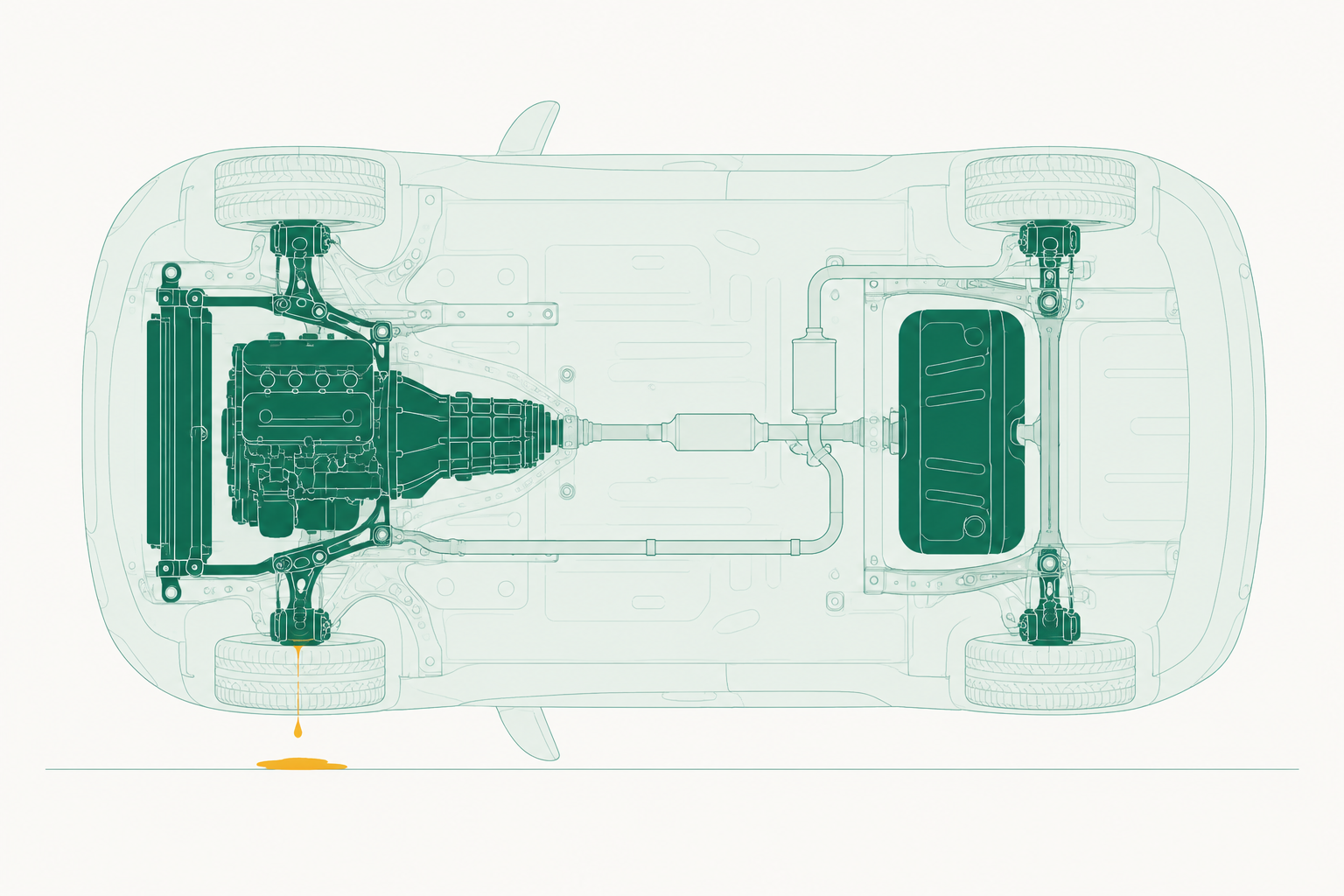
A clear, odourless puddle under the front passenger side is almost always air-conditioning condensate, and it needs no action at all. Anything with colour — brown, green, orange, red, or a rainbow film — is a fluid the car was built to keep inside. Colour and position together identify it: oil at the front of the engine, coolant near the radiator, brake fluid behind a wheel. Only two of the six mean stop driving.
Is it water, or is it not?
Most puddles people worry about are condensate. An air-conditioning system chills a small radiator behind the bulkhead until moisture in the cabin air condenses onto it, and that water runs down a drain tube onto the ground, roughly under the front passenger footwell. On a humid day a car sheds a surprising amount of it. Nothing has failed, and the same drip appears on brand new cars.
Two other harmless liquids get mistaken for faults. Screen wash is usually tinted blue or green and smells faintly of detergent. AdBlue, on diesels that use it, is clear and dries to a white crystalline crust that looks alarming and is not.
The test that separates all three from a real leak is residue. Water evaporates and leaves the ground clean; every fluid your engine actually needs leaves something behind.
What the colour is telling you
Manufacturers dye these fluids deliberately, so that a leak announces itself before a gauge does. Find your card below, then open it to confirm. If two cards sound plausible, take the more urgent one seriously until you have ruled it out.
Clear and odourless, front passenger side, after a warm day or using the air-con
Condensate draining from the air-conditioning evaporator.
Nothing. The system is working as designed.
How to be sure
Dab it with a clean tissue. Condensate has no colour, no smell and no feel to it, and dries without leaving a mark. Park overnight without touching the air-con — dry ground in the morning settles it.
Dark brown to black and greasy, under the front or middle of the engine
Engine oil from a cam cover gasket, sump plug, filter housing or crank seal.
Get the source traced. Sooner if it is near a tyre or a disc.
How to be sure
Rub a drop between gloved fingers. Oil is slippery rather than watery, smells of hot engine, and dries sticky, so old leaks collect road dust into a crust. Check the dipstick cold, then again a week later.
Bright green, orange, pink or blue, often near the front bumper
Coolant from a hose joint, the radiator, the expansion tank or the water pump.
Watch the temperature gauge, top up cold, book it this week.
How to be sure
Coolant is dyed so leaks are obvious. It feels slightly sticky, smells faintly sweet, and dries to a crusty ring rather than a clean stain. Follow the crust: hose clamps, radiator end tanks, the water pump weep hole. Hose it off the drive — it is lethal to cats and dogs.
Red or reddish-brown and thin, towards the front of the car
Power steering fluid, or automatic transmission fluid from a cooler line or seal.
Check the level and book it before the pump or gearbox runs dry.
How to be sure
Turn the steering slowly lock to lock with the engine running: a whine that rises with the turn points at the power steering side. Read the level through the sight glass without removing the cap. Fluid further back, around the bellhousing, points at the gearbox instead.
Oily and near-clear, right behind a road wheel or under the pedal box
A leaking caliper, flexible hose, brake pipe or master cylinder.
Stop driving. Call a garage or recovery rather than driving there.
How to be sure
Brake fluid is near-clear when new, amber to brown when aged, oily but thinner than engine oil, and it strips paint. The giveaway is the pedal: soft, spongy, or slowly sinking under steady pressure at a red light.
A strong petrol or diesel smell, with a rainbow film on wet ground
A failed fuel line, injector seal, filter housing or tank seam.
Do not start the engine. Get it recovered.
How to be sure
Fuel evaporates and leaves almost nothing behind, but the smell hangs around long after the wet patch has gone. If you can smell it from outside the car with the bonnet shut, treat it as a fire risk rather than a puddle.
Read the puddle from a car that has been standing still. Airflow drags drips backwards while you drive, so an overnight patch is far more honest than one that appeared after a run.
Where the puddle sits narrows it down
Position tells you nearly as much as colour. Working front to back: the very front of the engine bay covers the radiator, its hoses, the timing cover and the water pump. The middle covers the sump, the filter housing and the gearbox bellhousing — and oil at the bellhousing is worth knowing about, because tracing it means splitting the gearbox from the engine, which is the same strip-down as a clutch job.
A patch tight behind one road wheel is a brake circuit until proven otherwise. Towards the rear you have the fuel tank and its lines, and on rear-wheel-drive cars the differential.
One position is a special case. A damp passenger footwell with misted windows and a sweet smell inside the car is not a puddle on the drive at all. That is a heater matrix leaking coolant into the cabin, and it needs looking at before the screen becomes unusable.
Dark and greasy: engine oil Within weeks
Engine oil is the most common leak on an older car and the least likely to strand you, which is why it gets ignored for years. Fresh oil is amber; used oil is dark brown to black, slippery between the fingers, and it smells of hot engine when it lands on something warm.
The usual sources are the cam cover gasket at the top of the engine, the sump plug and its washer at the bottom — part of what a service replaces — the filter housing, and the crank seals at either end. A cam cover leak often produces no puddle at all, because the oil drips onto the exhaust manifold and burns off: a hot, acrid smell and a wisp of smoke from the bonnet shut line, and a spotless drive.
Two things move an oil leak up the queue. Oil on a tyre or a brake disc is a safety problem rather than a tidiness problem, and contaminated pads and discs are replaced rather than cleaned. And oil mixing with coolant — mayonnaise-coloured sludge under the filler cap, or a milky dipstick — is a head gasket symptom rather than a leak.
Bright and sweet: coolant Within weeks
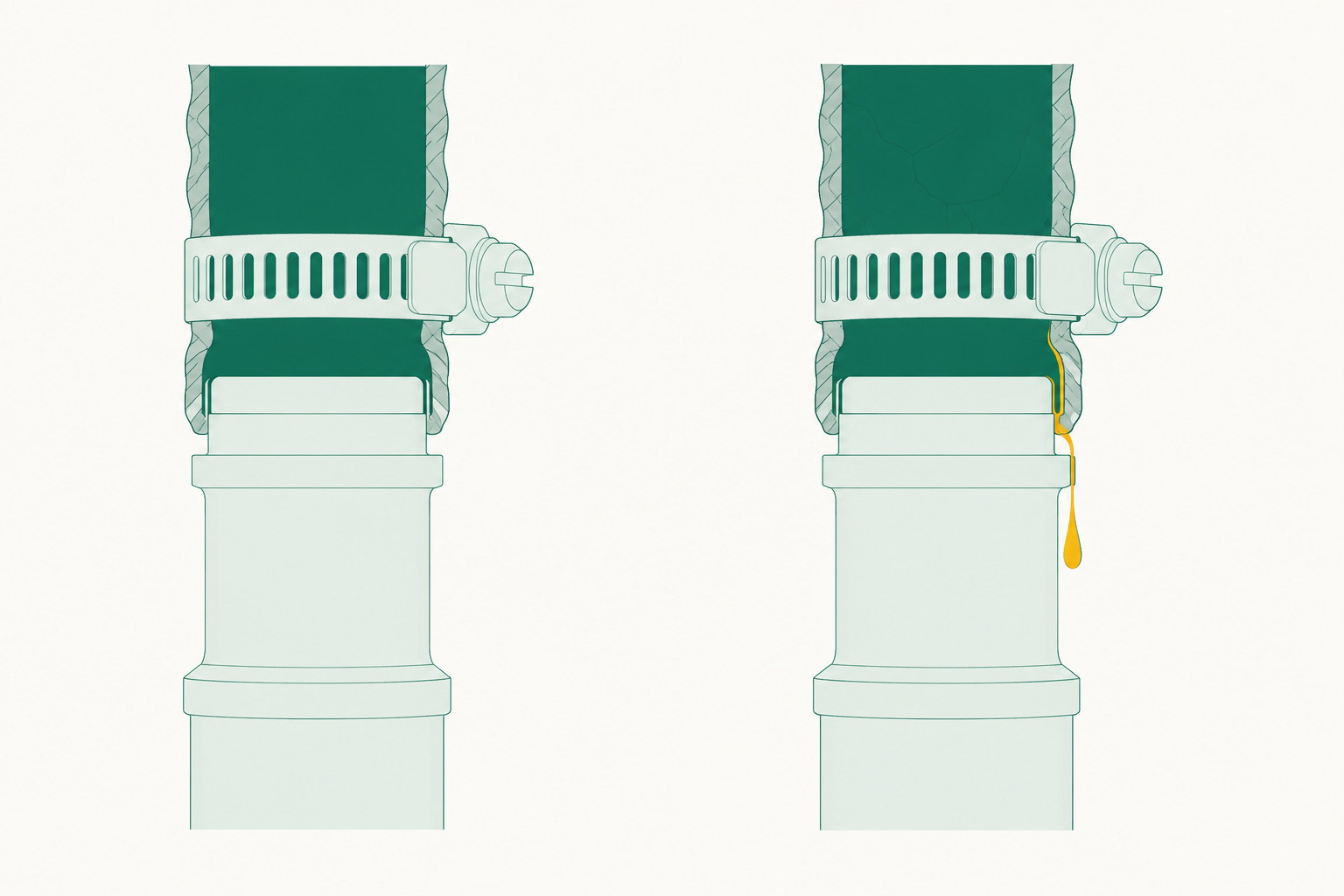
Coolant is the easiest fluid to identify and the one people most often top up and forget. It is dyed bright green, orange, pink or blue, feels faintly sticky rather than slippery, smells sweet, and dries to a crusty deposit at the point it escaped from. Follow the crust and you have usually found the leak: hose clamps, the radiator end tanks, a hairline crack in the expansion tank, or the weep hole on the water pump, which exists specifically so that a failing pump seal tells you before the bearing lets go.
The urgency is not the puddle, it is what happens when the level drops far enough. An engine running low on coolant can go from a normal temperature gauge to a warped cylinder head inside one motorway journey. If the needle climbs, stop and let it cool rather than pressing on to the next junction.
Coolant that disappears with no puddle anywhere is a different problem: either it is going out through the heater matrix into the cabin, or it is being burned in the combustion chambers.
A coolant leak cannot fail an MOT. The inspection manual excludes engine coolant, screen wash and AdBlue from the fluid leak check by name — which means a pass certificate tells you nothing at all about your cooling system.
Oily behind a wheel: brake fluid Stop driving
This is the one that changes your plans for the day. Brake fluid is near-clear when new and darkens to amber or brown as it ages and absorbs moisture. It is oily, thinner than engine oil, and aggressive enough to lift paint, so a run down a painted surface leaves a dulled patch.
Two positions matter. Tight behind a road wheel points at a caliper or flexible hose, or a wheel cylinder on drums. A damp patch high on the bulkhead, or under the pedal box inside the car, points at the master cylinder. Either way the symptom to trust is the pedal rather than the puddle: brakes that feel soft or spongy, or a pedal that slowly sinks while you hold steady pressure at a red light, mean the system is not holding pressure.
There is no version of this that waits until the weekend. A hydraulic system that is leaking can lose its braking effort without warning, and the fluid level dropping below the minimum mark is the last polite warning you get.
What your MOT already told you
A leak has to reach a defined threshold before it fails an MOT, and it is not the threshold most drivers assume. The inspection manual treats fluids differently depending on what they are and what they threaten — which is why a car can pass with a visible oil weep and fail outright on a fluid most people have never thought about.
| What the tester finds | Item | Category | What it means for you |
|---|---|---|---|
| A leak forming a pool wider than 75 mm within five minutes, engine idling | 8.4.1 (a)(i) | Major | Fails. Any fluid, any source, once it reaches that rate. |
| Fluid leaking continuously and posing a serious road safety risk | 8.4.1 (a)(ii) | Dangerous | Fails. The car shouldn’t be driven away. |
| A leak of engine coolant, screen wash or AdBlue | 8.4.1 | Not a defect | Excluded by name. Coolant leaks are not an MOT failure. |
| Master cylinder leaking | 1.1.10 (b)(ii) | Dangerous | Fails. The system is losing pressure at source. |
| Brake pipe or connection leaking on a hydraulic system | 1.1.11 (b)(ii) | Dangerous | Fails. Rigid pipe, usually corroded through. |
| Brake hose or connection leaking on a hydraulic system | 1.1.12 (c)(ii) | Dangerous | Fails. The flexible hose at the wheel end. |
| Brake fluid significantly below the minimum mark | 1.1.10 (d)(ii) | Major | Fails. Below minimum but still visible is only a minor defect. |
| Brake fluid not visible in the reservoir | 1.1.10 (d)(iii) | Dangerous | Fails. Treated as a system about to fail. |
| Lining, pad, disc or drum contaminated with oil or grease | 1.1.13 (b), 1.1.14 (b) | Major | Fails. Contaminated friction material is replaced, not cleaned. |
| Power steering fluid leaking, or the system malfunctioning | 2.1.5 (a) | Major | Fails, but only where a component, joint or seal has failed. |
| Steering box leaking oil to the point of dripping | 2.1.1 (e)(ii) | Major | A weep alone is a minor defect; dripping fails. |
| Fuel system leaking | 6.1.3 (b)(i) | Major | Fails. A missing or ineffective filler cap counts too. |
| Fuel system leaking excessively, or a fire risk | 6.1.3 (b)(ii) | Dangerous | Fails. The car shouldn’t be driven away. |
The threshold is a pool more than 75 mm across forming within five minutes with the engine idling. Below that rate, a leak can be written up as an advisory and the car still passes — which is why an advisory about a leak is a dated, written prediction rather than a warning.
If your last certificate mentioned a leak rather than failing you for one, that is an advisory, and the exact phrasing matters. Put your reg into our MOT advisory decoder to translate the tester’s shorthand — and the commonest of them all, oil leak, not excessive, has a page of its own.
Check it yourself in ten minutes
You can get most of the way to an answer on the driveway, with no tools. Car parked, cold, on level ground.
- Lay cardboard, not guesswork
Flatten a box under the parked car overnight, from the front bumper to about halfway back. A clean surface gives you colour and position at once.
It also gives you the rate — one spot, or a patch that spreads. - Fix the position against the wheels
Note whether it sits ahead of the front axle, between the axles, or tight behind one wheel — and which side. Then photograph it.
This is the single most useful thing you can hand a garage. - Colour, feel and smell, with gloves on
Slippery and dark is oil. Sticky and sweet is coolant. Thin and red is power steering or transmission fluid. Oily and pale near a wheel is brake fluid.
Never taste anything, and hose coolant off ground where animals walk. - Check the levels cold
Oil on the dipstick, coolant between minimum and maximum on the expansion tank, power steering through the sight glass, brake fluid against the minimum mark.
Leave the brake reservoir cap alone — you’re reading it, not opening it. - Know what this can’t tell you
A cold-start seep that stops once the seal warms and swells won’t show itself in a short check, and a leak that only appears under load won’t show itself on a driveway at all.
If the ground says one thing and the levels say another, believe the levels.
Still not sure what you’re looking at? Our car symptom checker works backwards from what the car is doing rather than what it has dropped on the drive, cheapest likely cause first.
Know which fluid it is? Find out what putting it right costs on your exact car before you ring a garage.
See repair costs by job and model →Puddles and leaks FAQ
Is a puddle under my car always a problem?
No. Clear, odourless water under the front passenger side after using the air-conditioning is condensate and needs no action at all. Any fluid with colour, smell or an oily feel is a fluid that should have stayed inside the car, and that does need tracing.
What colour is engine oil when it leaks?
Fresh engine oil is amber; used oil is dark brown to black. It feels slippery rather than watery, smells of hot engine when it lands on something warm, and dries sticky, so older leaks collect road dust into a crust rather than a clean stain.
Is a coolant leak an MOT failure?
No. The inspection manual excludes engine coolant, screen wash and AdBlue from the fluid leak check by name. The leak still matters, because an engine that runs low on coolant can overheat badly, but it will not fail the test on that alone.
Can I drive with a brake fluid leak?
No. Every hydraulic brake leak in the inspection manual is categorised as Dangerous, which means the car shouldn’t be driven. Call a garage or recovery rather than driving to one, and treat a soft or sinking pedal as confirmation.
Why is there clear water under my car after using the air-con?
Because the air-conditioning removes moisture from the cabin air and drains it out through a tube behind the bulkhead. The drip lands roughly under the front passenger footwell, appears on new and old cars alike, and stops once the system has been off for a while.
How much fluid loss is too much?
For the MOT, a leak that forms a pool more than 75 mm across within five minutes with the engine idling is a failure. For your own purposes the better measure is the reservoir: any fluid that needs topping up between services is leaking or being burned somewhere.
What does a red puddle under the front of my car mean?
Red or reddish-brown usually means power steering fluid or automatic transmission fluid. A whine when you turn the steering points at the power steering side; fluid further back, around the bellhousing, points at the gearbox instead.
Can a garage find a leak that only appears overnight?
Yes. The usual method is a UV dye added to the suspect system, then a run and an inspection under ultraviolet light, which shows the exact seal or joint rather than the general area. Photographing the puddle and its position before you go saves diagnostic time.