
What’s that burning smell from my car?
Six smells, what each one means, and the two that mean pull over rather than book in
- Faint, first cold morning
- Dust burning off the heater. Normal — no action.
- Hot oil, under the bonnet
- A leak landing on the exhaust. Book it in.
- Sharp smell inside the cabin
- Fumes or wiring. Pull over and investigate.
Start with where you smell it. A burning smell you notice standing beside the car with the bonnet up is almost always something dripping or rubbing onto hot metal, and it is a job to book rather than an emergency. A burning smell that reaches you inside the cabin while you are driving is the urgent version, because the two things that produce it — exhaust fumes and overheating wiring — are both reasons to pull over.
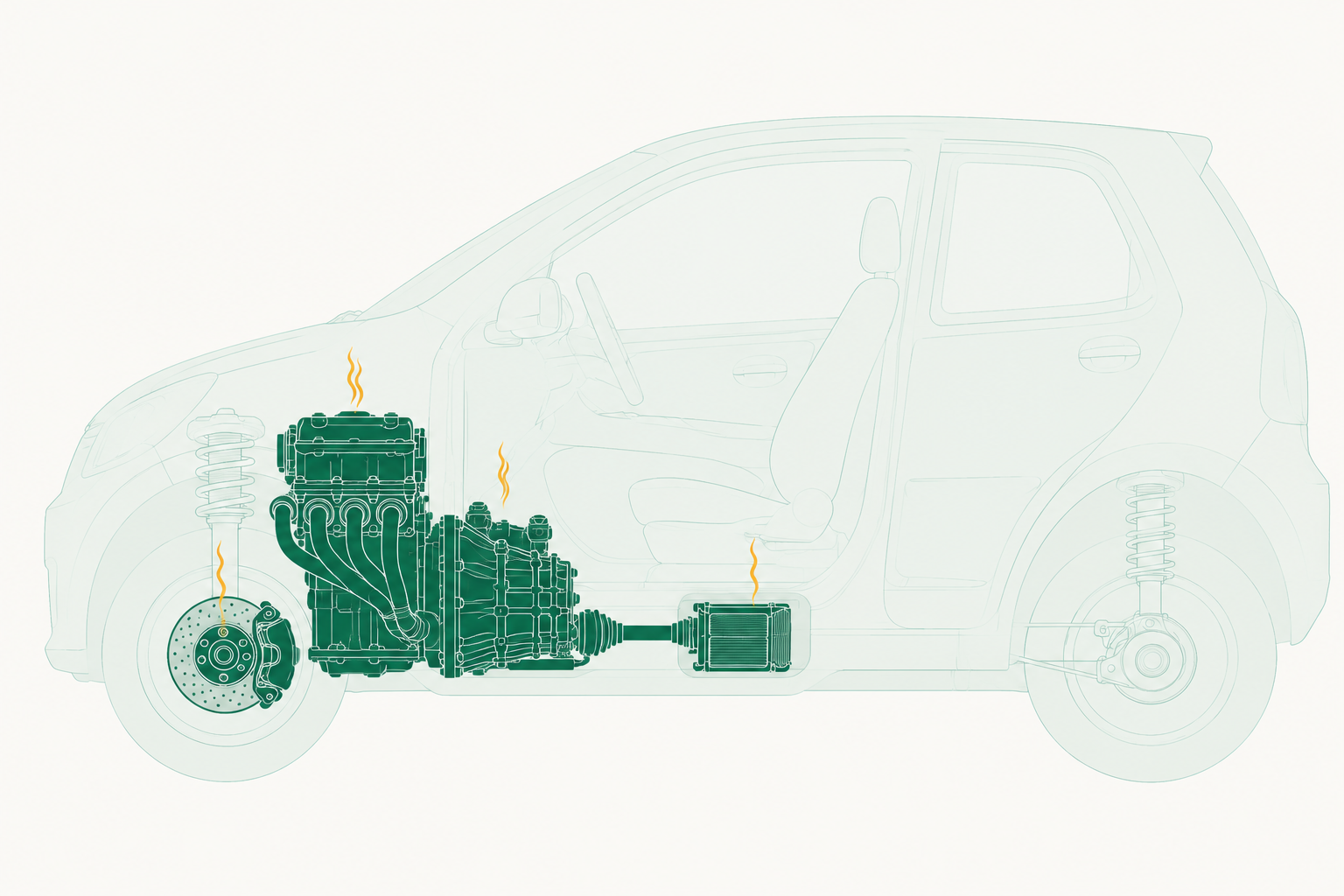
Inside the car, or outside it?
This single question sorts most of the work, because a car is reasonably good at keeping engine bay smells out of the cabin. Air comes into the interior through a vent at the base of the windscreen, passes through a pollen filter, and reaches you having been kept away from the hot parts on purpose. When something burning gets past all of that, it has either found a route it should not have, or it started inside the cabin.
So an acrid smell you notice when you open the bonnet after a run, and which fades once you walk away, points at the engine bay. A smell that arrives through the vents while you are driving, gets stronger with the fan, or lingers after you park with the doors shut, is the one to take seriously.
One qualifier: smells travel backwards. On the motorway, something burning at the front of the car can reach you through an open window rather than the vents, which is why the fan test in the cards below is worth doing before you conclude anything.
What the smell is telling you
Six smells cover nearly everything a car produces. Find yours, then open the card to confirm — and if two sound plausible, work on the more urgent one until you have ruled it out.
Faint and dusty, the first time the heater runs after a warm spell
Dust burning off the heater matrix, which has sat dry all summer.
Nothing. It should be gone within a few minutes of running.
How to be sure
It smells like a radiator switched on for the first time in autumn, not like anything mechanical. It appears the first time and not the second, and it does not come back until the heater has been unused for months. A new car can do the same thing with residues from manufacturing.
Hot, acrid oil under the bonnet, with wisps of smoke and no puddle on the drive
Oil escaping a gasket above the exhaust and burning off as it lands.
Get the leak traced. It is a gasket now and a fire risk if ignored.
How to be sure
Open the bonnet cold and look at the top of the engine and the exhaust manifold below it. Burnt-on oil leaves dark, baked staining and a crust rather than a wet patch. If there is nothing on the ground but a strong smell after every run, this is almost certainly it.
Hot metal or scorching, from one wheel, after a normal drive
A brake binding — a seized caliper or slide pins holding the pad on the disc.
Stop and let it cool. Do not carry on to see if it clears.
How to be sure
Park and hold the back of your hand near each wheel in turn, without touching. One noticeably hotter than the others is your answer. Supporting evidence: more brake dust on that wheel, a pull to one side, or fuel economy that has quietly got worse.
Sharp and acrid after hill starts, heavy traffic or towing
The clutch slipping — friction material overheating against the flywheel.
Book it. A slipping clutch does not recover on its own.
How to be sure
In a high gear at low speed, accelerate firmly. If the revs climb faster than the car does, the clutch is slipping rather than gripping. The smell arrives with that, usually after the kind of driving that makes you hold the pedal partly down.
Sweet and syrupy inside the car, with a misted screen and greasy film on the glass
The heater matrix leaking coolant into the cabin and vaporising it.
Book it, and watch the coolant level and temperature gauge meanwhile.
How to be sure
The screen mists up faster than the weather explains, and wiping it leaves a smear rather than clearing it. Check the passenger footwell carpet for damp. This is the one smell on the page that is sweet rather than acrid.
Sharp, plastic or fishy, inside the cabin, sometimes with a blown fuse or dim lights
Wiring or a connector overheating, or a component drawing more current than it should.
Pull over, switch off, and do not keep driving to find out.
How to be sure
You do not need to be sure, and that is the point. Overheating insulation has a distinctive sharp, slightly fishy smell that most people recognise instantly and then talk themselves out of. Treat any electrical smell in a car the way you would treat one in your house.
One symptom rarely proves a diagnosis. Use this to judge urgency — and to tell the garage “hot metal, front nearside, after a twenty minute run” rather than “it smells”.
Hot oil on the exhaust Within weeks
This is the most common burning smell on an older car, and the reason it confuses people is that it produces no puddle. The exhaust manifold sits below the cylinder head and runs far hotter than boiling water, so oil weeping from a gasket above it never reaches the ground — it lands, burns off, and leaves a smell plus a wisp of smoke from the bonnet shut line.
The usual culprit is the cam cover gasket, a strip of rubber that hardens with heat cycles until it no longer seals. Turbocharged engines add their own candidates, because the oil feed and return lines run to a component that is hotter still.
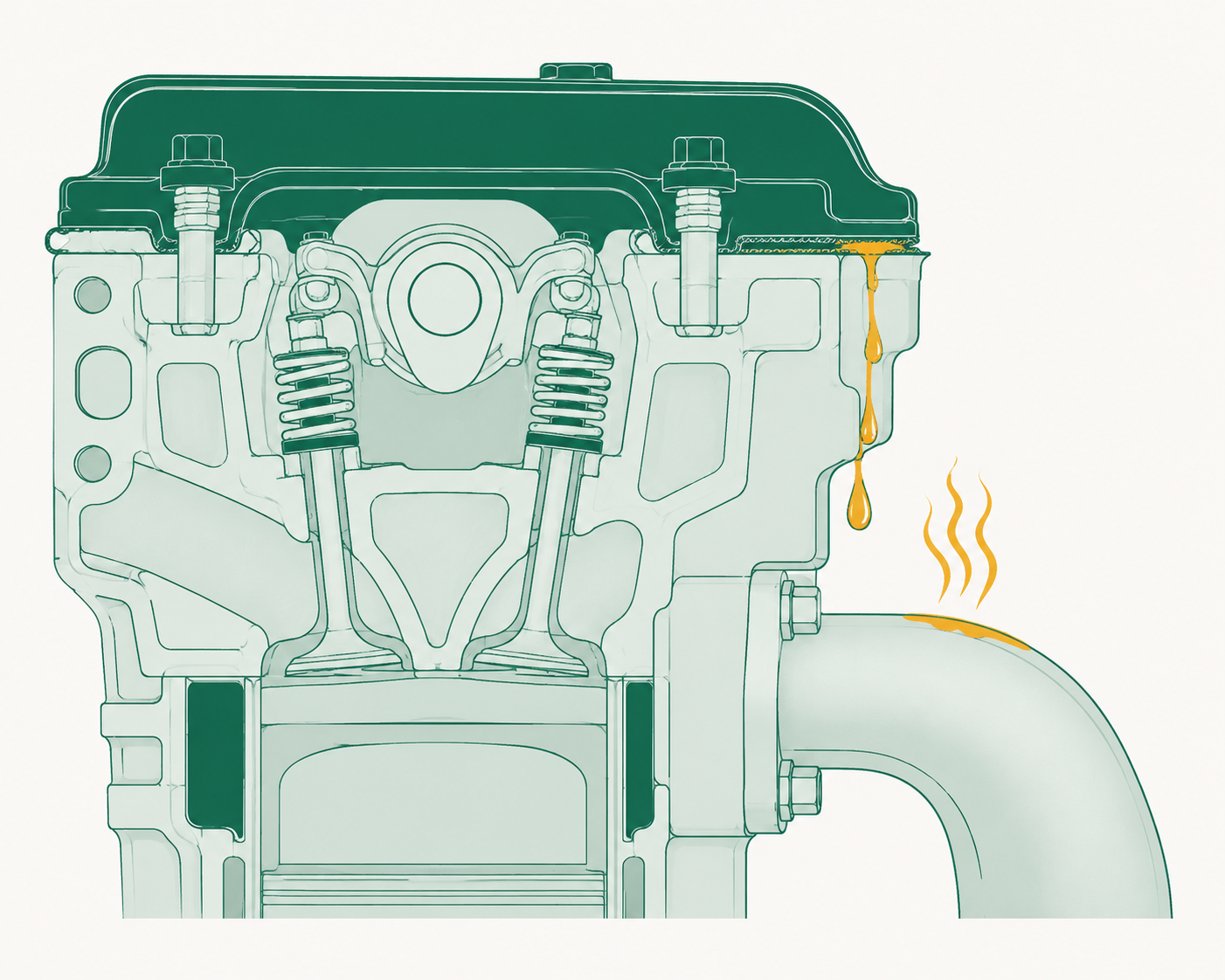
A leak that burns off is not a smaller leak than one that drips — it is a leak landing somewhere hot enough to vaporise it. That is why this one gets treated as urgent by garages and as trivial by owners.
If there is something on the ground as well, the colour and position narrow it down quickly, and our guide to what that puddle under your car is works through all six fluids. A cam cover gasket is a modest job on most engines; what makes it worth doing promptly is that the oil is landing on the hottest component under the bonnet, and that a service is the natural time to catch it.
Hot metal after a drive Stop driving
Brakes get hot — that is their entire function, converting movement into heat. A hard stop from motorway speed produces a smell that is perfectly normal and clears within minutes. What is not normal is that smell after ordinary driving, from one wheel, without you having braked hard at all.
That pattern means a brake is binding. A caliper piston that has seized in its bore, or slide pins that have rusted solid, leaves one pad pressed against the disc permanently. The car drags, that corner cooks, and the heat has nowhere to go. Left alone it destroys the pad and disc on that corner, can boil the brake fluid in the caliper, and in the worst case damages the wheel bearing next to it.
The caliper page covers what freeing or replacing one involves, and because the pad and disc on that corner have usually been cooked by the time you smell anything, pads and discs normally go with it. If the smell arrives alongside a noise rather than instead of one, our guide to squealing brakes separates the harmless noises from the expensive ones.
The one that actually smells like burning Within weeks
A slipping clutch produces the smell most people mean when they say a car smells burnt — sharp, acrid, and unmistakable once you have met it. The mechanism is simple: the clutch plate is meant to either grip the flywheel completely or be held clear of it, and slipping is the state in between. Held there, the friction material overheats and gives off exactly what a brake pad would.
It shows up after the driving that forces the issue: hill starts, stop-start traffic, towing, or a heavily loaded car. The confirming test costs nothing. In a high gear at low speed, accelerate firmly and watch the rev counter. Revs rising faster than road speed means the plate is slipping rather than driving.
What matters practically is that this does not stabilise. Once the friction material has been glazed by heat it grips less, which makes it slip more, which produces more heat. Our clutch replacement guide has the figures by model, and because the flywheel is usually inspected while the gearbox is out anyway, the clutch and flywheel page covers when that gets replaced too.
The two that mean stop, not book
Exhaust fumes in the cabin. A corroded exhaust or a failed manifold gasket can put combustion gases where the ventilation system picks them up. The smell is hot and sharp rather than oily, and the giveaway is that it gets stronger with the fan on and weaker with a window open. Carbon monoxide has no smell of its own, which is precisely why the smell of anything else exhaust-like inside a car is worth acting on rather than getting used to. An exhaust repair is one of the cheaper jobs on the list.
Anything electrical. Overheating insulation smells sharp and faintly fishy, and it usually arrives with a symptom: a fuse that keeps blowing, lights that dim or flicker, a switch that feels warm, a window that has stopped working. Sometimes it comes from a charging fault rather than the wiring itself, which is where an alternator enters the picture. Either way this is the one category on this page where the correct response is to stop the car and switch it off rather than finish the journey.
If none of the six cards fit what you are smelling, our car symptom checker works through smells alongside noises and warning lights, cheapest likely cause first.
What your MOT already told you
There is a structural reason your MOT certificate is quiet about everything on this page, and it is worth knowing: the test does not include a road test. Your car is inspected standing still, then run on rollers for the brake measurement. Nobody drives it up a hill, sits it in traffic, or takes it far enough for a caliper to cook. Every smell described here appears after driving — which is the one thing an MOT never does.
What the test does cover is the damage those smells come from, and one striking exception where the manual judges a fault by what reaches a person rather than by a measurement.
| What the tester finds | Item | Category | What it means for you |
|---|---|---|---|
| Exhaust fumes entering the cabin | 6.1.2 (b)(i) | Major | Fails. Judged by what reaches the occupants, not by a meter. |
| Exhaust fumes presenting a danger to health | 6.1.2 (b)(ii) | Dangerous | Fails. The car shouldn’t be driven away. |
| Exhaust system has a major leak or is insecure | 6.1.2 (a) | Major | Fails. Usually the corrosion that let the fumes in. |
| Any part of the noise suppression system insecure | 8.1.1 (b)(i) | Major | Fails. Heat shields live here. |
| Any part of the noise suppression system likely to become detached | 8.1.1 (b)(ii) | Dangerous | Fails. The car shouldn’t be driven away. |
| A leak forming a pool wider than 75 mm within five minutes, engine idling | 8.4.1 (a)(i) | Major | Fails — but a leak that burns off before it lands never gets measured. |
| Fluid leaking continuously and posing a serious road safety risk | 8.4.1 (a)(ii) | Dangerous | Fails. The car shouldn’t be driven away. |
| A leak of engine coolant, screen wash or AdBlue | 8.4.1 | Not a defect | Excluded by name. A leaking heater matrix fails nothing. |
| Lining, pad, disc or drum contaminated with oil or grease | 1.1.13 (b), 1.1.14 (b) | Major | Fails. Contaminated friction material is replaced, not cleaned. |
| Clutch condition | — | Not tested | No inspection exists. A slipping clutch passes every time. |
The exhaust fumes rows are unusual: almost everything else in the manual is a measurement or a visual check of a part. This one asks whether fumes are reaching the people inside — a judgement about the driver rather than the car. It is the closest the MOT comes to testing a smell.
The practical consequence runs both ways. A pass certificate is no comfort on a clutch, a binding caliper or a gasket weeping onto the manifold, because none of those are looked for. But if your last certificate carried an advisory about exhaust corrosion or oil contamination, that is a written, dated hint from someone who had the car on a ramp — and our MOT advisory decoder translates the wording.
Check it yourself in ten minutes
Do the first three straight after a drive, while everything is still hot, and the last two once the car has cooled.
- Decide inside or outside, with the fan
While driving with the smell present, switch the fan to full with the vents on recirculate, then off. Stronger with the fan means it is coming through the ventilation system.
Inside the cabin moves this from “book it” to “pull over”. - Walk round and compare wheel temperatures
Back of the hand held close to each wheel in turn, never touching. You are comparing four wheels against each other, not judging one in isolation.
One clearly hotter than the rest is a binding brake until proven otherwise. - Open the bonnet and find the smoke
Straight after a run, look along the shut line and over the top of the engine. Wisps rising from one area point at what is landing where.
Photograph it. Smoke stops before you reach the garage. - Look for baked-on oil once cold
Engine cold, look at the cam cover edges, then at the exhaust manifold and heat shields below. Fresh leaks are wet; older ones are dark, dry and crusted.
Staining above the manifold is the smell you have been chasing. - Know what this can’t tell you
Smells travel, and a hot component that has cooled tells you nothing. Nothing here identifies wiring, which is why an electrical smell skips the checklist entirely.
Anything sharp and fishy in the cabin: stop, switch off, call someone.
Worked out which one it is? See what the repair costs on your exact car before you ring a garage.
See repair costs by job and model →Burning smell FAQ
Why does my car smell like burning after driving?
Most often because oil is weeping from a gasket onto the exhaust manifold, which runs hot enough to vaporise it before it reaches the ground. That produces a strong smell and no puddle. The other common causes are a brake binding on one wheel, and a clutch that has been slipping.
Is a burning smell from a car dangerous?
It depends where you smell it. Under the bonnet after a run, it is usually a job to book rather than an emergency. Inside the cabin it is different: exhaust fumes and overheating wiring both reach you that way, and both are reasons to pull over and switch off rather than finish the journey.
What does a burning clutch smell like?
Sharp and acrid, similar to overheated brakes, and it appears after hill starts, stop-start traffic or towing. Confirm it without tools: in a high gear at low speed, accelerate firmly and watch the rev counter. Revs climbing faster than road speed means the clutch is slipping.
Why does one wheel smell hot after a normal drive?
Because that brake is binding — usually a seized caliper piston or slide pins that have rusted solid, leaving a pad pressed against the disc permanently. Hold the back of your hand near each wheel without touching: one noticeably hotter than the others confirms it. Stop and let it cool.
Does a burning smell fail an MOT?
The smell itself is not tested, and the MOT includes no road test, so most of the faults that cause one never come to light. The exception is exhaust fumes entering the cabin, which is a major defect, or a dangerous one where they present a risk to health.
Why does my car smell sweet rather than burnt?
A sweet, syrupy smell inside the car points at coolant rather than anything burning, usually a heater matrix leaking into the cabin and vaporising on the hot core. The supporting signs are a windscreen that mists faster than the weather explains and a greasy film that smears when wiped.
My car smells of burning when the heater comes on in autumn. Is that a fault?
Usually not. The heater matrix sits dry through the summer and collects dust, which burns off the first time it gets hot. The smell should be faint, should clear within a few minutes, and should not return the next time you use it. If it persists, or smells sweet rather than dusty, treat it as something else.
Can I keep driving with a burning smell?
Not without deciding which one it is first. A hot oil smell under the bonnet is a job for the next week or two. A hot metal smell from one wheel means stopping to let it cool. An electrical smell, or anything exhaust-like reaching you through the vents, means stopping and switching the engine off.