
Why does my engine rattle on a cold start?
Time it with the stopwatch on your phone — the number of seconds is the diagnosis
- Under two seconds
- Oil refilling the valve gear. Normal on most engines.
- Three to ten seconds
- Usually the timing chain tensioner. Book it in.
- Longer, or with a warning light
- Stop driving. Same-day inspection.
A rattle lasting a second or two on a cold start is normal on a great many engines — oil has drained out of the valve gear overnight and the noise stops the moment pressure returns. A rattle lasting three to ten seconds, especially one that gets longer the longer the car has stood, is usually the timing chain tensioner failing to hold oil pressure. That one is a warning, and it is worth acting on.
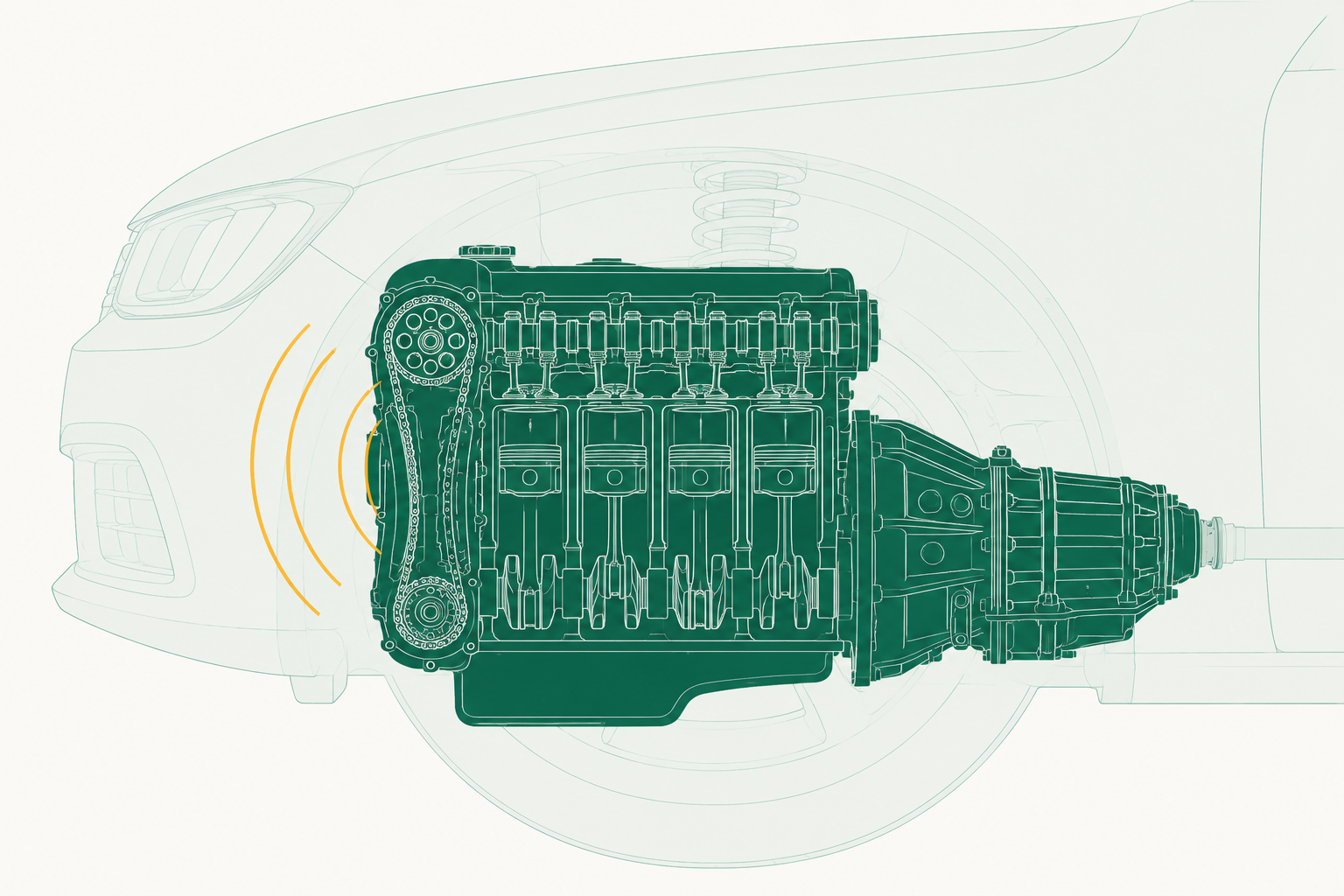
How long does it rattle?
This is the whole diagnosis, and it costs nothing. Next cold morning, start the engine and count. Not roughly — actually count, or use the stopwatch on your phone. Duration separates the harmless from the expensive far more reliably than the sound does, because nearly every cold-start rattle is the same underlying event: parts running without oil pressure for a moment.
Then do it again after the car has stood for two or three days. If the rattle is longer after a longer rest, oil is draining out of something that is supposed to hold it. Find your card below, then open it to confirm.
A light tick or tap for a second or two, then clean and quiet
Hydraulic lifters or lash adjusters refilling as oil pressure comes up.
Nothing, provided it is consistent and short.
How to be sure
The noise is tapping rather than clattering, comes from the top of the engine, and behaves the same whether the car stood overnight or a week. It should not change with revs once warm, and the oil light should go out immediately on starting.
Three to ten seconds of clattering from the timing end, worse after standing
The chain tensioner bleeding down overnight, leaving the chain slack until pressure builds.
Book an inspection within weeks, and stop extending oil changes.
How to be sure
Time it after one night, then after three or four days standing. A tensioner problem gets measurably longer with the rest; a lifter tick does not. The noise comes from one end of the engine rather than along the top of it.
A diesel-like clatter that seems to come from the bulkhead end of the engine
On some engines the chain sits at the gearbox end, so the noise reaches you from behind the engine.
Get it identified quickly — access is what makes this one expensive.
How to be sure
Open the bonnet with the engine running cold and listen along the back of the block rather than the front. If it is loudest there, and your car uses a chain rather than a belt, treat it as urgent even while it is still brief.
A rattle that arrived alongside a service interval you stretched
Sludge and worn oil starving the tensioner and the chain guides.
Fresh oil of the correct grade, then re-time the rattle after a few hundred miles.
How to be sure
Check what grade the handbook specifies and what actually went in. Thicker oil than specified takes longer to reach a tensioner on a cold morning. If an oil change shortens the rattle noticeably, that tells you the feed was the problem, not the chain.
A tinny buzz that comes and goes with revs, not with temperature
A loose heat shield or exhaust mounting resonating.
Cheap to fix, and it is an MOT item — worth doing before the test.
How to be sure
With the engine cold and off, tap along the exhaust and the shields above it. A loose shield answers back. This rattle does not care how long the car stood, which is what separates it from everything else on this page.
Rattle plus an oil warning light, a flickering oil light, or a deep knock
Oil pressure is genuinely low, whatever the cause.
Stop the engine. Do not drive it to the garage.
How to be sure
You do not need to be sure. An oil light that flickers or lingers after starting is the one symptom on this page that justifies not restarting the engine at all. A knock that deepens as you rev is the same answer.
One symptom rarely proves a diagnosis. Use this to judge urgency — and to tell the garage “eight seconds, worse after standing” rather than “it rattles”.
Why it happens when cold and not when warm
When you switch an engine off, oil drains downwards into the sump. Overnight, the galleries, the lifters and — critically — the timing chain tensioner all lose some of what they were holding. On restart there is a brief window before the pump refills everything, and in that window parts that are normally held firmly are not.
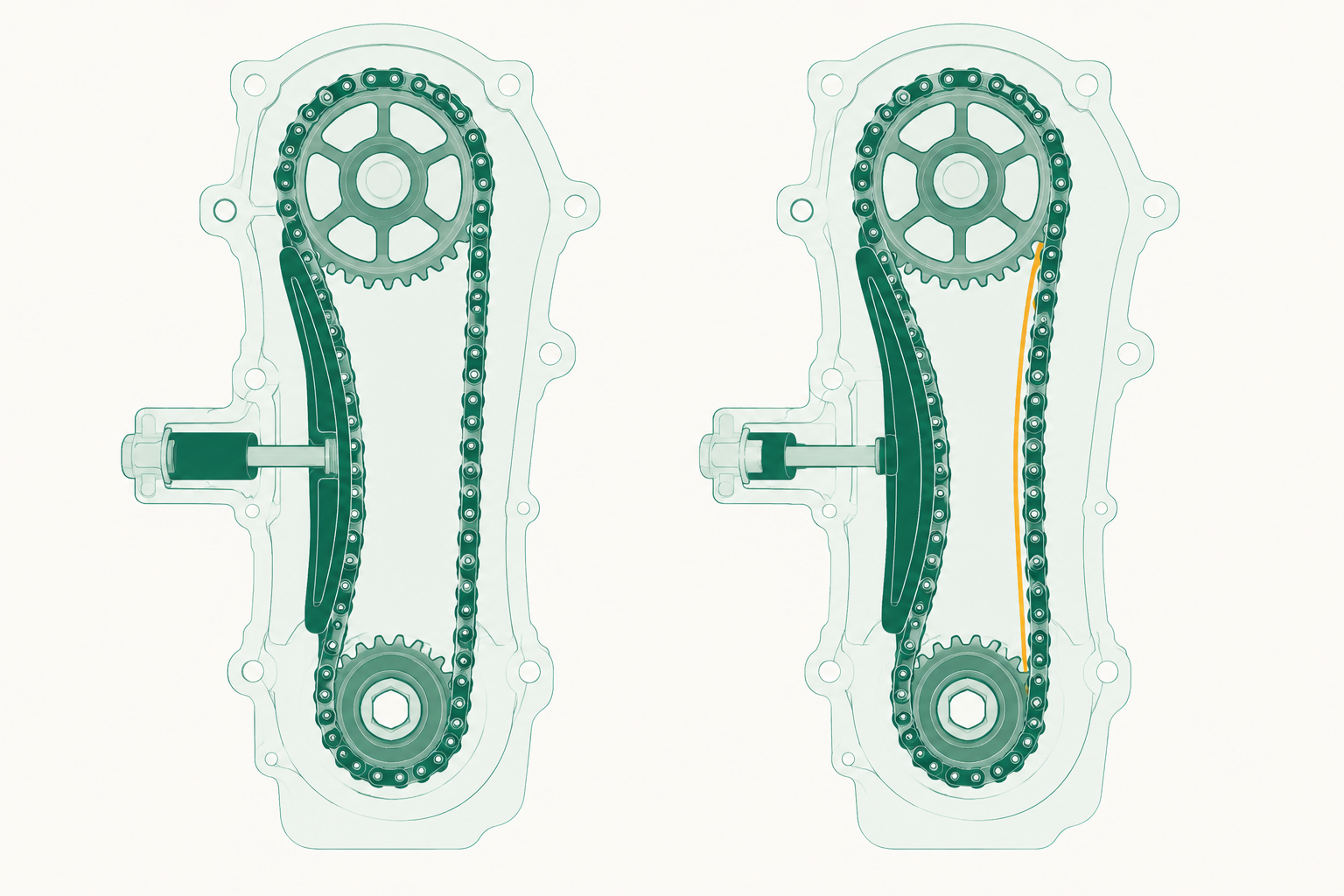
A timing chain does not run tight on its own. It is held under tension by a spring-loaded tensioner that is pressurised by engine oil, pushing against a plastic guide. Drop the oil pressure and the chain has slack in it; slack chain slaps against its guides, and that slapping is the rattle you hear. Once pressure returns, the tensioner extends, the slack disappears, and the noise stops.
Which is why the length of the noise matters more than its volume. A healthy system refills almost instantly. A tensioner with a worn seal, a blocked oil feed, or a ratchet that no longer holds takes longer — and a chain that has stretched gives the tensioner more slack to take up in the first place.
The chain tensioner, explained Within weeks
Timing chains are marketed as lifetime components, and the phrase does a lot of quiet work. It means the manufacturer does not schedule a replacement — not that the chain outlives the car. In practice chains stretch, guides wear, and tensioners fail, and the first sign of all three is the same brief rattle on startup.
A cold-start rattle is the cheapest warning a timing system ever gives you. It arrives while the chain is still doing its job, and it usually arrives months before anything skips.
What makes it worth acting on is what happens if a chain jumps a tooth. On an interference engine — which is most of them — the valves and pistons occupy the same space at different moments, and the timing gear is the only thing keeping that appointment. Lose it and the pistons meet the valves. That is not a repair, it is an engine.
Oil is the other half of the story. The tensioner is fed by the same oil that lubricates everything else, so extended service intervals, the wrong grade, and a diet of short journeys all shorten a chain’s life through the same mechanism: sludge that restricts the feed. What a service actually includes matters more on a chain engine than on a belt one, because the belt at least has a scheduled replacement to catch problems.
If your car turns out to have a belt rather than a chain, the calculation changes completely: belts are replaced on a schedule, and a rattle is not how they announce themselves. Our cambelt or chain checker answers which one you have by engine.
Which engines are known for it
Some engine families have a documented reputation here, and knowing whether yours is one of them changes how urgently you treat a short rattle.
BMW’s N47 diesel is the well-known case, and the reason is geometry rather than metallurgy: the chain sits at the gearbox end of the engine rather than the front. Access means removing the engine or the gearbox, which turns a chain job into one of the most expensive routine repairs on any mainstream car. The BMW 3 Series timing page covers which engines are affected and what the work involves.
The VAG 1.4 TSI and early 2.0 TSI had tensioner designs that were revised more than once, and a rattle on these is usually the tensioner rather than the chain. Both the Audi A3 and VW Golf pages set out which engine got which version, because the same badge on the boot can mean either.
Small turbocharged petrols with belts running in oil are a different failure entirely, and worth knowing about because owners often mistake one for the other. A wet belt degrades into the oil rather than snapping, and the debris blocks the oil pickup — so the noise you hear is low oil pressure, not slack timing. The wet belt guide explains which engines use one and what the symptoms actually are. Honda’s 1.0 VTEC Turbo is the surprise entry on most owners’ lists.
Rattles that aren’t the timing gear
Heat shields. Thin steel panels spot-welded above the exhaust, and the first thing to corrode loose underneath a British car. They buzz at particular engine speeds and are unrelated to temperature or standing time. Cheap, and an exhaust and shield fix is worth doing before an MOT rather than after.
Catalytic converter internals. The ceramic honeycomb inside can break up and rattle like gravel in a tin. The test is crude and reliable: with the exhaust cold, rock it firmly by hand and listen. A broken cat also tends to bring an engine management light with it.
The dual-mass flywheel. Rattles at idle rather than only on startup, and the giveaway is the clutch pedal: press it and the noise usually changes or stops, because you have just unloaded the springs inside it. The clutch and flywheel page covers how that job differs from a plain clutch.
Auxiliary belt tensioner or a pulley. This one whirrs or rattles from the front of the engine at all temperatures, and it often arrives with a squeal. It is a fraction of the cost of anything to do with timing, which is exactly why it is worth ruling out first — a failing alternator pulley can sound alarmingly like a chain to anyone standing over the engine.
If none of these fit, our car symptom checker works through engine noises alongside everything else the car is doing, cheapest likely cause first.
What your MOT already told you
Here is the part that surprises most owners, and it is worth knowing before you take any comfort from a pass certificate: the MOT does not inspect your timing chain or your cambelt. Neither appears anywhere in the inspection manual as a test item. A car can pass its test on the same morning that its chain rattles for ten seconds on the driveway.
What the test does cover are the things that rattle for other reasons — and one strange, revealing exception.
| What the tester finds | Item | Category | What it means for you |
|---|---|---|---|
| Timing chain or cambelt condition | — | Not tested | No inspection exists. A pass says nothing about either. |
| Any part of the noise suppression system insecure | 8.1.1 (b)(i) | Major | Fails. This is where a loose heat shield lands. |
| Any part of the noise suppression system likely to become detached | 8.1.1 (b)(ii) | Dangerous | Fails. The car shouldn’t be driven away. |
| Exhaust system has a major leak or is insecure | 6.1.2 (a) | Major | Fails. Often the same corrosion that freed the shield. |
| Engine mounting severely damaged, causing excessive movement | 6.1.8 (a)(i) | Major | Fails. A collapsed mount turns normal vibration into a knock. |
| Engine mounting fractured, missing or excessively loose | 6.1.8 (a)(ii) | Dangerous | Fails. The car shouldn’t be driven away. |
| Engine management light inoperative or indicating a malfunction | 8.2.1.2 (h) petrol, 8.2.2.2 (g) diesel | Major | Fails. A timing fault severe enough to log a code fails here. |
| Smoke test not carried out because of abnormal engine noise, or a camshaft belt in unsatisfactory condition | 8.2.2.2 | Refusal to test | Recorded on a VT30. The tester judged it unsafe to rev. |
That last row is the only place a cambelt appears in the entire manual — as a reason a diesel tester may refuse to run the smoke test at all. The one official mention of your timing system is a safety warning to the person testing your car, not a check on your behalf.
The practical consequence is that timing gear is one of the few major systems where nobody is watching except you. Everything else on your car gets looked at annually by someone with a ramp. This does not — so a rattle you can time on your own driveway is a more informative piece of evidence than anything on your last certificate. If that certificate did mention noise or an engine light, our MOT advisory decoder translates the wording.
Check it yourself in five minutes
No tools, no ramp. You need a genuinely cold engine — parked overnight, not one that ran an hour ago.
- Time it properly
Stopwatch running before you turn the key. Note the number of seconds from firing up to silence, and write it down with the date.
One number, recorded twice, beats any amount of describing the sound. - Repeat after the car has stood longer
Time it again after two or three days parked. Compare with your overnight figure.
Longer after a longer rest means something is draining that shouldn’t. - Locate which end it comes from
Bonnet open, engine cold and running, stand at the front then to one side. Timing gear sits at one end of the engine; valve gear runs along the top.
Loudest at the bulkhead end usually means a rear-mounted chain. - Rule out the cheap suspects cold
Engine off, exhaust cold. Tap along the heat shields, then rock the exhaust and the catalytic converter by hand.
If it answers back when tapped, it isn’t your timing chain. - Check the oil, then check what grade it is
Dipstick on level ground, cold. Then compare the grade in the handbook with whatever the last invoice says went in.
A tensioner is fed by that oil. Wrong grade or long overdue is a cause, not a detail.
What waiting actually costs
The honest position is that a two-second rattle may never become anything, and plenty of engines make one for years. But the failure mode at the other end of this is unusually harsh, and it does not give a second warning. A chain that skips takes the valves with it, and on most engines that ends the car rather than the repair.
The cost curve is also steeper than most jobs. A tensioner caught early is a modest repair on many engines. A full chain kit is a bigger one. A chain kit on an engine with the timing gear at the gearbox end means removing the engine or the box to get at it — the same parts, several times the labour. And a chain that has already jumped means a cylinder head off, at best.
For figures on your car rather than a general range, our cambelt and timing cost guide breaks it down by model and by engine, including which cars use a chain, which use a belt, and which use a belt that runs in oil.
Rattling on every cold start? See what timing work costs on your exact car before you ring a garage.
See timing costs by model →Cold-start rattle FAQ
Is it normal for an engine to rattle for a second on startup?
On many engines, yes. Oil drains out of the valve gear when the engine is switched off, and there is a brief moment on restart before pressure returns. A light tick lasting a second or two, consistent whether the car stood overnight or for a week, is usually hydraulic lifters refilling and needs no action.
How long is too long for a cold-start rattle?
Anything beyond about three seconds is worth investigating, and anything that lengthens as the car stands longer is worth investigating promptly. Time it with a stopwatch after one night and again after three days. The comparison between those two numbers tells you more than the total does.
Does a rattling timing chain mean the engine is about to fail?
Not immediately. A rattle usually appears while the chain is still doing its job, which is precisely why it is useful. What it does mean is that the tensioner, the guides or the chain itself are worn, and that the failure at the end of that road is severe — a chain that skips a tooth lets the valves and pistons meet.
Are timing chains really lifetime components?
Only in the sense that manufacturers do not schedule a replacement. Chains stretch, plastic guides wear and tensioners fail, and none of that is covered by a service. Oil quality and change intervals affect chain life more than mileage does, because the tensioner is fed by the same oil as everything else.
Can changing the oil stop a cold-start rattle?
Sometimes, and it is worth trying first. If the oil is old, sludged or a thicker grade than the handbook specifies, it reaches the tensioner more slowly on a cold morning, which lengthens the rattle. If fresh oil of the correct grade shortens it noticeably, the feed was the problem. If it changes nothing, the wear is mechanical.
Does the MOT check my timing chain or cambelt?
No. Neither appears in the inspection manual as a test item, so a pass certificate says nothing about either. The only mention of a cambelt anywhere in the manual is as a reason a tester may refuse to carry out the diesel smoke test, on the grounds that revving the engine would be unsafe.
Why does my engine only rattle after standing for several days?
Because whatever should be holding oil has had longer to drain. A hydraulic tensioner that leaks down slowly may still be full after one night and largely empty after four, so the chain has more slack to take up and the noise lasts longer. That pattern is one of the more reliable pointers to a tensioner rather than lifters.
Could the rattle be something other than the engine?
Frequently. Loose heat shields, broken catalytic converter internals, a worn dual-mass flywheel and a failing auxiliary belt tensioner all rattle, and none of them care how long the car stood. Test the cheap ones cold: tap the shields, rock the exhaust, and press the clutch pedal at idle to see whether the noise changes.