
Car judders when pulling away — clutch, flywheel or something cheaper
Usually the clutch friction face, sometimes the flywheel behind it — and sometimes a mounting that costs a fraction of either.
How to tell the three apart before you get a quote, and why none of them appear on an MOT.
- Judder only while the clutch is slipping
- The friction face. It never recovers, and it takes the flywheel with it if you wait.
- Judder plus a rattle at idle that stops when you press the pedal
- Dual-mass flywheel. The expensive version — and the one to diagnose before ordering parts.
- Judder with a clonk, and it does it in reverse too
- Mountings or drive shaft joints. Cheapest outcome on this page, so rule it out first.
A car that judders when pulling away is almost always telling you the clutch friction face no longer grips smoothly — it grabs and releases many times a second instead of taking up drive in one clean movement. Behind that sit two other suspects: a failing dual-mass flywheel, and worn engine or gearbox mountings letting the whole drivetrain rock. The three cost very different amounts, so the order you check them in matters.
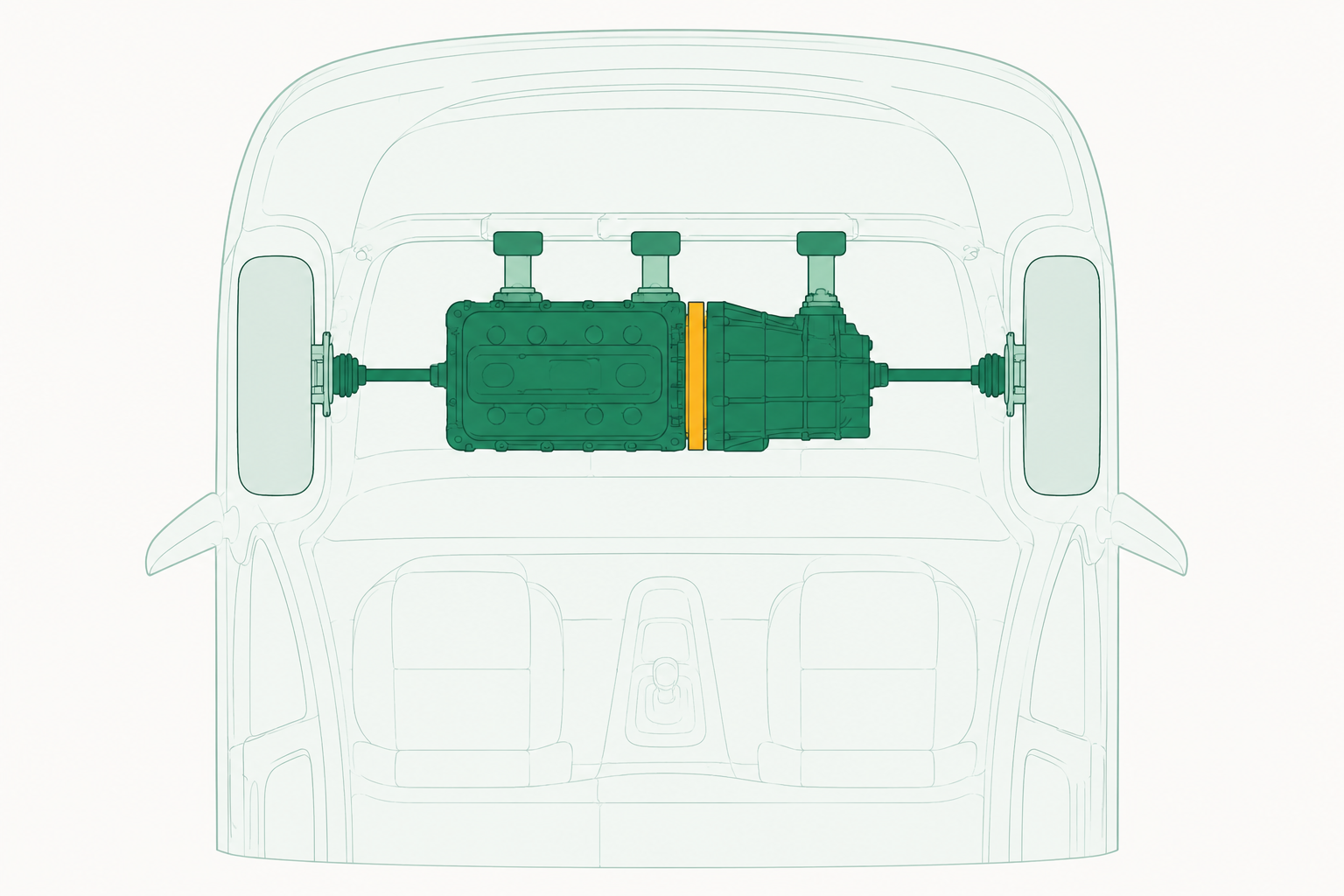
What judder actually is
Pulling away is the one moment when the engine and the wheels are turning at different speeds and something has to bridge the gap. The clutch does it by letting two surfaces slip against each other under spring pressure, gradually matching one speed to the other. Done properly you feel a single smooth engagement.
Judder is that engagement happening in rapid bursts instead. If the friction face has hard, glazed patches or an uneven high spot, grip changes as the plate turns: it bites, the drivetrain winds up, the bite eases, the drivetrain springs back. That cycle repeats many times a second and arrives through the floor and the seat as a shudder that vanishes the instant the clutch is fully home.
Which is the single most useful thing to know about the symptom. A clutch fault can only exist while the clutch is slipping, so it can only be felt in the seconds between the pedal starting to lift and the drive being fully taken up. Anything that judders once the clutch is fully engaged, or that judders in an automatic with no clutch pedal at all, belongs somewhere else — and the cards below sort that out.
Shudder in the first moment of taking up drive, worst on a hill or with the car loaded
The friction face has gone uneven or glazed. The classic clutch judder, and the commonest case.
Book it in. It gets worse, and a slipping clutch eventually damages what it runs against.
How to be sure
Load is the test. Find a gentle incline, pull away deliberately slowly and note whether the shudder grows. A worn face is worst when it is asked to transmit the most torque through the smallest contact, which is exactly a loaded hill start. If the same slow, careful pull-away on the flat is smooth and the hill is awful, the friction face is the thing being asked too much.
Rattle from the gearbox area at idle in neutral, which stops when you press the clutch pedal
A dual-mass flywheel whose internal springs and damping have worn out.
Get it diagnosed before anyone orders a clutch kit. This changes the size of the job.
How to be sure
The pedal is the switch. Sit in neutral, engine warm and idling, and listen with a window down; then press the clutch pedal to the floor. If the rattle disappears while your foot is down and returns when you lift, the noise is coming from the flywheel assembly rather than the engine. Cold-start rattles that fade as the engine warms are a different subject — see our guide on engine rattle on a cold start.
Judder plus a sharp acrid smell after a hill start, and the revs rise without the car keeping up
The clutch is slipping badly enough to overheat. Grip is going, not just going uneven.
Stop using it for hills and loads and get it in now. Heat is what turns a clutch job into a flywheel job.
How to be sure
Watch the rev counter rather than feeling the pedal. In a high gear at low speed, accelerate firmly: if the revs climb faster than the road speed, the clutch is slipping. Our guide to burning smells from a car separates that smell from the several other things that can produce one.
A clonk as drive is taken up or released, and the judder happens in reverse as well
Worn engine or gearbox mountings, or a drive shaft joint. The clutch may be fine.
Have the mountings checked first. This is the cheapest thing on this page by a long way.
How to be sure
Do it with the bonnet up and the handbrake firmly on. Watch the top of the engine while a helper takes up drive very gently in first, then in reverse. Sound mountings allow a small, damped movement; worn ones let the engine lurch and settle back with a knock. A fault that behaves identically forwards and backwards is pointing at mountings or shafts rather than at a friction face.
Started shortly after a new clutch was fitted
Usually the flywheel that the new clutch was bolted to, or an oil leak nobody dealt with.
Take it back to whoever did the work. This is a rework conversation, not a new quote.
How to be sure
Timing is the evidence, and the questions are specific. Ask whether the flywheel was replaced or reused, whether it was measured, and whether the crankshaft and gearbox input seals were checked while the gearbox was out. A new friction plate on a worn flywheel or against a weeping seal will judder within months, and all three questions have to be answered before parts get ordered again.
An automatic or twin-clutch gearbox that shudders at low speed, with no clutch pedal involved
Torque converter shudder, or wet clutch packs and their fluid. A different system with a different fix.
Have it diagnosed as a gearbox matter. Do not let it be priced as a manual clutch.
How to be sure
Note the exact conditions: a converter shudder typically appears at a light throttle at a steady low speed, not while accelerating hard from rest. Fluid condition and service history matter far more here than they do on a manual, so take the record with you — our gearbox repair cost page covers where this ends up.
What goes wrong on the friction face
Glazing. Friction material is meant to wear slowly and evenly, presenting a matt surface that grips consistently. Repeated slipping without enough load — riding the pedal in traffic, holding the car on a hill with the clutch instead of the brake — polishes patches of it hard and shiny. A glazed patch grips differently from the matt material either side of it, and that difference is what your seat feels.
Oil. The clutch lives in a sealed housing between two oil-filled assemblies, with a crankshaft seal on one side and a gearbox input shaft seal on the other. A seal that weeps puts a film of oil onto a surface whose entire job is friction. It takes remarkably little: a leak far too small to notice on the driveway will contaminate a friction face and produce judder and then slip. This is the reason a good garage looks at both seals while the gearbox is out, and the reason a cheap clutch job can come back.
Distortion. Severe heat from a slipping clutch can leave the friction plate or the pressure plate no longer perfectly flat, and a plate that is not flat cannot make even contact however good the material on it. This is usually a consequence of the other two rather than a cause on its own.
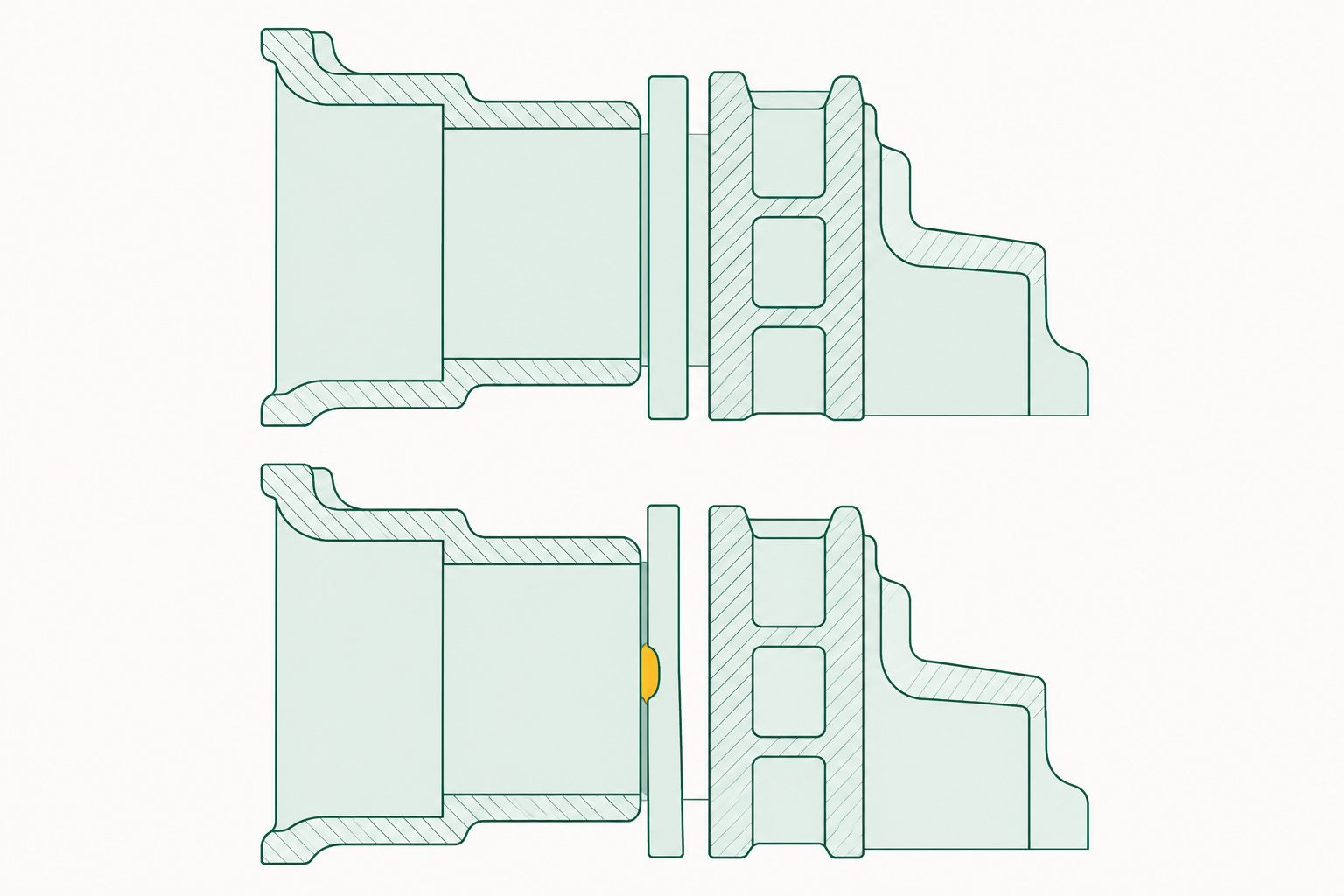
The oil leak that ruins a clutch is much smaller than the one an MOT can fail. The test only rejects a fluid leak that pools more than 75mm across within five minutes with the engine idling. A seal weeping a few drops a week is nowhere near that — and it is more than enough to contaminate a friction face. Our page on the oil leak not excessive advisory covers what that line on a certificate is really warning you about.
The dual-mass flywheel, and why it changes the bill
A conventional flywheel is a single lump of iron. A dual-mass flywheel is two discs connected through springs and friction elements, designed to absorb the pulses a modern engine sends into the drivetrain — which is why they became common on diesels and small turbocharged petrols in the first place, and why those cars are so quiet at idle.
Everything inside one wears. As the springs and damping tire, the two halves develop more free movement than they should, and the assembly starts letting the drivetrain oscillate rather than damping it. That produces judder on take-up and, very often, the rattle at idle that stops when you press the pedal — pressing the pedal unloads the assembly and the noise goes with it.
The reason it matters commercially is that it cannot be resurfaced or reused. A single-mass flywheel can often be machined flat and put back. A dual-mass one is a sealed assembly with a wear limit, so a car that needs one needs a new part, and the price gap between a clutch kit and a clutch kit plus flywheel is the single biggest variable in this whole repair. Both routes are priced on our clutch replacement cost page, with the flywheel version broken out on clutch and flywheel cost.
What you should not accept is a guess in either direction. Fitting a new clutch to a tired dual-mass flywheel is how a repair comes back inside a year; replacing a healthy flywheel because it was easier to include is how a bill grows by hundreds for nothing. It is measurable, and the measurement is the whole point of paying for a diagnosis.
When it is not the clutch at all
Start with the cheapest possibility, because it is genuinely common and it is the one people skip. Engine and gearbox mountings are rubber and hydraulic parts that hold a very heavy assembly and absorb the twist it produces every time drive is taken up. When one collapses, the whole engine and gearbox rock on take-up and settle back with a knock, and the shudder that reaches you feels exactly like a clutch on its way out. The difference is that a mounting behaves the same in reverse and the same at any temperature, and the fault is visible to anyone who watches the engine while drive is applied.
Drive shaft joints are next. The inner joint on each shaft handles plunge as the suspension moves, and a worn one can shudder under load in a way that comes and goes with steering angle. This is the one place where the protective boots matter: a split boot lets grit into a joint that was full of grease, and once that has happened the joint is on borrowed time. The wording you may see on a certificate is explained on our CV boot deteriorated advisory page.
Automatics deserve their own sentence, because the language transfers badly. There is no friction plate to wear out in the way a manual has one; a shudder at light throttle usually implicates the torque converter or the fluid, and a twin-clutch box has its own wet clutch packs with their own service requirements. Anyone quoting you for a clutch on an automatic without a diagnosis has skipped a step.
Making the next one last
Clutch life varies enormously between two identical cars, and almost all of the difference is in how the pedal gets used. Four habits do nearly all the damage, and all four are free to change.
Holding the car on a hill with the clutch instead of the brake or handbrake makes the plate slip for as long as you wait, at the exact combination of high load and low airflow that glazes and overheats it. Resting a foot on the pedal while driving keeps the pressure plate slightly unloaded, so the plate slips imperceptibly for miles at a time. Pulling away at high revs asks the face to absorb a large speed difference all at once, and the energy goes in as heat. And sitting in traffic in gear with the pedal down loads the release mechanism and the flywheel assembly needlessly — neutral and a released pedal costs nothing.
The other half of the job belongs to whoever fits it. The seals either side of the housing should be inspected while the gearbox is out, because access afterwards costs the same labour again. That single decision is the difference between a clutch that lasts as long as the last one and a repair you meet twice.
What your MOT already told you — and what it could not
Here is the part that surprises people who assume a recent pass means the expensive things are fine. The manual has a whole sub-section on transmission, and it lists prop shafts, drive shafts, their couplings and bearings, and drive chains and belts. It does not list the clutch, the flywheel or anything inside the gearbox.
| What the tester checks | Defect code | Category | What it means for you |
|---|---|---|---|
| Engine or gearbox mounting deteriorated enough to allow excessive movement | 6.1.8 (a)(i) | Major | The cheap cause of judder is testable — but only once the movement is obvious |
| Mounting fractured, missing or excessively loose | 6.1.8 (a)(ii) | Dangerous | The severe version. Note the manual counts mountings bolted to the gearbox too |
| A drive shaft joint or coupling excessively worn | 6.1.7 (c)(i) | Major | Shafts and joints are inspected. What they connect to is not |
| A CV joint boot severely deteriorated | 6.1.7 (g)(i) | Minor | A perished boot on its own passes. Only a split one that lets dirt in is a Major |
| A fluid leak pooling more than 75mm across within five minutes | 8.4.1 (a)(i) | Major | Far more than the leak needed to ruin a clutch. Coolant is not a failure item at all |
| A brake pad contaminated with oil or grease | 1.1.13 (b) | Major | The same seal that spoils a clutch fails the test the moment its oil reaches a pad |
| The clutch, as a driving control | 6.2.7 | Major | The only mention of the word in the manual — and it applies to large passenger vehicles, not to cars |
Read that last row again, because it is the whole point of this section. The word clutch appears once in the inspection manual, in a sub-section on driving controls that applies to large passenger vehicles. For an ordinary car there is no clutch check, no flywheel check and no gearbox check of any kind.
So a pass certificate is silent on the single most expensive mechanical repair most drivers ever face. It is not that testers overlook it — they are not asked to look. The judder you can feel from the driver’s seat is information the test does not collect.
What the test does give you is the surrounding evidence, and it is worth reading in that light. A mounting advisory tells you movement was noticeable but not yet excessive. A CV boot advisory tells you grit is about to reach a joint. An oil leak advisory tells you a seal is weeping — and on a car that is starting to judder, that line is a very strong hint about which seal and what it has been landing on.
Our page on what MOT advisories mean explains how that language is chosen, and how to read your MOT history shows how to spot the same item repeating across tests, which is the pattern that matters. To decode a specific line from your certificate, paste it into the MOT advisory checker. For what the test covers in general, see MOT cost.
Check it yourself in five minutes
-
Confirm it only happens while the clutch is slipping
Pull away and note precisely when the shudder stops. If it disappears the moment the pedal is fully up and the car is driving, it is a clutch-family fault. If it carries on afterwards, look at wheels, shafts and mountings instead.
-
Try it in reverse
Reverse gently up the same slope you tried forwards. A friction face fault usually behaves differently in reverse; mountings and shafts behave the same. This one test separates the cheap outcome from the expensive one.
-
Listen at idle, then press the pedal
In neutral with the engine warm, listen for a rattle from the gearbox area, then push the clutch pedal down. A rattle that goes away while your foot is down and returns when you lift points at the dual-mass flywheel.
-
Watch the engine move
Bonnet up, handbrake hard on, a helper taking up drive very gently. A small damped movement is normal. A lurch and a knock means a mounting, and that is a much smaller bill than anything inside the housing.
-
Ask what the flywheel measured — this is the bit you cannot do
Whether the flywheel is within its wear limit can only be established with the gearbox out and a measurement taken. Nothing you can feel from the seat distinguishes a clutch job from a clutch and flywheel job, and that distinction is most of the price. Ask for the figure, not an opinion.
One more thing no home test can settle: whether a seal has been leaking onto the friction face. It is invisible until the gearbox comes off, and it is the reason two identical quotes can produce very different outcomes twelve months later. Ask specifically whether the crankshaft and gearbox input seals will be inspected while access is free.
What a garage will actually do
Before anything is dismantled, the cheap causes should be eliminated: mountings checked under load, drive shafts and joints inspected, and on an automatic the fluid and its history looked at. That inspection costs a fraction of the repair and occasionally ends the story there.
If it is the clutch, the gearbox has to come out, which is most of the labour on the job whatever is found inside. With access open, the friction plate, pressure plate and release mechanism are assessed, the flywheel is measured against its limit, and both oil seals are inspected. Clutch parts are replaced as a kit rather than individually, because mixing a new plate with a used pressure plate reintroduces exactly the uneven contact you are paying to remove.
Ask three questions and you will avoid nearly every bad version of this repair. Was the flywheel measured, and what did it measure. Are the crankshaft and gearbox input seals being renewed or reused. And is the quote a kit price or a kit-plus-flywheel price, so a phone call halfway through the job is not the first you hear of it. If a figure arrives that you want tested against the market, our repair quote checker does that, and on an older car it is worth running the numbers through is my car worth fixing before committing — this is one of the repairs that can outrun a car’s value. Where you have it done also moves the total noticeably, which is what our comparison of independent garages and main dealers is for.
Clutch replacement priced by make and model, with and without the flywheel, and what the same job costs at a dealer.
See clutch pricesFAQ
Why does my car judder when pulling away?
Because the clutch friction face is no longer gripping evenly. Glazed or contaminated patches grip differently from the material around them, so the clutch bites and releases many times a second instead of engaging once. Worn engine mountings and a failing dual-mass flywheel produce a very similar shudder.
Is clutch judder dangerous to drive with?
It is not usually a stop-driving fault, but it always gets worse and it can leave you unable to pull away at all. If the revs rise without the car keeping up, or there is a sharp burning smell after hill starts, the clutch is slipping and heat is doing damage that makes the eventual repair larger.
How do I know if it is the clutch or the flywheel?
Listen at idle in neutral, then press the clutch pedal. A rattle from the gearbox area that stops while your foot is down and returns when you lift points at a dual-mass flywheel. The certain answer needs the gearbox out and the flywheel measured against its wear limit.
Can a clutch judder be fixed without replacing it?
Rarely. Once the friction face is glazed, contaminated by oil or no longer flat, there is nothing to adjust and nothing to clean. The exception is when the judder is coming from a worn mounting or a drive shaft joint rather than the clutch, which is why those should be ruled out first.
Why did my new clutch start juddering?
Usually because the flywheel was reused when it was past its limit, or an oil seal was left weeping onto the new friction face. Both are avoidable with the gearbox out and both are fair questions to put to whoever did the work, as a rework rather than a fresh quote.
Does the MOT check the clutch?
No. The word appears once in the inspection manual, under driving controls, and that sub-section applies to large passenger vehicles rather than cars. There is no clutch, flywheel or gearbox check on an ordinary car, so a pass certificate says nothing about any of them.
What makes a clutch wear out early?
Holding the car on a hill with the clutch instead of the brake, resting a foot on the pedal while driving, pulling away at high revs, and sitting in traffic in gear with the pedal held down. All four make the friction face slip when it should be either fully engaged or fully free.
Why does my automatic shudder if it has no clutch pedal?
Because the shudder is coming from a different system. On a torque converter automatic it usually implicates the converter or the fluid, and a twin-clutch gearbox has wet clutch packs with their own service needs. It should be diagnosed as a gearbox matter, not priced as a manual clutch.