
Why does my car hum louder the faster I go?
One test at forty miles an hour separates a wheel bearing from your tyres
- Changes as you steer
- A wheel bearing. Book it in within weeks.
- Ignores the steering
- Tyres or alignment. Check the wear pattern.
- Heat or smell from one wheel
- Stop. Binding brake, or a bearing collapsing.
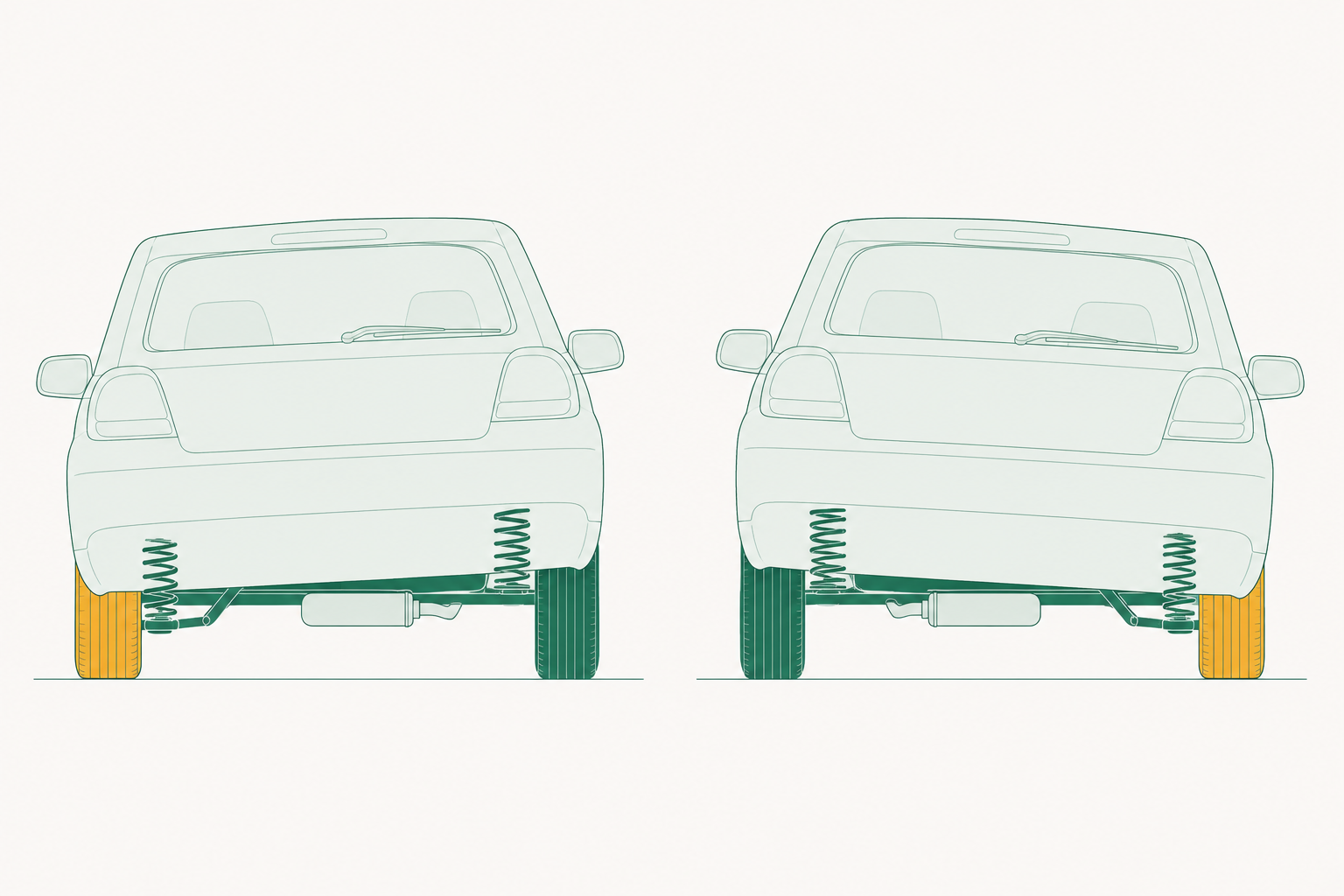
A hum or drone that gets louder as the car goes faster is almost always coming from something that turns with the wheels — a wheel bearing or the tyres. One test separates them. At a steady speed on an empty road, weave gently within your lane. If the noise gets louder one way and quieter the other, it is a wheel bearing. If it ignores the steering completely, look at your tyres.
First: does it follow speed, or revs?
Before anything else, work out what the noise is tied to, because that halves the list of suspects immediately. Get to a steady speed, then change gear. If the pitch stays the same while the revs change, the noise follows road speed, which means something rotating with the wheels: bearings, tyres, brakes, driveshafts.
If the pitch rises and falls with the rev counter instead, you are listening to the engine, its ancillaries or the gearbox, and this is the wrong guide — our cold-start noise guide and the symptom checker cover those.
The second useful observation is character. A wheel bearing produces a drone or growl, deep and mechanical, sometimes with a faint rhythmic edge to it. Tyre noise is broader and more like rushing — closer to road roar than to a machine. Both get louder with speed, which is exactly why so many people replace tyres to cure a bearing.
What the noise is telling you
Find your card, then open it to confirm. Where two sound plausible, work on the more urgent one until you have ruled it out.
The hum gets louder one way and quieter the other when you weave gently
A worn wheel bearing on the side that gets louder when loaded.
Book it within weeks. It will not stabilise.
How to be sure
Load transfers to the outside of a turn, so a bearing usually shouts when its own side is loaded. Steering gently left loads the right-hand wheels: if the noise grows, look right. Repeat both ways twice before deciding, on a quiet road at a steady speed.
A steady roar that ignores the steering entirely, worse on smooth tarmac
Uneven tyre wear — usually feathered or cupped tread from alignment or worn suspension.
Check the tread by hand, then get the alignment looked at.
How to be sure
Run a palm across the tread from inner edge to outer, then the other way. Feathered tread feels smooth one direction and like a saw the other. Cupped tread has high and low patches around the circumference. Both roar, and neither cares what the steering is doing.
The noise appeared the day new tyres were fitted
A different tread pattern or compound. Nothing is wrong.
Nothing, provided it has not changed since.
How to be sure
The timing is the whole answer, and the test is whether it is getting worse. A bearing deteriorates week by week; a tread pattern sounds identical in six months. If a new set is noticeably louder than the old, that is the tyre, not the car.
A whine that changes when you lift off and comes back when you accelerate
Transmission or final drive rather than a bearing — the load path changes when you coast.
Get it diagnosed before assuming a bearing and paying for one.
How to be sure
At a steady speed, lift off the accelerator without braking, then gently reapply. A bearing barely notices; a driveline whine usually changes clearly between drive and overrun. The steering test does nothing here, which is the second clue.
Humming plus heat or a hot smell from one wheel after a drive
A binding brake, or a bearing far enough gone to be generating its own heat.
Stop and let it cool. Do not carry on to see whether it settles.
How to be sure
Hold the back of your hand near each wheel in turn without touching. One markedly hotter than the others settles it. Our burning smell guide covers how to tell a binding brake from everything else that smells hot.
Humming with vibration through the steering wheel, or a wheel that feels vague
Play rather than roughness — the bearing is no longer holding the wheel where it should be.
Stop driving and get it recovered rather than driven.
How to be sure
You do not need to be sure. Roughness is a noise problem and gives you weeks. Play is a security problem, and the inspection manual grades it as dangerous once it reaches the point of affecting directional control. Vibration through the wheel is the symptom that separates the two.
One symptom rarely proves a diagnosis. Use this to judge urgency — and to tell the garage “drone from about forty, louder when I steer left” rather than “there’s a noise”.
The weave test, done safely
This is the single most useful thing on this page, and it costs nothing. The principle is simple: a car leans in a turn, transferring weight onto the outside wheels. A worn bearing gets noticeably louder when it is the one carrying the load.
Do it on a quiet, straight, dry road with nothing behind you, at a steady forty or so. Not a swerve — a gentle drift from one side of your lane to the other and back, the sort of movement you would make avoiding a pothole. Steer gently left, listen, then gently right, listen. Repeat twice before concluding anything, because the first run is always spent working out what you are listening for.
Reading the result: steering left transfers load onto the right-hand wheels. If the hum grows when you steer left, the noisy bearing is on the right. If it grows steering right, it is on the left. If both directions sound identical, the noise is not load-sensitive and you are looking at tyres or driveline instead.
One honest caveat. On a car with two worn bearings on the same axle, the test can come back ambiguous, because there is a noisy bearing on both sides. Ambiguity is itself a result: it points at bearings rather than away from them.
What a wheel bearing actually does Within weeks
A wheel bearing is the only thing holding your wheel square to the car while letting it spin freely. Inside is a set of hardened steel balls or rollers running between two precisely machined tracks, packed with grease and sealed for life. It carries the weight of that corner of the car, plus every cornering and braking force, several hundred times a minute.
Failure is nearly always the seal first. Once water or grit gets past it, the grease is contaminated, the polished tracks get scored, and every pass of every roller over a scored track makes a small noise. Multiply that by the number of rotations at motorway speed and you get a drone.
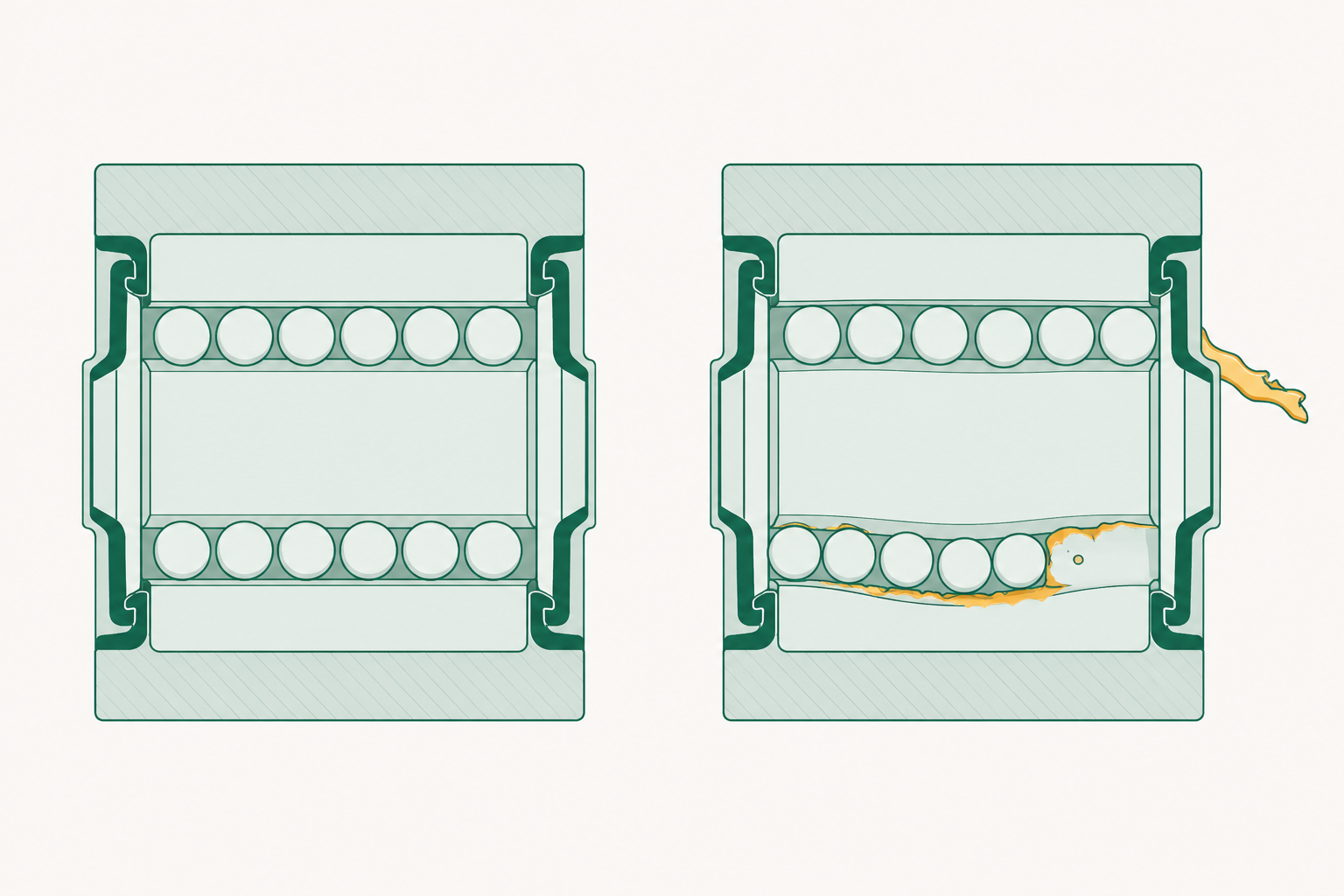
Noise and play are two different stages of the same failure. A rough bearing is a noise problem that gives you weeks. A bearing with play has stopped holding the wheel in position, and the manual grades that as dangerous once directional control is affected.
That progression is why nobody sensible tells you to ignore a hum. It also explains the price difference between doing it now and doing it later: a wheel bearing replacement caught early is a contained job, while a bearing that has been left long enough to damage the hub, the driveshaft splines or the wheel speed sensor takes several other parts with it.
When it is the tyres after all
Tyres make noise by design — that is what a tread pattern does — but a tyre wearing unevenly makes considerably more of it, and the wear pattern tells you why.
Feathering means each tread block is worn to a ramp, sharp on one edge and rounded on the other. It is caused by the tyre being dragged very slightly sideways every metre, which is what a misaligned wheel does. You can feel it with a palm long before you can see it.
Cupping means alternating high and low patches around the circumference, and it points at the suspension rather than the alignment. A damper that has stopped controlling the wheel lets it bounce microscopically, and the tyre wears where it lands hardest. That makes a suspension fault the underlying cause and the tyre noise a symptom.
Edge wear on the inner or outer shoulder is alignment again, or a tyre that has spent its life under-inflated. It roars, and it eats a set of tyres in half the miles they should have done.
The important practical point: replacing noisy tyres without fixing what wore them unevenly buys you a quiet car for a few thousand miles and the same problem afterwards.
What your MOT already told you
This is the one symptom on this site where the tester uses exactly the sense you have been using. The inspection method for wheel bearings is written plainly: raise each wheel clear of the ground, spin it, and listen for roughness. Separately, rock the wheel to check for play.
But notice the conditions. The wheel is jacked, unloaded, and turned by hand at something close to walking pace. Your hum appears at fifty, with the full weight of the car on that corner and cornering loads on top. A bearing can be rough enough to drone on a motorway and feel perfectly acceptable spun on a jack — which is exactly why cars pass their MOT and hum all the way home.
| What the tester finds | Item | Category | What it means for you |
|---|---|---|---|
| A wheel bearing with excessive play | 5.1.3 (a)(i) | Major | Fails. Play is checked by rocking the wheel, not by listening. |
| Play so excessive the bearing is likely to break up, or directional control is impaired | 5.1.3 (a)(ii) | Dangerous | Fails. The car shouldn’t be driven away. |
| A wheel bearing excessively rough | 5.1.3 (b)(i) | Major | Fails. This is the noise version, judged by hand and ear. |
| A wheel bearing likely to collapse | 5.1.3 (b)(ii) | Dangerous | Fails. Roughness has its own dangerous tier. |
| Tyre tread depth below the requirement | 5.2.3 (e) | Dangerous | Fails. Rated dangerous, not major — unusual for a wear item. |
| A tyre with a lump, bulge or tear from structural separation | 5.2.3 (d)(ii) | Dangerous | Fails. Structural failure of the carcass. |
| A tyre obviously under-inflated | 5.2.3 (l) | Minor | Passes, but recorded. Under-inflation is what wears edges. |
| A suspension pin, bush, joint or bearing excessively worn | 5.3.4 (a)(i) | Major | Fails. Frequently the reason a tyre cupped in the first place. |
| A shock absorber with negligible damping effect | 5.3.2 (d) | Major | Fails. The other common cause of cupped tread. |
| Road noise itself | — | Not tested | Nothing in the test involves driving the car on a road. |
Tread depth below the legal minimum is a dangerous defect rather than a major one — one of very few wear items graded that highly. A tyre that is merely close to the limit is usually recorded as an advisory instead, which is a dated warning rather than a fine.
All of which makes the advisory section of your last certificate unusually informative here. Wheel bearing has slight play and tyre worn close to the legal limit are among the commonest advisories written in the country, and both describe a fault that will be louder and dearer by your next test. Our advisory decoder translates whatever wording yours used.
Check it yourself in ten minutes
The first step needs a quiet road. The rest are done on the driveway with the car cold.
- Run the weave test twice
Quiet, straight, dry road, steady speed, nothing behind you. Gentle drift left, listen; gentle drift right, listen. Twice each way.
Louder steering left means the right-hand side is the noisy one. - Separate speed from revs
At a steady speed, change up a gear. If the pitch of the noise does not change with the revs, it is tied to road speed.
Speed-linked noise lives in the wheels, not the engine. - Read the tread with your hand, not your eyes
Palm flat across each front tyre, inner edge to outer, then back the other way. Compare left with right, and front with rear.
Smooth one way and sharp the other means alignment, not bearings. - Rock each wheel cold
With the car safely supported, hold each wheel at twelve and six o’clock and rock it, then at three and nine. Any knock or free movement is play rather than roughness.
Play changes this from “book it” to “do not drive it”. - Know what this can’t tell you
Nothing here distinguishes a bearing that is merely rough from one about to seize, and a bearing that feels fine by hand can still drone under load.
A quiet jack test does not overrule a loud motorway.
What waiting actually costs
A wheel bearing is one of the few components that reliably announces itself long before it becomes dangerous, and equally reliably gets worse rather than better. The noise is the early stage. Play is the later one, and the gap between them is measured in months of ordinary driving rather than years.
The financial argument is about collateral damage. A bearing usually presses into a hub carrier and locates the driveshaft, and on many cars it also carries the ring that the wheel speed sensor reads. Left long enough, a failing bearing can score the hub, damage the shaft splines, and put a light on the dashboard for the anti-lock braking system, none of which were part of the original job.
The safety argument is shorter. The manual has four separate defect entries for wheel bearings and two of them are dangerous. That is a legislator’s way of saying this component is not one to run to failure. For figures on your car rather than a general range, our wheel bearing cost guide breaks it down by model and by axle.
Worked out which side it is? See what the repair costs on your exact car before you ring a garage.
See wheel bearing costs by model →Humming noise FAQ
How do I know if a humming noise is a wheel bearing or my tyres?
Weave gently within your lane at a steady speed on a quiet road. A wheel bearing gets louder when its own side is loaded, so the noise changes as you steer. Tyre noise ignores the steering entirely. Repeat the test twice each way before deciding, because the first run is spent learning what to listen for.
Which side is the bad wheel bearing on?
Load transfers to the outside of a turn, so steering gently left loads the right-hand wheels. If the hum grows when you steer left, the worn bearing is on the right, and the other way round for a noise that grows steering right. If both directions sound the same, suspect tyres instead.
Can I drive with a noisy wheel bearing?
For a short period, yes, if the only symptom is noise. Roughness gives you weeks rather than days. Vibration through the steering wheel, a vague-feeling wheel, or heat and smell from one corner are different: those indicate play or a bearing generating its own heat, and mean stopping rather than booking.
Does a noisy wheel bearing fail an MOT?
It can. A wheel bearing that is excessively rough is a major defect, and one likely to collapse is dangerous. Play is assessed separately, with its own major and dangerous tiers. The catch is that the tester spins the wheel by hand, unloaded, so a bearing that drones at speed can still feel acceptable on a jack.
Why does my car still hum after new tyres?
Because the noise was not the tyres. This is the commonest wasted expense on this page: a bearing drone and a tyre roar both rise with speed, so tyres get replaced first. The weave test would have separated them, and it costs nothing.
What causes tyres to wear unevenly and get noisy?
Feathered tread, sharp one way and smooth the other, comes from misalignment dragging the tyre sideways. Cupped tread, with high and low patches around the circumference, usually comes from worn dampers or suspension joints. Edge wear points at alignment or long-term under-inflation.
How long does a wheel bearing last once it starts humming?
There is no reliable figure, because it depends on why the seal failed and how the car is used. What is predictable is the direction: bearings get worse, not better, and the progression from roughness to play is measured in months of normal driving rather than years. Treat the noise as the warning it is.
Is the noise more likely to be front or rear?
Front bearings usually fail first on front-wheel-drive cars, because they carry more weight and take the driveshaft loads as well. Rear bearings are quieter to live with and often ignored for longer. Position the sound by opening a window on each side in turn at a steady speed.