
Steering wheel shakes when braking — what it’s telling you
Nine times out of ten it’s the front discs — and “warped” is the wrong word for what has happened to them.
How to tell front from rear, what actually goes wrong inside a disc, and the MOT defect code that covers this exact fault.
- Shake in the steering wheel
- Front discs, worn unevenly. Book it in — this one never settles down on its own.
- Pulse in the pedal only
- Rear discs or drums. Same underlying fault, cheaper end of the car, less urgent.
- Shake at speed without braking
- Wheels, not brakes. Get them balanced before anyone quotes you for discs.
A steering wheel that shakes when braking almost always means the front brake discs have worn unevenly — thicker in some places than others, so the pads grip harder once per wheel turn. Rear discs cause a pulsing pedal and a shimmy you feel through the seat instead. If the shake is there at speed even when you are not braking, it is the wheels, not the brakes. This page sorts one from the other.
Front discs or rear? Your car has already told you
Work out which end of the car is doing it before anything else — the answer is already in your hands and under your foot, and it changes the size of the job.
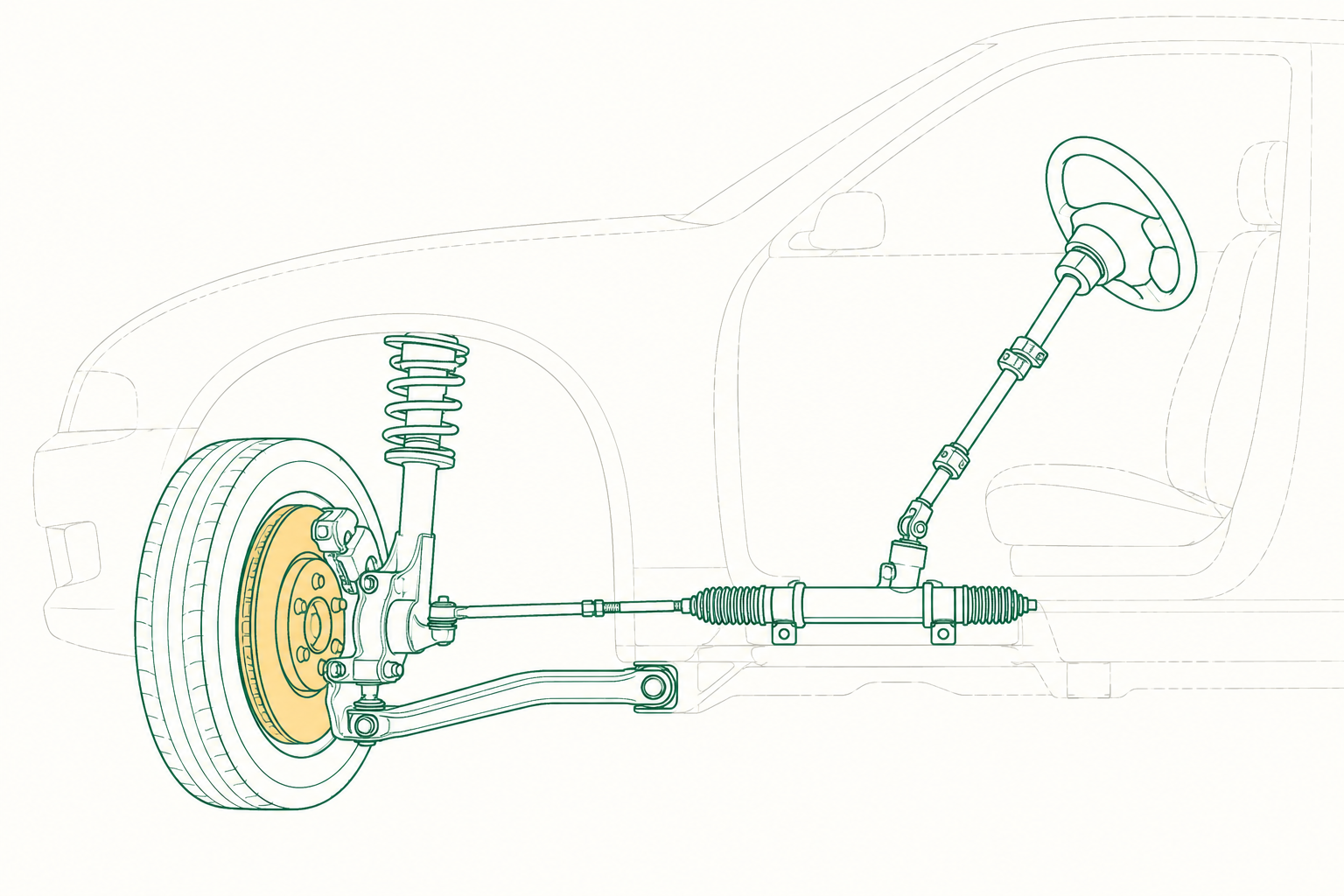
The front wheels are the steered wheels. Every time the pads clamp a disc, that force travels back through the hub, the suspension arm and the track rod to the steering rack, and the rack is bolted to the column you are holding. A disc that grips unevenly sends a pulse down that path once per wheel revolution, felt as a side-to-side wobble in the rim, strongest between roughly 50 and 70 mph.
The rear wheels have no such connection to the steering. A rear disc doing exactly the same thing has only two routes to you: up the hydraulic circuit into the pedal, and up through the body into the seat. If the wheel in your hands stays calm while the pedal dances, look at the back of the car. Plenty of cars do both at once — but the front is what you notice, and the front is what makes the car harder to hold in a lane under heavy braking.
Shake in the steering wheel, only when braking, worst from motorway speed
Uneven thickness in the front discs. The classic case, and the one this page is mostly about.
Book it in within a few weeks. It gets worse, never better, and it drags the pads down with it.
How to be sure
Find a quiet stretch, get to a legal speed and brake gently rather than hard. Uneven discs show up best under light, sustained pressure, because hard braking presses the pads into the disc the whole way round and masks the pulse. If the wobble appears under gentle braking and vanishes the moment you lift off, that is the front discs talking.
Pedal pulses under your foot, steering wheel stays fairly steady
Rear discs or drums. Identical fault, but there is no mechanical path from the rear axle to your hands.
Same repair, back of the car. Less urgent than the front, but the pulse will keep growing.
How to be sure
Brake gently and pay attention to your back rather than your hands. Rear discs give a low shimmy through the seat base, in the same rhythm as the pedal pulse. If a passenger feels it and you can barely see the wheel moving, it is the rear.
Shakes at speed all the time — braking makes no difference either way
Wheel balance, a buckled rim or a tyre with a damaged belt. Nothing to do with the brakes at all.
Have the wheels balanced and the rims checked before you let anyone sell you discs.
How to be sure
The test is the accelerator, not the brake. On a clear road, get to the speed where the shake is worst, then lift off and coast without touching the brake. If it carries on unchanged, the brakes are not involved — a brake fault only exists while the pads are pressed against something.
Shakes and pulls to one side when you brake, and one wheel is hot after a drive
A calliper that is not releasing. One brake is dragging, cooking its own disc and doing the work of two.
Get it looked at now. This is the version of the fault that ends in a failed MOT and a much bigger bill.
How to be sure
After a normal drive, hold the back of your hand a few inches from each front wheel in turn — near the rim, never touching it. Wheels get warm in normal use, so you are looking for a clear difference between the two sides, not warmth on its own. If there is a burning smell too, see our guide to burning smells from a car.
Shudder plus a grinding noise, and the pedal travels further than it used to
The pads have gone past the friction material and metal is running on metal, cutting the disc as you drive.
Stop using the car for anything but the trip to a garage. Every mile now costs you a disc.
How to be sure
Grinding is not squealing. A squeal is a designed warning, a metal tab touching the disc on purpose — our guide on squealing brakes covers it. Grinding is a coarse metallic rasp that rises with wheel speed and gets louder as you press. Once you hear that, the pad is gone.
Started within a few hundred miles of new discs and pads being fitted
Usually the fitting rather than the parts: dirt left on the hub face, or wheel bolts done up unevenly.
Take it back to whoever fitted them. This is a rework, and a fair garage will treat it as one.
How to be sure
Timing is the evidence. Uneven wear through normal use takes tens of thousands of miles; a disc that starts pulsing within a few hundred was almost certainly running out of true from the moment it was bolted on. Say exactly that when you ring: shake appeared shortly after new discs, please check hub face runout.
Why “warped discs” is almost never what has actually happened
Every forum thread on this subject uses the same phrase, and it describes something that hardly ever happens. A warped disc would be one that has bent — heated so far past its limits that the iron deformed and stayed deformed. Cast iron discs are thick, heavily ribbed and built to shed heat, and getting one that hot takes conditions most road cars never see.
What actually happens is that the disc stops being the same thickness all the way round. The pads sweep a ring on each face, and if parts of that ring end up fractionally thicker than others, then once per revolution the pads are squeezed further apart and clamp harder. That rhythmic grab is what your steering wheel is reporting. Workshops call it disc thickness variation, and the differences are startlingly small: a couple of hundredths of a millimetre is enough to feel clearly at speed.
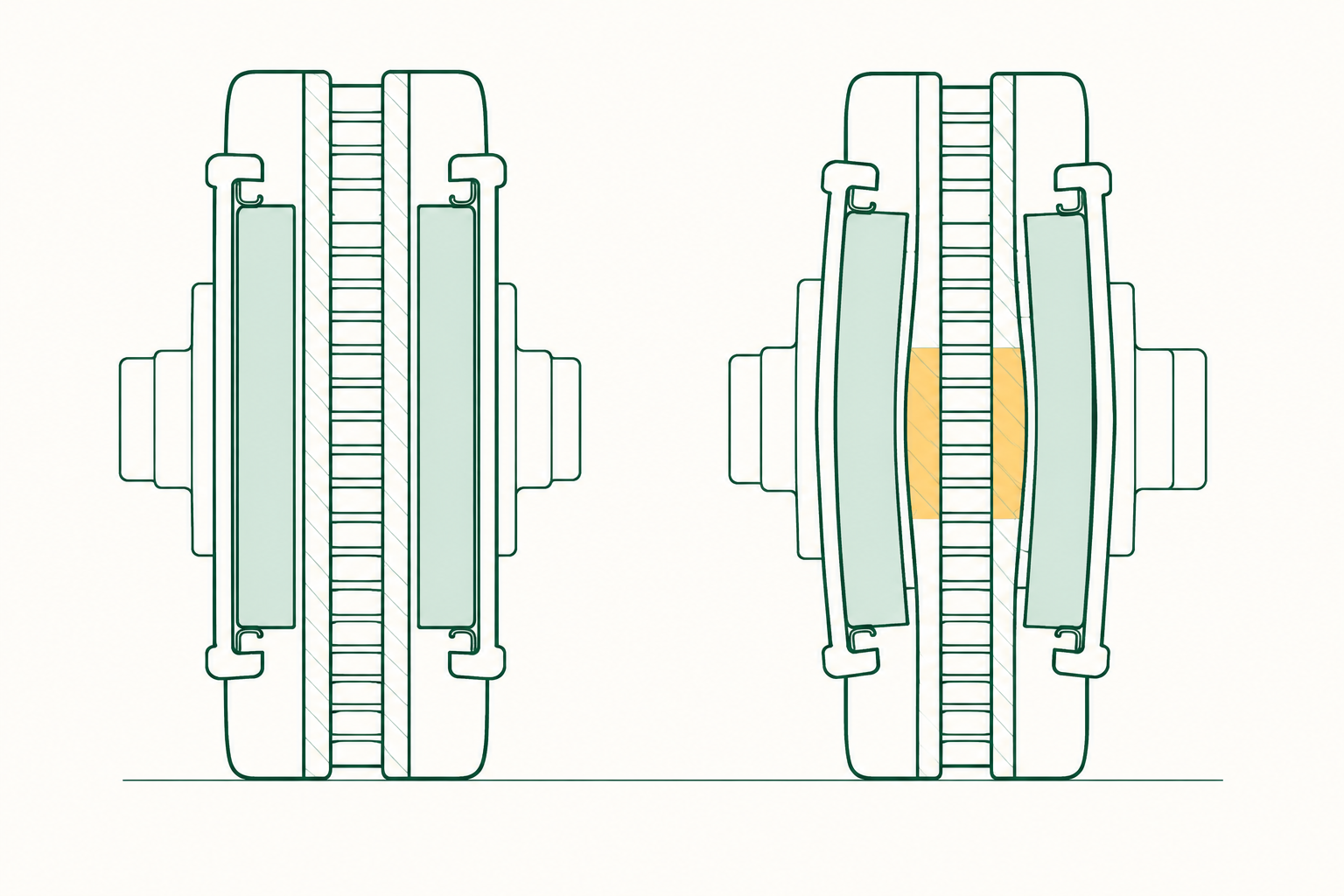
The word “warped” costs drivers money. It suggests heat damage and a part that failed on its own, which invites a quote for discs and nothing else. Uneven thickness usually has a cause somewhere other than the disc — and if that cause is not found, the new disc goes the same way.
What makes a disc wear unevenly in the first place
The disc was not running true when it was bolted on. This is the big one, and it is almost always avoidable. The disc mounts against a machined face on the hub, and that face collects rust. A film you could barely feel with a fingernail is enough to hold the disc a fraction out of square, so it wobbles very slightly as it turns, brushing the pads on one part of its sweep and not another, and grinds itself thin in exactly that band. The car drives normally for months, then starts pulsing. A hub face cleaned back to bright metal prevents it; one left as found guarantees it.
The wheel bolts were done up unevenly. A wheel is clamped to the hub through the disc, so tightening the bolts also loads the disc. Rattled round in sequence with an impact gun rather than tightened progressively across the pattern with a torque wrench, they pull it slightly out of flat — the commonest way a routine tyre change plants a brake fault that surfaces thousands of miles later.
Friction material was baked onto the face. Pads work partly by laying a thin, even film of their own material onto the disc. Sit on the brake pedal after heavy braking — the end of a long downhill, a fast road into a queue — and one hot pad rests against one spot on a very hot disc, leaving a patch of deposit. Later braking then hits that patch harder than everywhere else and the difference grows. The fix costs nothing: after heavy braking, roll gently rather than holding the pedal, or use the parking brake at a standstill so the front discs are free.
A calliper that will not let go. Slide pins seize and pistons stick, most often underneath a car that lives with wet weather and salted roads. A dragging pad heats its disc continuously, which accelerates everything above and gives you the pull-to-one-side version of the fault. It also fails an MOT in its own right, so it is worth ruling out before you spend anything on discs — costs for both jobs are on our brake calliper replacement cost and brake pads and discs cost pages.
When the shake is not the brakes at all
The coasting test works because a brake fault can only be felt while the pads are pressed against the disc. Lift off, the pads retract, the connection breaks and the shake must stop. Anything that survives that test lives in the rotating assembly instead.
Wheel balance is the ordinary answer: weights fall off, particularly the stick-on kind on alloys in winter, and a wheel a few grams out shakes the steering in one narrow speed band and goes quiet above and below it. A brake fault, by contrast, happens whenever you brake at almost any speed. A buckled rim or damaged tyre shakes above a threshold and worsens the faster you go — if yours started immediately after a pothole, our pothole damage claim tool covers what you can recover.
A worn wheel bearing makes noise rather than movement: a drone that rises with road speed and changes as you steer. If there is sound as well as shake, read our guide on humming noises while driving and the wheel bearing replacement cost page before assuming brakes. Worn steering joints rarely shake a car alone, but they amplify a disc fault enormously — which is why a garage that finds both will want to do both.
What your MOT already told you — and what it could not
Here is the part almost no one knows. The MOT inspection manual has a defect code that describes your symptom precisely, and a separate rule that explains why your car can carry a set of discs you can feel through the steering wheel and still pass.
| What the tester checks | Defect code | Category | What it means for you |
|---|---|---|---|
| Brake effort rising and falling once per wheel turn on the rollers | 1.2.1 (e) | Major | This is your symptom, measured. It is a fail — but only if it is bad enough to show at rolling-road speed |
| Brake effort recorded with the pedal untouched | 1.2.1 (f) | Major | A binding brake. The calliper fault that cooks discs is caught here, whether or not the disc has gone uneven yet |
| One wheel much weaker than its partner on the same axle | 1.2.1 (b)(i) | Major | Below 70% of the other side fails. This is the pull-to-one-side version of the fault |
| Same imbalance, but on the steered axle | 1.2.1 (b)(ii) | Dangerous | Below 50% on the front axle is the harsher category — you should not drive it away |
| Condition of the disc itself, by eye | 1.1.14 (a)(i) | Major | Only if significantly and obviously worn. A thin but tidy-looking disc passes |
| Disc cracked, loose or about to come apart | 1.1.14 (a)(ii) | Dangerous | The rare, serious version — and one of the few brake-disc entries in the harshest category |
The manual is explicit that a disc has to be significantly worn before a tester rejects it, and adds that “being worn below the manufacturer’s recommended limits is not a reason in itself”.
Read that twice. Your discs can be thinner than the manufacturer says is safe, and the test still has no grounds to fail them. A pass is not a statement that your brakes are in good condition — it is a statement that they cleared a minimum on the day.
The fluctuation check has the same shape of limitation, and it is why cars pass in the morning and shake all the way home. On the rollers the wheel turns at close to walking pace while the tester holds a steady, moderate pressure and watches the effort rise and fall. A variation barely visible at that speed is the same variation arriving at the steering rack more than ten times a second on a motorway, with far more energy behind it. The manual asks whether the fluctuation is excessive; your hands are simply a more sensitive instrument than the rollers are allowed to be.
Worth knowing too: there is no road drive in the test. Nobody takes your car up to speed and brakes. All of the above is measured with the car stationary, which is why a symptom that only exists above 50 mph can go entirely unrecorded.
If your last certificate carried an advisory about the discs, that is the tester saying this in shorthand. Our page on the brake disc worn, pitted or scored advisory explains that specific wording, and what MOT advisories mean covers the system as a whole. To decode the line on your own certificate, paste it into the MOT advisory checker.
Check it yourself in five minutes
-
Do the coasting test first
On a clear road at the speed where the shake is worst, lift off and coast without braking. Gone means brakes. Unchanged means wheels or tyres, and you can stop reading about discs.
-
Brake gently, not hard
Light, sustained pressure from motorway speed shows uneven discs at their clearest. Note whether the movement is mostly in the steering wheel, mostly in the pedal, or both.
-
Feel for heat after a normal drive
Hold the back of your hand near each front wheel in turn without touching it. One side clearly hotter than the other points at a dragging calliper rather than a tired disc.
-
Look through the wheel at the disc face
A healthy disc is evenly grey with fine, uniform scoring. Look for a bright polished band, a rusty band that never wears clean, or a lip at the outer edge you can catch a fingernail on.
-
Find the minimum thickness stamped on the disc
Most discs carry their minimum thickness cast or stamped near the hub or on the outer edge. It will not tell you what the disc measures now, but it is the number a garage should be checking against — and something specific to ask about.
What none of this can tell you is the actual thickness variation, because it is far too small to see or feel by hand. That measurement takes a micrometer at several points around the disc, and it is a fair thing to ask a garage whether they took it.
Why the shake came back after new discs
This is the commonest follow-up question on the subject, and the answer is nearly always the same: the discs were the symptom, not the cause. New discs on a car whose real problem is a sticking calliper, a rusty hub face or impact-gunned wheel bolts will wear unevenly on the same schedule as the last set.
So the useful question is not which brand of disc to buy — it is what was done to the rest of the corner. Was the hub face cleaned to bright metal? Were the calliper slide pins freed off and greased, or just wiped? Were the wheel bolts torqued across the pattern rather than run round with a gun? A garage that answers those three without hesitating will not see your car back for the same fault.
There is also a bedding-in period, real but short. Fresh pads need a few dozen moderate stops to lay their film down evenly, and heavy braking in that window is how an uneven patch gets planted on a brand new disc. If you were told to take it easy at first, that is why.
What a garage will actually do
The wheel comes off, the disc is measured with a micrometer at several points around its sweep and against a dial gauge for run-out, and the calliper is checked for free movement. That inspection is the difference between a repair and a parts swap, and it is fair to ask whether it was done.
Machining a disc flat again used to be routine and now rarely is. Modern discs are made thin to save weight, so there is often too little metal to take off while staying above the minimum thickness, and the labour to set up and skim frequently costs more than a new disc. Expect replacement, in pairs across an axle — a car with one fresh disc and one worn one brakes unevenly by design.
Pads go with them as a matter of course, because old pads carry the shape of the old disc in their face and bedding them onto a new one reintroduces exactly the uneven contact you are paying to fix. Rear discs follow the same logic lower down the price list; the numbers for every common model are on our brake pads and discs cost page. If a calliper is seized too, brake calliper replacement is the second half of the job — and where you have it done matters, which is what our comparison of independent garages and main dealers is for.
Front discs and pads, priced by make and model, with what the same job costs at a dealer.
See brake disc pricesFAQ
Why does my steering wheel shake when braking?
Because the front brake discs have worn to slightly different thicknesses around their circumference. Once per wheel revolution the pads are pushed a fraction further apart and grip harder, and that pulse reaches your hands through the hub and steering rack. Rear discs cause the same fault but arrive through the pedal instead.
Are my brake discs warped?
Almost certainly not, in the literal sense — genuinely bent discs are rare on road cars. What you have is uneven thickness, differences of a couple of hundredths of a millimetre around the disc face, caused by the disc running slightly out of true or by friction material baked onto one area.
Is it safe to drive with a steering wheel that shakes when braking?
Short local journeys, usually yes. But it always worsens, it lengthens stopping distances and it makes the car harder to hold straight in an emergency stop. If it also pulls to one side, grinds, or the pedal travels further than it used to, drive it only to a garage.
Why does the shake only happen at motorway speeds?
Because the pulse arrives at the frequency the wheel is turning. At town speed the variation is a gentle nudge; at motorway speed the same disc delivers it more than ten times a second with far more energy, which is enough to set the whole steering assembly moving.
My brake pedal pulses but the steering wheel is steady — what is that?
Rear discs or drums. The rear axle has no mechanical connection to the steering, so the fault can only reach you through the hydraulic circuit into the pedal and through the body into the seat. Same underlying wear, cheaper end of the car, usually less urgent.
Will an MOT fail my car for shaking when I brake?
It might. The manual has a Major defect for excessive fluctuation in brake effort through each wheel revolution, which is exactly this fault. But it is measured on rollers at close to walking pace, and there is no road drive in the test, so a variation you feel clearly at speed can sit below the threshold.
Can warped discs be machined instead of replaced?
Rarely worth it now. Modern discs are made thin to save weight, so there is often too little metal to skim while staying above the minimum thickness stamped on the disc, and the labour usually exceeds the price of a new one. Replacement in pairs across the axle is normal.
Why did the shake come back a few months after new discs?
Because the cause was never fixed. A sticking calliper, rust left on the hub face, or wheel bolts rattled up with an impact gun will make a new disc run out of true and wear unevenly on the same timescale as the old set. Ask whoever fitted them what was done to the hub and calliper.